
Hang the center of most wall art 57 to 60 inches from the floor. That's the museum standard, built around average adult eye level, and it works for nearly any wall in your house. The main exceptions: art above furniture follows a gap rule instead, seated rooms drop a few inches lower, and staircases measure from each tread. The exact math for nail placement is below.
TL;DR:
- Most wall art should have its center around 57 inches from the floor, but adjust slightly higher or lower based on ceiling height, room function, or furniture placement.
- To find the exact nail height, measure the frame height, divide by two, add 57, then subtract the hook or wire drop for precise placement.
- When hanging art above furniture, leave a gap of 4 to 8 inches between the top of the furniture and the bottom of the frame, and aim for the art to span about two-thirds of the furniture width.
- For gallery walls, layout on the floor first, maintain 2 to 3 inches spacing, and tape the full arrangement to the wall to ensure visual balance before hanging.
- Use appropriate hardware based on wall type and weight, such as studs, anchors, or French cleats, and always check the hardware's weight rating for security.
Table of Contents
- What Is the Ideal Art Hanging Height? Quick Rules and Numbers
- How Do You Calculate the Correct Nail Height for a Frame?
- How High Should Art Hang Above a Sofa or Console?
- How Do You Plan and Hang a Gallery Wall Correctly?
- Do Room Type and Ceiling Height Change the Rule?
- What Hardware Keeps Heavy Art Secure on the Wall?
- Does Everyone's Eye Level Really Sit at 57 Inches?
- Should Photography, Paintings, and Mirrors Hang at Different Heights?
- How Do Lighting and Shadows Affect Art Placement?
- Are There Cultural Differences in How Art Gets Hung?
- A Professional Organizer's View on Art and Everyday Living
- Sources
- FAQ
What Is the Ideal Art Hanging Height? Quick Rules and Numbers
Most of what you need fits in a handful of numbers. Keep this list nearby when you're marking walls.
- Center height: 57 inches is the classic museum benchmark; go up to 60 inches in rooms with higher ceilings or where people mostly stand, like entryways and hallways.
- Above a sofa or headboard: leave a moderate visual gap between the top of the furniture and the bottom of the frame.
- Above a console, credenza, or dresser: leave a small to moderate gap between the furniture and the bottom of the frame.
- Gallery wall spacing: keep consistent spacing between frames for a cohesive cluster.
- Gallery wall width: the total arrangement should span a large but balanced proportion of the furniture width beneath it.
- Seated rooms: hang art somewhat lower than standing eye level, since eye level drops when people sit.
The 57-inch figure isn't arbitrary. It's the museum and gallery standard for average adult eye level, which is why professionally curated spaces feel visually calm even when the art varies wildly in size. Once you start applying it, you'll notice how often home galleries hang too high, usually because people center art relative to the furniture below it instead of the floor.
How Do You Calculate the Correct Nail Height for a Frame?
The 57 inch center rule tells you where the middle of the art should land. Getting a nail or hook to put the middle there requires one more step, because the hardware isn't at the center of the frame. It's above it.
Here's the formula, and it's the same one professional installers use:
- Measure the frame height in inches, top to bottom.
- Divide that number by two to find the frame's midpoint.
- Measure the hook drop: the distance from the top edge of the frame down to the point where the wire or hook actually catches when pulled taut.
- Add the midpoint to 57, then subtract the hook drop. That gives you the exact height for your nail or hook.
The formula looks like this: nail height = 57 + (frame height ÷ 2) − hook drop.
Try it with a real frame. Say your art is 24 inches tall, and the wire sits 3 inches down from the top when pulled taut. Half of 24 is 12. Add that to 57, and you get 69. Subtract the 3 inch hook drop, and your nail goes at 66 inches from the floor, not 57. This exact arithmetic, including the common mistake of skipping the hook drop step, is explained well by Austin Gallery. Skip that subtraction and your "57 inch" piece ends up hanging several inches too high, which is the single most common hanging mistake homeowners make.
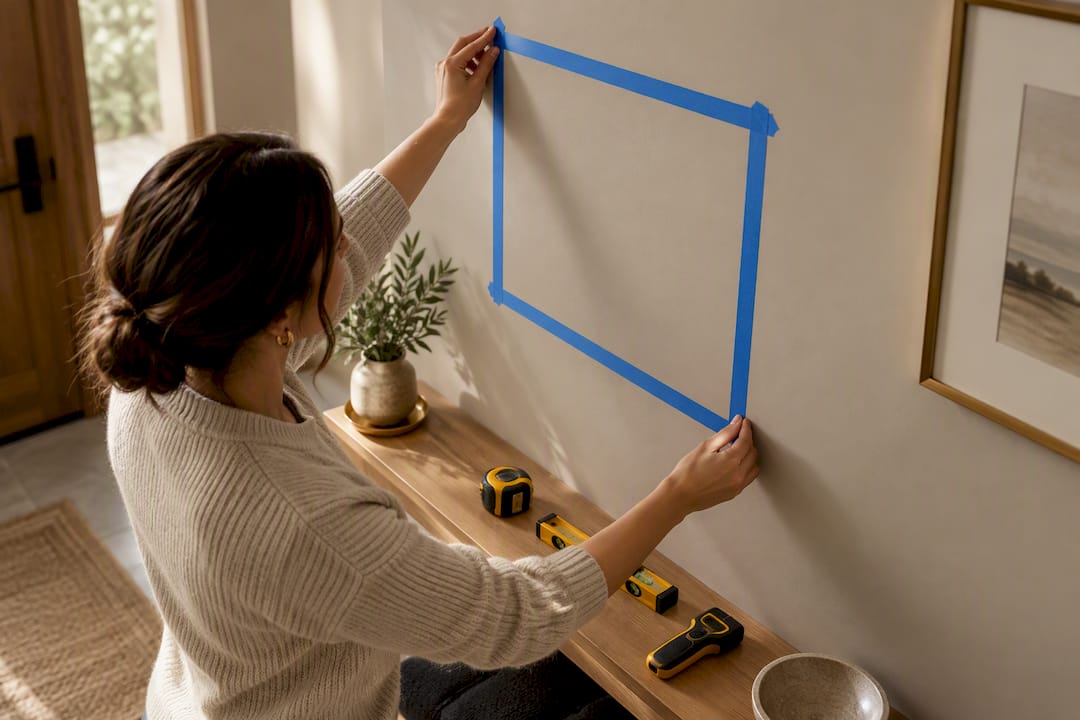
Pro Tip: Cut a paper template the exact size of your frame, tape it to the wall at your calculated height, and step back before you drill anything. Fifteen seconds of looking will save you a patched hole later.
Keep a tape measure, a level, painter's tape, a paper template, and a stud finder on hand before you start. That last tool matters more than people think, and we'll get to why in the hardware section.
How High Should Art Hang Above a Sofa or Console?
Furniture changes the math. Once a couch, bed, or console anchors the wall, the 57 inch rule takes a back seat to a relational rule: measure up from the furniture, not up from the floor.
- Above a sofa: leave 6 to 8 inches between the top of the sofa back and the bottom of the frame.
- Above a bed or headboard: the same 4 to 8 inch range applies, with most designers favoring the tighter end for a snug, intentional look.
- Above a console or credenza: 4 to 8 inches of breathing room keeps the piece from feeling like it's floating off on its own.
- Width proportion: aim for the art (or gallery cluster) to span roughly two thirds to three quarters of the furniture's width.
Do the width math with real numbers and it gets easy fast. A standard 84-inch sofa times 0.7 lands you around 59 inches of art width, which might be one large horizontal canvas or a three-piece cluster hung close together. A 60 inch console times 0.7 gives you about 42 inches, small enough for a single mid-size framed print.
Nonstandard furniture is where people get stuck. If your console is an odd 38 inches because it's a vintage find, don't force a standard frame size onto it. Multiply 38 by 0.67 and 0.75, and you get a target range of about 25 to 29 inches. Shop or custom-frame within that window, and the proportions will read as deliberate rather than accidental.
How Do You Plan and Hang a Gallery Wall Correctly?
A gallery wall isn't a collection of separate decisions. It's one composition, and it needs to be measured that way. The trick is treating the whole arrangement's optical center, not any single frame's center, as the thing that sits at 57 to 60 inches.
- Lay every piece out on the floor first, in the exact layout you plan to hang, before a single nail goes in the wall.
- Pick an anchor piece, usually the largest or most visually dominant frame, and position it first.
- Build outward from the anchor, maintaining consistent spacing between every pair of frames.
- Keep gaps between frames to 2 to 3 inches across the entire layout so the cluster reads as unified rather than scattered.
- Calculate total width and height of the finished arrangement before you commit, so you know exactly where the optical center falls relative to the 57 to 60 inch line.
- Cut paper templates for every frame, tape the full layout to the wall, and mark nail positions through the paper before removing it.
This floor-first, anchor-out method is standard practice among installers because it catches spacing errors before they become wall damage. A few things worth double-checking as you go:
- Confirm your spacing is consistent on all four sides of each frame, not just top to bottom.
- Step back ten feet periodically. Gallery walls that look balanced up close sometimes tilt visually from across the room.
- Photograph the floor layout before hanging, so you have a reference if a piece gets bumped mid-installation.
Do Room Type and Ceiling Height Change the Rule?
Every room in your house doesn't behave the same way, and the 57 to 60 inch range is a starting point you're meant to adjust from.
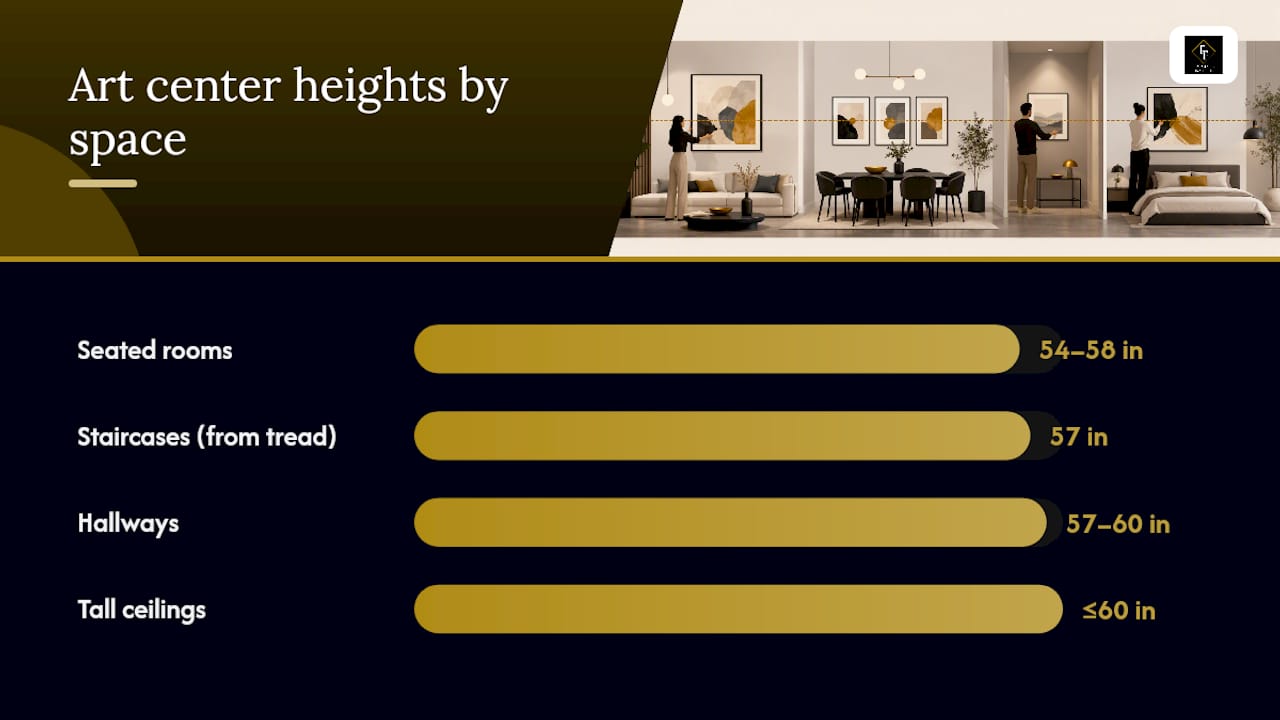
Seated rooms like living rooms and dining rooms call for a lower center, typically 54 to 58 inches, since people spend most of their time looking at that wall from a chair or couch rather than standing. This lines up with the furniture-gap rule: if you follow the sofa gap correctly, you'll often land in that lower range naturally without having to think about it separately.
Staircases need a different approach entirely. Measure 57 inches up from the tread directly beneath each piece, not from the bottom of the stairs. This keeps the visual line following the angle of the stairs instead of creating an awkward stair-step effect in the art itself.
Tall ceilings tempt people to raise everything to fill the space, but that usually backfires. Scale up the art instead, or stack pieces vertically, rather than pushing the center higher than 60 inches. A bigger canvas or a two piece vertical stack fills a tall wall far better than one small frame floating near the ceiling.
Hallways and circulation spaces can stick with 57 to 60 inches, with attention to door and window clearances so frames don't collide with swinging doors.
Deliberate departures from these numbers are fine when there's a real reason, like a low sightline from a specific viewing chair or an architectural quirk that the standard rule doesn't account for.
What Hardware Keeps Heavy Art Secure on the Wall?
Getting the height right means nothing if the piece falls off the wall. Match your hardware to the wall type and the weight in your hands, not just what happened to be in the drawer.
- Find a stud when you can. For hollow drywall without a stud nearby, use toggle bolts or molly anchors rated for the frame's weight.
- Check hook weight ratings before you buy. A single small picture hook might handle 20 pounds, but anything heavier or wider needs two points of contact to stop the frame from swiveling.
- Consider a French cleat or picture rail for large or valuable pieces. Professional installers prefer these because they distribute the load across a wider surface instead of concentrating it on one nail.
- Renters should look at rated adhesive strips or picture-hanging rail systems built for repositioning without wall damage, but check the manufacturer's weight limit since most cap out well below what a nail or anchor can hold.
- Before you call it finished: check the level, then give the frame a firm tug test to confirm the hardware holds under real pressure, not just its own weight.
Pro Tip: For anything over 15 pounds, always use two hanging points spaced apart rather than one central point. It keeps the piece from tilting every time someone closes a door nearby.
Does Everyone's Eye Level Really Sit at 57 Inches?
The 57 inch figure is an average, and averages hide a lot of variation. Adult eye level in a standing position typically falls somewhere in the mid to high 50s depending on height, which is exactly why the museum standard clusters there rather than at a single fixed number. A household of people ranging from 5'2" to 6'2" isn't going to share one perfect eye level, and that's fine. Fifty-seven works because it's close enough to comfortable for most people in most rooms, not because it's precise for any one viewer.
Where this matters more than people expect: homes with a wide height range among frequent occupants, or spaces used mostly by one group, like a home office used primarily by one person, a nursery where a caregiver often views art while holding a child, or a formal dining room where guests are seated for most of the viewing. In those cases, it's worth eyeballing the actual sightline rather than defaulting blindly to 57.
A quick way to test it: stand where you'll usually be when looking at the piece, close your eyes, then open them and see where your gaze naturally lands on the wall. That's your real eye level for that spot, and it might be 55 inches or 59 inches depending on who's standing there and whether they're seated or upright. Adjust a couple of inches either direction based on that test, and you'll get a result that feels more accurate than the number alone ever could.
Should Photography, Paintings, and Mirrors Hang at Different Heights?
The 57 inch rule applies across mediums, but the way each type of piece reads on a wall shifts the practical adjustments you make around it.
Paintings, especially large statement canvases, tend to tolerate the standard center height well since they're usually viewed from a distance and have enough visual weight to anchor a wall on their own.
Photography often gets displayed in smaller formats or grids, which pushes it toward gallery-wall treatment rather than a single centered piece. Because photo prints are frequently viewed up close, for detail, keeping the cluster's optical center at 57 to 60 inches while tightening frame spacing to the lower end of the 2 to 3 inch range tends to read better than a loosely spaced arrangement.
Mirrors function differently because they're meant to be used, not just viewed. A mirror over a console or in an entryway should hang with its center closer to the actual eye level of the people using it functionally, which sometimes means centering slightly lower than 57 inches if the space is used mostly by a household with shorter members, or slightly higher in a primarily male household. A decorative mirror with no functional use, like one hung purely for visual interest above a mantel, can follow the standard rule like any other piece of framed art.
One more distinction worth noting: reflective surfaces catch and redirect light differently than flat art, so a mirror hung at the right height in one lighting setup can throw glare or reflect an unflattering ceiling fixture in another. Worth checking at different times of day before committing to the final position.
How Do Lighting and Shadows Affect Art Placement?
Height on a tape measure and height as your eye actually perceives it aren't always the same thing, and lighting is usually the reason why. A piece hung at a technically correct 57 inches can look off if it sits in heavy shadow, under a downlight that washes out its lower half, or across from a window that creates glare at certain times of day.
Overhead lighting positioned directly above a frame tends to cast a shadow across the top of the piece, which visually pushes the perceived center downward even though the physical measurement hasn't changed. If your lighting setup does this, you might find that art hung at a true 57 inches reads as sitting slightly low, and nudging it up an inch or two compensates for the visual effect.
Natural light creates its own complications. A wall that gets strong afternoon sun can wash out colors in a painting or create glare across a glossy print or mirror, sometimes badly enough that the piece is hard to appreciate at certain hours regardless of how well it's positioned vertically. Rotating placement so higher-glare pieces avoid direct light paths, or adding UV-filtering glass for valuable work, solves more problems than adjusting height ever will.
Picture lights and adjustable gallery track lighting can correct for a lot of this after the fact, angled to hit the center of the piece rather than the top, which keeps the shadow line from creeping downward. If you're hanging art in a room with strong directional light, it's worth testing the spot at different times of day before finalizing your nail height, since a spot that looks perfect at 10 a.m. can look completely different by sunset.
Are There Cultural Differences in How Art Gets Hung?
The 57 inch center isn't a universal law. It's a Western museum convention, largely shaped by American and European gallery standards built around average adult eye level in those populations. Walk into a traditional Japanese home and you'll find art, often a single hanging scroll, displayed in a tokonoma alcove at a height and scale meant for a seated viewer on tatami mats, which produces a dramatically lower effective viewing line than a Western living room built around furniture-height seating.
European gallery traditions, particularly the dense "salon style" hanging popular in nineteenth century France, stacked art from near the floor to near the ceiling in a single wall of frames, prioritizing overall wall coverage over any single centered eye-level line. That style has come back into fashion in maximalist interiors, and it deliberately breaks the 57 inch rule by design rather than by mistake.
Scandinavian and minimalist design traditions tend to favor the opposite: generous negative space around a single centered piece, hung precisely at standard eye level with almost nothing else on the wall, which makes the 57 to 60 inch rule more load-bearing in that context than in a busier, more layered style.
None of this means the museum standard is wrong for your home. It means the rule is a strong, well-tested default for typical Western living spaces, and stylistic traditions that intentionally depart from it are doing so with purpose, not by accident. If your design taste runs toward salon-style density or an alcove-inspired minimal display, the underlying logic still holds: know the standard first, then decide where and why you're breaking it.
A Professional Organizer's View on Art and Everyday Living
Placement never happens in isolation. Professional organizers think about sightlines from the couch, the kitchen, and the front door before a single nail goes in, because art has to work with how a room actually gets used, not just how it photographs. At Flawlessly Functional, that habit of prioritizing daily function alongside visual appeal carries over from closets and pantries to walls. A 4.9 Google rating reflects clients who wanted their whole home, art included, to work as one considered system. For large gallery installs or full staging ahead of a move, a professional eye can catch proportion issues a tape measure alone won't.
— Steve
Sources
For deeper detail on the rules covered here, see Austin Gallery's breakdown of the 57 inch formula, FindArtInfo's hanging height guide, The Hanging Calculator's seated-room adjustments, and Noble Abode's primer on the 57 inch rule.
- How to Hang Art — Height Rules, Hardware & Gallery Walls
- How High to Hang Art: The 57-Inch Rule and Every Exception
- Art Hanging Guide: Heights, Spacing & Gallery Walls | The Hanging Calculator
- How to hang art: pro tips and safety guidance
FAQ
At What Height Should Art Be Hung?
The center of most wall art should sit 57 to 60 inches from the floor, following the museum eye-level standard. Adjust lower, around 54 to 58 inches, in rooms where people are mostly seated, or use the furniture gap rule when art hangs above a sofa or console.
What Is the 57 Inch Rule?
The 57 inch rule states that the vertical center of a piece of art should hang 57 inches from the floor, matching the average adult standing eye level used by museums and galleries. It's the anchor number behind most professional art placement, though 60 inches is also common in taller or more formal spaces.
What Is the 2/3 Rule for Hanging Pictures?
The 2/3 rule refers to sizing artwork so it spans roughly two thirds to three quarters of the width of the furniture beneath it, such as a sofa or console table. A gallery wall cluster should follow the same proportion as a single large piece.
What Is the 60 Inch Rule for Hanging Pictures?
The 60 inch rule is a slight variation on the 57 inch standard, often used in rooms with higher ceilings, more formal settings, or spaces where people primarily stand rather than sit. Both numbers come from the same museum eye-level logic; 60 inches simply sits at the taller end of that range.