
Pick one anchor (a tray or a stack of books), build up in three heights with nothing over 18 inches tall, and stop filling the surface once about a third of it is still bare. That's the whole system. It works because it keeps the table usable, keeps your sightline to the TV or your guests clear, and gives your eye a rhythm to follow instead of a jumble to sort through.
TL;DR:
- Keep the surface filled with about three objects at varying heights under 18 inches, leaving a third of the table visible for a balanced look.
- Use odd numbers and set objects in groups of three for a deliberate arrangement that avoids a cluttered or accidental appearance.
- Adapt the arrangement to your table shape, clustering objects toward the center for round tables and dividing zones for rectangular and square tops.
- Regularly remove one item instead of adding, ensuring the styled look remains fresh and functional through simple editing.
- Incorporate personal objects and seasonal swaps to maintain a cozy, meaningful vibe without sacrificing style or practicality.
Table of Contents
- Coffee Table Styling Principles That Actually Hold Up
- How Do You Style a Coffee Table Step by Step?
- Styling Themes You Can Copy Exactly
- Adapting the Formula by Table Shape
- Common Coffee Table Styling Mistakes and How to Fix Them
- Keeping a Styled Coffee Table Functional Day to Day
- A Professional Note on Balancing Style With Real Life
- Choosing Decor That Matches Your Room's Style and Palette
- Adding Personal and Meaningful Objects Without Losing the Look
- Seasonal and Holiday Coffee Table Styling Ideas
- Why Editing Beats Shopping
- Let Flawlessly Functional Style It for You
- Sources
Coffee Table Styling Principles That Actually Hold Up
Every arrangement that looks intentional instead of accidental follows the same three rules, and none of them require a design degree to apply.
Start with odd numbers. Designers lean on the rule of three because groups of three read as composed, while groups of two or four tend to look like leftovers you forgot to put away. A candle, a small stack of books, and one object on top of that stack reads as a decision. The same three items lined up in pairs reads as an accident.
Next comes height. Every strong vignette has a low anchor, a mid-height piece, and one tall element, and that tall element should stay under about 18 inches so it doesn't block conversation across the table or the view to a screen.
- Low/anchor: a tray, a wide bowl, or a stack of oversized books
- Mid: a candle, a small vase, or a stack of two to three books
- Tall: a single sculptural piece, a bud vase with one stem, or a small framed piece propped upright
The anchor itself has a formula, too: a tray should cover roughly one-third to one-half of the table's surface (https://furniturecity.com/blogs/news/master-the-art-of-the-coffee-table-styling-with-the-rule-of-three), big enough to feel deliberate without swallowing the whole top.
Pro Tip: Leave about one-third of the table bare. That empty space isn't wasted, it's what lets the styled portion actually register as styled instead of blending into visual noise.
How Do You Style a Coffee Table Step by Step?
Most tables can go from bare or overstuffed to finished in about 10 to 15 minutes once you know the order of operations.
- Clear everything off and reassess the scale. A round 36-inch table and a 60-inch rectangular one call for different amounts of stuff, so start from zero before deciding what goes back.
- Choose your anchor. Pick a tray or a stack of 2 to 4 books sized to the table, not the other way around. This becomes the base everything else sits on or around.
- Layer low, then mid, then tall. Place the anchor first, add a mid-height object next to it, then finish with one tall piece kept under 18 inches.
- Add one texture or living element. A small plant, a single stem in a bud vase, or a natural-fiber coaster set keeps the grouping from feeling stiff. Editors and stylists repeatedly point to this step as the one that makes a table feel finished rather than staged.
- Edit by removing one item. Step back, take a photo on your phone, and pull the piece that feels extra. This single edit does more for the finished look than any object you could add.
Pro Tip: If a table feels "off" but you can't figure out why, the fix is almost always subtraction, not addition. Remove the newest thing you added first.
Styling Themes You Can Copy Exactly
You don't need to invent a concept from scratch. Four motifs cover most living rooms, and each one gives you a shopping list, not a mood board.
- Mini-library: Stack two to three hardcovers as your anchor, top them with a small sculptural object, and set a low candle beside the stack. The books do triple duty here: they're a platform, a personality signal, and your height source all at once.
- Nature-led: A single-stem vase or a small potted plant paired with a textured wood or ceramic bowl. Keep it to two pieces so the natural element stays the focus instead of competing with itself.
- Grounding: One large pillar candle as the visual anchor, flanked by a small bowl holding matches or a neat coaster stack. This works especially well on smaller tables where a tray would eat too much surface.
- Play: A game set, a puzzle box, or a tactile object like worry stones, positioned on one end while the center stays open for actual use. Best for households where the table earns its keep every evening.
A loose but reliable version of the formula, echoed across multiple designer sources, combines a book stack, a tray, one natural element, and one or two sculptural pieces. Mix and match freely.
Adapting the Formula by Table Shape
Geometry changes where the eye lands, so the same three pieces get arranged differently depending on what shape you're working with.
- Round or oval: Cluster everything toward the center and let it radiate outward slightly. Keep the outer ring completely clear so the table doesn't look crowded from any seat.
- Rectangular: Split the surface into two or three zones. Put your tall element at one end, your tray at the other, and leave the middle third open for feet, drinks, or a laptop.
- Square: Cluster slightly off-center rather than centering everything, and skip the temptation to put a matched object in each of the four corners. Symmetry on a square table reads as stiff, not styled.
- Ottoman: Skip small trinkets entirely and use one oversized tray. It stabilizes anything you set on soft upholstery and protects the fabric from drink rings and crumbs.
Common Coffee Table Styling Mistakes and How to Fix Them
Most amateur-looking tables share the same handful of problems, and every one of them has a five-minute fix.
- Too many objects. Do the "remove one" edit until you land closer to 30 to 40 percent empty surface. Editorial stylists routinely pull an item after the initial arrangement for exactly this reason.
- Even, mirrored groupings. Two candles flanking a centered bowl looks like a hotel lobby. Break the symmetry and regroup in threes.
- Tall items blocking sightlines. If a vase or sculpture interrupts conversation or the TV view, move it to the side or swap it for something under 18 inches.
- A tray that's too small. A tray that can't hold your actual clutter isn't doing its job. Size up until it can corral everything into one zone.
Keeping a Styled Coffee Table Functional Day to Day
Styling only holds up if it survives Tuesday night. Stash remotes in a small lidded box tucked onto the tray. A stack of two or three coasters can live right next to it instead of scattered across the table.
Households with kids or pets should lean on heavy, stable objects and flameless candles, and swap anything that stains for washable textiles. Pairing containment pieces with a dedicated everyday zone is what actually makes a styled table survive real life instead of looking good for one photo.
- One-minute reset: remotes back in the box, plant straightened, crumbs gone.
- Weekly check: wipe the tray, refill matches or swap a wilted stem.
Pro Tip: Store a small stack of blank coasters inside the lidded box itself. You'll never lose them in the couch cushions again.
A Professional Note on Balancing Style With Real Life
At Flawlessly Functional, we style coffee tables the same way we organize entire homes: assess the space, choose an anchor, define zones, then build in maintenance from day one. That last step is where most styling advice stops short, and it's the reason ours holds up past the first week.
Our team carries a 4.9 Google rating built on exactly this kind of detail work, across luxury organizing projects and full-room interior styling engagements throughout San Antonio. If a styled table sounds good in theory but never survives contact with your actual household, a consult is worth booking before you buy another tray.
Choosing Decor That Matches Your Room's Style and Palette
A coffee table doesn't exist in isolation, and objects that look great in a catalog photo can clash badly once they're sitting three feet from your sofa. The fastest way to choose well is to pull your palette straight from what's already in the room.
If your sofa and rug run warm and neutral, add a wood tray and a ceramic vase in the same tonal family rather than introducing a bright accent color that fights the rest of the room. Cooler, more minimalist spaces tend to hold up better with matte finishes, glass, and a single muted plant, since anything too glossy or saturated reads as clutter against clean lines.
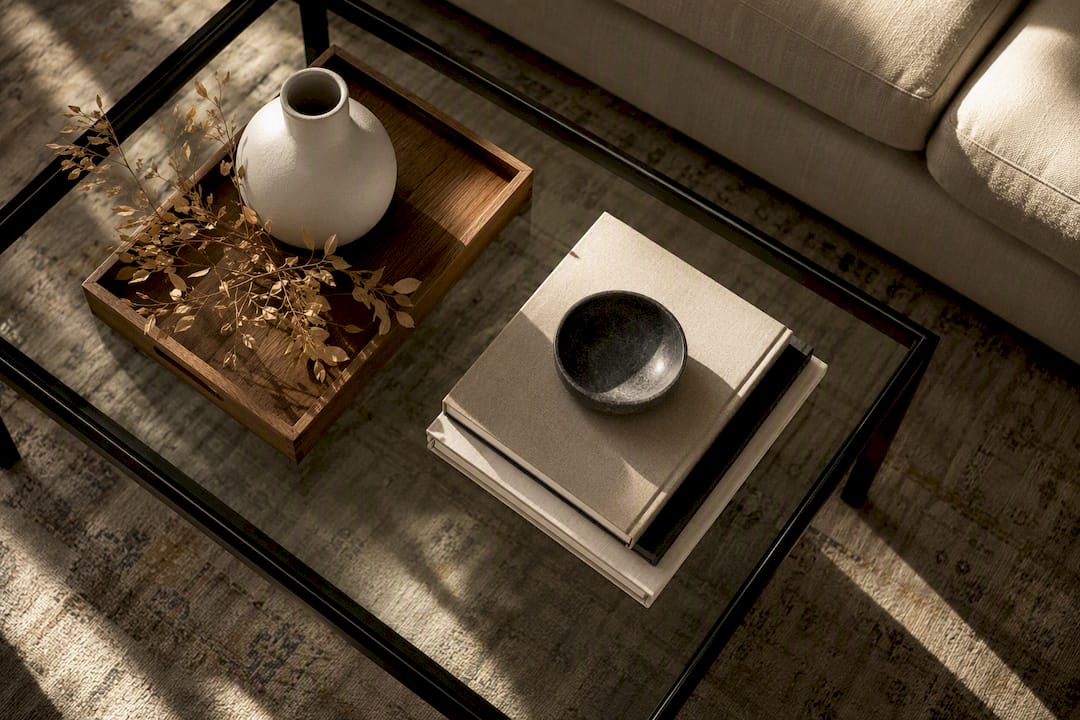
Material matters as much as color. A common misstep is pairing the wrong finish with the table itself, like setting a clear glass vase on a glass tabletop where it visually disappears. Match or contrast deliberately: wood objects ground a glass table, while a matte stone bowl adds weight to a light oak surface.
Scale should track the room, not just the table. A grand living room with high ceilings can carry a taller sculptural piece and a bigger tray, while a cozy den looks better with smaller, closer-set objects that don't compete with a low ceiling line. When in doubt, take a photo of the room first and hold prospective decor pieces up in frame before you buy anything.
Adding Personal and Meaningful Objects Without Losing the Look
The vignettes that feel most like a home, rather than a hotel lobby, almost always include one object with a story behind it. A coffee table styled entirely from a catalog looks nice for a week and forgettable after that.
The trick is treating personal pieces the way you'd treat any other object in the arrangement, meaning they still need to earn their height and their spot. A travel souvenir can serve as your tall element instead of a generic sculpture. A small dish from a grandparent can double as your low anchor for matches or rings. A stack of books you've actually read, rather than ones bought for their spine color, still performs the mid-height role while carrying more meaning than a staged prop.
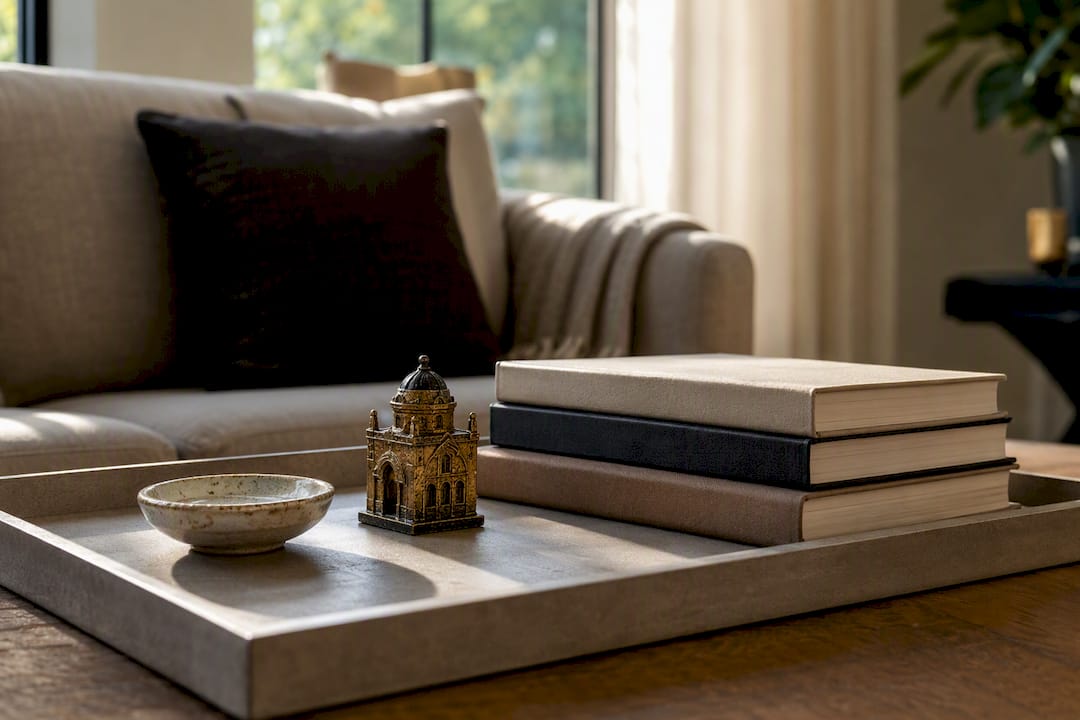
Photographs are trickier since frames can clutter fast. One small frame, styled into the mid-height zone rather than lined up in a row, keeps the sentimental value without turning the table into a memory wall. Skip anything fragile or irreplaceable if the table sees daily traffic from kids or pets. The goal is a table that still looks like your family lives there, not a museum case.
Seasonal and Holiday Coffee Table Styling Ideas
Swapping seasonal touches is the easiest way to keep a styled table from going stale, and it takes far less effort than a full redecorate.
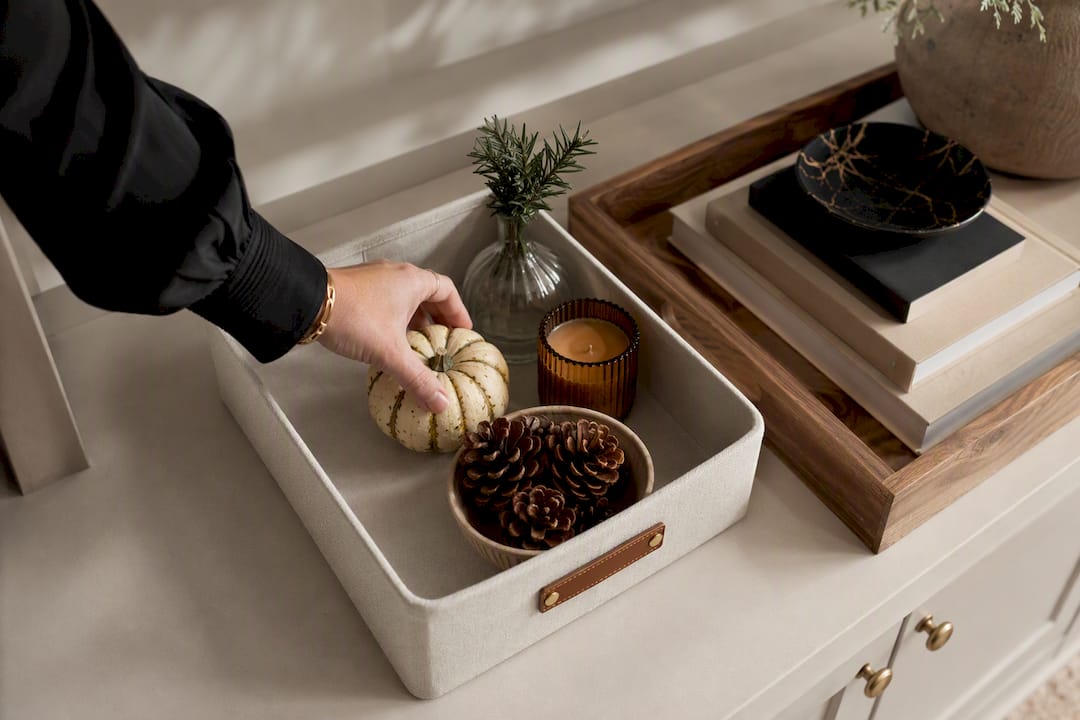
For fall, swap a summer plant for a small gourd or a bowl of pinecones next to your existing book stack, and switch a bright candle for something in amber or clove. Winter holidays call for restraint more than volume: a single sprig of greenery in a bud vase and one metallic object usually reads as festive without tipping into clutter. Spring favors fresh stems over anything dried, so a single-bloom vase can replace a candle as your mid-height piece for a few months. Summer is the easiest season to lean into negative space, since lighter, airier rooms tend to look better with fewer objects and more visible surface.
Keep a small seasonal swap kit in a bin so you're rotating two or three pieces in and out rather than rebuilding the entire vignette four times a year. Your anchor, whether it's a tray or a book stack, rarely needs to change season to season. Only the mid and tall pieces need to shift.
Why Editing Beats Shopping
The instinct when a coffee table looks unfinished is to buy something new. That's almost never the actual fix. Most vignettes improve more from removing one object than from adding one, because subtraction restores the negative space that made the original pieces readable in the first place.
Try it tonight: pull the newest item off your table and look again. If the table looks better, you've found your problem. If it looks the same, that item was never the issue and something older is.
— Steve
Let Flawlessly Functional Style It for You
If reading through all these formulas made you realize your living room needs more than a tray swap, that's exactly where we come in. Flawlessly Functional is the alternative to trial-and-error styling for homeowners in San Antonio who'd rather have it done right the first time than spend a Saturday reshuffling candles.

Our luxury home organizing services apply the same assess, anchor, zone, and maintain process to your whole living room, not just the coffee table, so the styling actually survives daily use. If you're mid-move, our concierge team also handles packing and unpacking so styled vignettes don't get thrown in a box and forgotten. Book a consult with Flawlessly Functional and get a living room that looks finished and still works for real life.
Sources
For deeper technique breakdowns, see Vogue's interview with stylist Colin King, Magnolia's styling formula, and Martha Stewart's functional styling guide. For organized storage systems that support a styled table, see One Day Doors & Closets.
- How to Style a Coffee Table, According to Master Interior Stylist Colin King | Vogue
- Master the art of the coffee table styling with the rule of three
- How to Style a Coffee Table – Magnolia
- How to Style a Coffee Table | Martha Stewart
- How to Style a Coffee Table Like a Magazine Editor | One Home Therapy