
Yes, color-coding boxes by room, marking them on multiple sides, and posting a master key at both homes will speed up your unloading and cut down on misplaced boxes. Assign one color per room, mark every box in that color plus a short content note, and post the legend where movers can see it. Before you pack a single item, grab colored tape or stickers and a permanent marker.
TL;DR:
- Colored tape is the most visible and durable option for stacking boxes, but it offers minimal space for detailed notes or contents.
- Labeling each box on at least two sides and the top prevents hidden labels and reduces the need to move boxes to check their contents.
- Building a master key with color assignments and box number ranges posted at both homes ensures consistent organization throughout the move.
- Pairing color coding with sequential numbers and digital QR codes for priority boxes maximizes efficiency in locating specific items later.
- Outsourcing labeling to professional movers can save time and prevent errors, especially in larger households or multi-day, multi-floor moves.
Table of Contents
- What to Buy for Color Coded Moving Boxes
- How to Set Up a Color Coded Packing System Step by Step
- Do's, Don'ts, and Quick Fixes for Color Coded Moving Labels
- When to Add Numbers, QR Codes, and Inventory Apps
- Where to Buy Color Coded Moving Labels and What They Cost
- How Concierge Movers Refine Color Coded Systems
- Should You Build This System Yourself or Hire Help?
- Skip the Labels and Let Flawlessly Functional Handle It
- Sources
What to Buy for Color Coded Moving Boxes
Your labeling system is only as good as the materials holding it together for three days in a moving truck. Colored packing tape, stickers, and printable labels each solve the problem differently, and picking the wrong one for your situation causes headaches on move day.
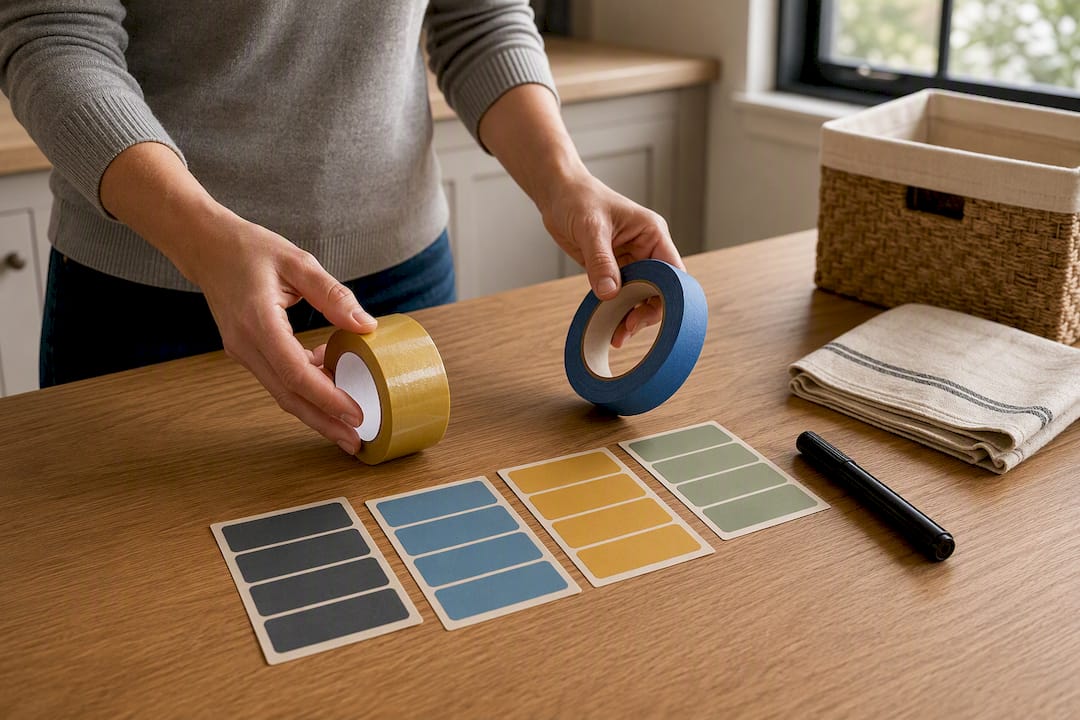
Colored packing tape wraps the whole box in color, which means it's visible from almost any angle, even when boxes are stacked four high in a dark truck. It's cheap, it's fast to apply with a tape gun, and it doesn't peel off during a bumpy ride. The downside: once you commit a roll of blue tape to "kitchen," you're stuck if you run out mid-pack.
Stickers give you more room to write specifics, and dot stickers in bright colors work well as a secondary marker alongside tape. They're weaker on rental boxes, though. Adhesive residue is a real risk, and thin paper stickers can tear off in transit.
Printable labels (made at home or from a template) let you combine a color block, room name, and box number in one clean label. This is the option organizers tend to prefer because it does double duty. It's not as fast to produce as grabbing a tape roll, but it's the most information-dense choice per label.
- Colored duct or packing tape: best for full visibility on stacked boxes, weak for detail
- Colored dot or square stickers: good for quick color-coding, moderate detail
- Printed labels with color blocks: most detail, best for organized movers, more prep time
- Colored painter's tape: rental-friendly, removes cleanly, less durable in heat
For markers, use a waterproof permanent marker like a Sharpie for standard cardboard. On dark-colored tape, a metallic or paint marker is the only thing that shows up. Large, bright labels placed on multiple sides matter more than most people expect. A single label on top disappears the moment boxes get stacked, and a label on just one side is a coin flip whether anyone sees it before they set the box down.
Pro Tip: If you're moving out of a rental, skip stickers entirely and use painter's tape in your chosen colors. It peels off cardboard without leaving a sticky ghost mark, and you can write directly on it with a marker.
Label size matters more than color choice in a dim garage or a truck with one bare bulb for light. Aim for labels at least 3 inches tall, and write room names in block letters at least an inch high. Anything smaller gets lost the moment there's any distance between the label and the person reading it.
How to Set Up a Color Coded Packing System Step by Step
Building the system before you pack is what separates a smooth move-in from a scavenger hunt. Here's the order that actually works.
-
Walk the new home and assign a color to each room. Kitchen might be red, master bedroom blue, kids' rooms yellow and green, home office purple. Keep it to rooms, not sub-categories. You don't need a different color for "kitchen pantry" versus "kitchen counter."
-
Build a master key and print two copies. List every color next to its room name, and if you're numbering boxes, note the range for each color (Red 1 through Red 24, for example). A printed key posted at both the old and new home is the single habit that makes color-coding actually work instead of becoming a guessing game halfway through the move.
-
Pack one room at a time, never mixing colors in a single box. This sounds obvious, but it's the rule people break most often when they're tired at 11 p.m. and just want a box filled. A "miscellaneous" box that's half red and half blue defeats the entire point.
-
Mark each box on at least two sides and the top. Boxes get stacked, turned, and shoved against walls. A label on only one face means someone has to move the box to check it, which is exactly the extra step you're trying to eliminate.
-
Add a short content note under the color, not instead of it. Something like "Red, Kitchen, pots + pans" beats a color alone. Color should support the label, not replace it entirely, since colorblind helpers, low light, and simple human error all reduce color to a backup signal on its own.
-
Flag fragile or priority boxes with an extra marker. A star, a piece of red tape, or the word "FRAGILE" in your marker keeps breakables from getting buried under three other boxes in the truck.
-
Post signs at the new home before moving day. Tape a sheet of paper with the room's color and name on the doorframe of each room. This turns your movers, friends, or family into a self-directing crew instead of a line of people asking you where box after box goes.
-
Hand a printed legend to your movers or helpers before they touch a single box. Even the best color system fails if nobody explains it. A one-page sheet taped to the truck's inside wall works better than shouting instructions across a driveway.
Pro Tip: Pack a "first box" in a distinct color, like orange, that doesn't match any room. Fill it with phone chargers, coffee, snacks, toilet paper, and basic tools. This is the box you want off the truck first, and giving it its own unique color means nobody confuses it with the kitchen pile.
Following this order matters because it front loads the thinking. Once the key exists and the rooms are labeled at the destination, packing turns almost mechanical. You're not deciding where things go while you're exhausted and holding a box. You already decided that on day one.
Do's, Don'ts, and Quick Fixes for Color Coded Moving Labels
A color system only saves time if it holds up under real moving conditions: stacked boxes, bad lighting, and tired helpers who've never seen your house before.
Do this:
- Use high-contrast colors that don't blur together from ten feet away (avoid two shades of blue for two different rooms)
- Put labels on at least two sides plus the top, every time, no exceptions
- Pair every color with a short written label, since color-coding works best as a visual shortcut layered on top of text, not a replacement for it
- Post the master key at both the old home and the new one
Avoid this:
- Nearly identical shades for different rooms (navy and royal blue look the same under a truck's dome light)
- Relying on tiny handwriting as the only marker, since it's unreadable from across a room
- Skipping the second and third label placement because you're in a hurry
Stacked boxes are the biggest real-world failure point. The fix is simple: label the top of every box in addition to the sides, since a stack only shows you the top surface until someone starts unloading. Low light causes similar problems, which is why bold block letters beat cursive or thin pen every time. If a box shows up with a missing or torn label, keep a spare marker and tape roll in your car so you can patch it on the spot rather than guessing later.
For multi-floor or multi-day moves, pairing colors with patterns or icons expands your system without adding confusing new solid colors. Once you exceed roughly six or seven colors, people start mixing them up. Striped tape for a fourth bedroom, or a small icon sticker (a fork for kitchen, a book for office) layered over your base colors, solves the problem cleanly.
| Mistake | Why it fails | Quick fix |
|---|---|---|
| Similar shades for different rooms | Colors blur together in low light or at a distance | Choose colors from different families (red, yellow, blue, green) |
| Label on one side only | Stacked or turned boxes hide the label | Label two sides plus the top |
| Color with no text | Colorblind helpers or mixed-up tape rolls cause errors | Always add a short room and contents note |
| More rooms than colors | People confuse similar-numbered colors | Add patterns, stripes, or icon stickers |
When to Add Numbers, QR Codes, and Inventory Apps
Color-coding tells you which room a box belongs in. Numbering and digital tools tell you exactly what's inside it, which matters the moment you're searching for one specific thing in a sea of forty identical boxes.
The simplest upgrade is dual coding: color plus a sequential number within that color group. Yellow 1, Yellow 2, Yellow 3, and so on. Combining a color with sequential numbers creates a basic inventory system that cuts down on boxes going missing, because you can count them off against your master list as they come off the truck.
QR codes are worth the extra prep time only in specific situations. If you're moving a large household, storing items long term, or you know you'll need to find one particular item fast (medication, important documents, a kid's favorite toy), a QR code linked to a photo and short contents list saves real time later. Pairing color-coding with an inventory app or QR code lets a quick scan pull up photos and a detailed list for that exact box, which beats opening five boxes to find one item.
- Basic moves (studio to one-bedroom, short distance): color plus number is plenty
- Larger households or long-distance moves: add QR codes on 10 to 15 priority boxes, not all of them
- Long-term storage mixed with moving: QR codes plus a photo inventory app pay for themselves
Digital inventory adds prep time up front, but it earns that time back the moment you need to find one specific item fast, like baby formula or a prescription, buried somewhere in dozens of nearly identical boxes.
The trade-off is honest: scanning and photographing forty boxes takes real time you don't get back until you need it. For most households, applying that extra step to a handful of priority boxes, rather than the entire move, gets you most of the benefit without turning packing into a data entry job.
Where to Buy Color Coded Moving Labels and What They Cost
You don't need anything exotic to build this system. Big-box hardware stores, moving supply retailers, and truck rental companies all carry what you need.
- Colored packing tape: sold individually or in multi-packs at hardware stores and moving supply sites, typically a few dollars per roll
- Preprinted room label kits: moving suppliers sell 10-room label kits designed specifically for this purpose, usually priced as an affordable add-on to a box or truck rental order
- Sticker packs: dot stickers or square labels in assorted colors, sold in packs of several hundred for a modest price
- Blank printable label sheets: free templates plus the cost of standard printer labels if you want to add box numbers and content notes yourself
For rental boxes specifically, skip anything with strong adhesive backing. Standard stickers and some tapes leave residue or peel the cardboard surface, which matters if you're returning bins to a rental company or reusing boxes for a future move. Painter's tape or low-tack washi tape in your chosen colors is the safer swap. It costs slightly more than standard packing tape but removes cleanly.
If you want the highest durability for a long move or a move involving storage, spend the extra few dollars on a heavier tape or a laminated printable label. Cheap paper stickers tend to curl or fall off after a day in a hot truck, right when you need them most.
How Concierge Movers Refine Color Coded Systems
Professional organizers and move managers use the same color-coding foundation homeowners do, but they add layers that catch problems before they happen. At Flawlessly Functional, a move typically starts with a room-by-room walk-through of the new home before a single box gets packed, so the color assignments are locked in and printed as a crew legend before moving day even arrives.
Double coding is standard practice on concierge moves: every box gets a color, a sequential number within that color, and a one-line content note. That third layer is what separates a professional pack job from a rushed DIY one, since it means any team member (or the client) can locate a specific item without opening multiple boxes to hunt for it.
- Pre-mapped color assignments finalized before packing starts, not decided box by box
- A printed crew legend handed out at the start of the move, not explained verbally on the fly
- Priority colors (first-night essentials, medications, important documents) called out separately from general room colors
- A designated unloading zone at the new home where boxes get staged by color before anyone starts unpacking
Pro Tip: Set aside a "landing zone" just inside the front door of the new home. Movers drop boxes there first, sorted loosely by color, before anyone carries them to the actual rooms. It keeps foot traffic and confusion down during the busiest hour of the move.
The emotional relief of walking into an already-organized home is the real payoff of this extra structure. A color system built with this much intention turns unpacking from a weeks-long slog into something closer to a same-week finish.
Should You Build This System Yourself or Hire Help?
A basic color-coded system is genuinely DIY-friendly for a small apartment or a short-distance move with a handful of rooms. Buy tape, assign colors, print a key, and you're set in an afternoon.
The math changes for larger households, moves involving storage, or a family with more urgent priorities than color-sorting forty boxes at 10 p.m. on a weeknight. If your move spans multiple days, multiple floors, or a household with kids and pets adding chaos on top of the packing itself, the time you'd spend building and managing the system yourself often costs more than hiring it out.
A concierge move doesn't replace color-coding. It absorbs the labor of building and running it, using the same underlying logic professionals rely on, just without you doing the walk-through, the printing, or the box-by-box marking yourself.
Skip the Labels and Let Flawlessly Functional Handle It
If building and managing a color-coded system sounds like one more task on an already packed moving to-do list, consider concierge move services that do that labeling work for you instead of handing you a marker and a roll of tape.

Every box that leaves your old home gets packed, coded, and logged as part of an inventory system built by professionals who do this daily, not once every few years. That means color assignments, box numbers, and content notes are already in place before the truck arrives, and unpacking happens with the same structure, right down to placing items where they belong instead of leaving boxes stacked in the garage. It's less prep work for you and fewer decisions to make while you're already stretched thin with everything else a move demands.
If you'd rather spend moving week doing anything other than color-sorting boxes at midnight, schedule a consultation with Flawlessly Functional and find out what a fully packed, labeled, and unpacked move actually looks like.
Sources
- How To Color-Code Boxes for Moving — HireAHelper
- How (& Why) To Color Code Your Moving Boxes — The Homes I Have Made
- Label moving boxes for maximum efficiency — MobileAttic