

Downsizing after divorce is usually the right move, and it works best when you treat it as a sequence, not a single decision. Secure your ID, financial, and legal documents today. Sketch a bare-month budget so you know your real number. Pause any major decisions for a week. Then work through decluttering, the money and legal steps, the actual move, and the emotional side, in that order.
TL;DR:
- Decluttering should be done room by room, using a three-bin system and questions to determine what to keep, sell, donate, or store.
- Financial and legal checks, including updating beneficiaries, closing joint accounts, and understanding notice requirements, must be addressed within the first 90 days.
- Moving costs can be minimized with careful planning: consider DIY if belongings are limited and friends are available, or hire full-service movers for fragile or time-sensitive relocations.
- Emotional recovery involves simplifying routines, setting boundaries, and using memory boxes for sentimental items to ease decision fatigue.
- Hiring a professional organizer or moving manager is advisable when time, emotional energy, or value justifies outside help to manage logistics and reduce stress.
Table of Contents
- What Should I Do First When Downsizing After Divorce?
- How Do You Decide What to Keep When Decluttering After Divorce?
- What Financial and Legal Steps Protect You During Downsizing?
- DIY Movers or Full-Service: What Actually Saves Money?
- How Do You Manage the Emotional Side of Downsizing?
- When Should You Hire a Professional Organizer or Moving Manager?
- Ready for Hands-Off Downsizing Support?
- A Personal Note on Starting Smaller
- Sources
What Should I Do First When Downsizing After Divorce?
The first 30 days set the tone for everything after. Rushing this window creates the expensive mistakes; slowing down here actually speeds up the rest of the process. A staged approach, moving from triage to decluttering to the physical move to settling in, reduces overwhelm and improves outcomes for people rebuilding after divorce.
Here's how to break the timeline down:
- Days 1 to 30: Gather and copy IDs, account statements, and legal filings. Build a bare-month budget covering only essentials. Flag any court deadlines or notice requirements immediately.
- Days 31 to 90: Start decluttering room by room. Sell or donate high-value items you won't take with you. Request moving and storage quotes so pricing isn't a surprise later.
- Days 91 to 180: Lock in your new housing. Update beneficiaries, insurance, and account ownership. Confirm your address change everywhere it matters, including with the court if custody orders apply.
Smaller housing also tends to lower mortgage, tax, and upkeep costs, which is part of why this timeline pays off financially, not just emotionally.
How Do You Decide What to Keep When Decluttering After Divorce?
Pick one room per weekend and sort everything into three bins: Keep, Sell/Donate, and Storage. Nothing goes back into a closet undecided. That rule alone eliminates most of the second-guessing that stalls people out for months.
For anything that makes you hesitate, run it through four quick questions:
- Could you replace it easily and cheaply if you got rid of it?
- Have you used or worn it in the last year?
- Does it carry real sentimental weight, or just mild guilt about wasting money?
- Does keeping it cost more in storage fees than it's worth?
For selling, local consignment shops and Facebook Marketplace tend to move furniture and mid-value goods faster than a driveway sale. High-value items, jewelry, art, designer furniture, often recoup more through consignment or resale channels than through a quick garage sale. For donations, confirm the charity's receipt policy before you drop items off if you plan to claim anything at tax time.
Short-term storage makes sense for items tied to a pending decision, like furniture waiting on a custody arrangement for the kids' bedrooms. It rarely makes sense for things you're storing purely out of guilt.
Pro Tip: Photograph sentimental items before you let them go. A picture preserves the memory without the box taking up a closet for the next five years.

What Financial and Legal Steps Protect You During Downsizing?
Your finances need protecting before your furniture does. Start with a bare-month budget, essentials only, no averages, so you know the actual floor you're working with. Then list every joint account, loan, and insurance policy still tied to your ex-spouse's name.
Watch these areas closely:
- Marital home sale: timing, title transfer, and whether the mortgage is assumable or needs refinancing.
- Joint debt: closing or separating shared credit lines before the balances become a shared liability again.
- Beneficiary updates: life insurance, retirement accounts, and any old wills naming your former spouse.
- Relocation with children: most U.S. states require written notice before a custodial parent moves, and the other parent often has a limited window to object.
Women over 50 frequently see a significant drop in standard of living after divorce, which is exactly why the bare-month budget and urgent legal checks can't wait until "later." If you're unsure whether a move triggers a notice requirement, or if joint debt is about to come due, that's the moment to call a family-law attorney or financial advisor, not after the moving truck is booked.
DIY Movers or Full-Service: What Actually Saves Money?
DIY moving saves cash if you have a small apartment's worth of belongings, healthy friends willing to help, and a weekend to spare. Full-service movers earn their cost once you're dealing with furniture, fragile items, or a timeline that can't slip.
- Get three quotes minimum. Ask each mover about binding versus non-binding estimates, insurance coverage, and whether packing materials are included.
- Match the service to your stress level. If you're managing custody handoffs the same week you're moving, pay for full-service. It's worth every dollar of the difference.
- Check storage insurance separately. Most facility policies cover only a fraction of an item's value unless you add coverage.
- Build a pack-and-go day checklist: chargers, medications, a change of clothes, key documents, and anything the kids need for the first 48 hours in the new place.
A local partner like One Day Doors & Closets can help if your new space needs a closet system rebuilt before your things go in, rather than after.
How Do You Manage the Emotional Side of Downsizing?
Decision fatigue is the real enemy here, not the boxes. Clinicians recommend making your world smaller on purpose for a few weeks to a couple of months, fewer commitments, simpler routines, less to decide every day, so your brain can recover from the hundreds of decisions divorce already forced on you.
Build in daily anchors:
- A fixed block for admin tasks, so paperwork doesn't creep into every hour.
- Some form of daily movement, even a 15 minute walk.
- One person you check in with regularly, even briefly.
- A protected block of rest time that nothing interrupts.
For sentimental items, a memory box works better than an all-or-nothing purge. Keep the box, let go of the rest, and revisit it in six months if you're still unsure. Many people who've given away or sold belongings after divorce describe feeling lighter almost immediately, not just less cluttered. If sadness turns into something heavier, or co-parenting conflict is spiking, a therapist or co-parenting counselor is worth the call sooner rather than later.
Pro Tip: Set a two-week check-in with yourself. If a smaller routine still feels unbearable rather than just uncomfortable, that's a signal to bring in outside support, not a sign you're failing at this.
When Should You Hire a Professional Organizer or Moving Manager?
Hire help when time, emotional bandwidth, or the value of what you own makes DIY risky. That's true if you're managing a demanding job alongside the move, if packing feels emotionally paralyzing rather than just tedious, or if you're staging the marital home for sale and need it to show well fast.
A concierge moving manager or luxury organizer typically handles:
- Full move planning, from timeline to logistics coordination.
- Packing and unpacking, room by room, with a system that survives the move.
- Storage coordination for items you're not ready to place yet.
- Staging support if the home is going on the market.
When vetting a provider, ask about their process, confirm they carry insurance, request references, and get pricing and milestones in writing before anything starts. Flawlessly Functional's organizing and moving service pages lay out exactly this kind of scope, and the company's 4.9 Google rating gives you a real, checkable signal before you commit to anyone.
Ready for Hands-Off Downsizing Support?
If you're staring down a marital home that needs staging, a garage full of decisions you can't face alone, or a moving date that arrived faster than your energy did, that's exactly when a concierge service earns its cost. Professional concierge services can handle planning, packing, unpacking, and storage coordination, so you're not managing all of it alone while rebuilding your life.

Instead of juggling movers, storage units, and a decluttering deadline solo, you get one coordinated plan built around your actual home and timeline. Explore luxury home organizing services to see how a project gets structured from start to finish, or reach out directly through the contact page to talk through your specific move. Either way, the next step is a conversation, not another box to sort alone.
A Personal Note on Starting Smaller
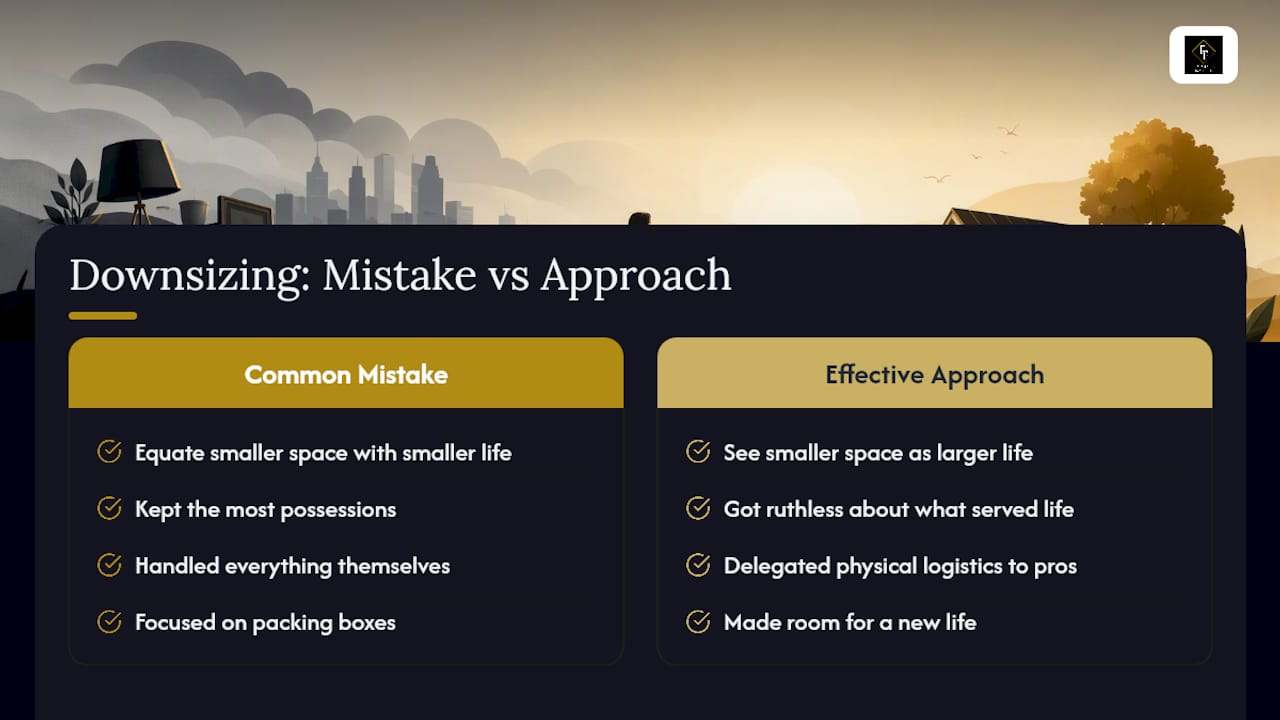
I've spent years watching people confuse "smaller space" with "smaller life," and it's almost always the opposite. The clients who come out of a divorce move steadier aren't the ones who kept the most. They're the ones who got ruthless about what actually served their new life and let a professional handle the parts that drained them most, usually the physical logistics, not the emotional ones.
That's the gap most advice misses: downsizing isn't really about the boxes. It's about making room, literally and otherwise, for a life you're building on your own terms. If you want help with that process, professional organizers are available for exactly this kind of project.
— Steve
This article is general information, not a substitute for advice from a qualified financial advisor. Consult a qualified financial professional about your own circumstances before acting on anything here.
Sources
- Relocation after divorce: legal requirements and notice rules
- Life after divorce: coping strategies and rebuilding
- How downsizing helped me heal & start over after divorce