
The single highest-impact move in laundry room organization is building a real workflow, sort, wash, dry, fold, store, and give each step its own dedicated spot. Once that framework exists, two tactics deliver the fastest visible change: adding vertical storage to free up floor and counter space, and installing a folding surface so clean clothes have somewhere to land besides a pile on top of the dryer. The examples below show how that plays out in real rooms, from rental-friendly hacks to a professional's full approach.
TL;DR:
- Vertical storage solutions, such as floor-to-ceiling shelves and modular systems, maximize wall space and improve organization without sacrificing floor area.
- Adding a folding counter over front-load machines or beside top-loaders transforms laundry routines into scheduled folding, avoiding clutter and mess.
- Using a three-bin sorting system near the entry point simplifies laundry organization and reduces the need for custom furniture.
- Proper ventilation, including clean venting and airflow gaps behind shelving, is essential to prevent mold and maintain dry, odor-free laundry spaces.
- Small laundry rooms benefit from stackable appliances, narrow carts, and over-the-door organizers, allowing efficient use of limited space without major modifications.
Table of Contents
- Top Laundry Room Organization Strategies at a Glance
- How Do You Maximize Vertical and Wall Space?
- What Cabinetry and Counter Changes Make the Biggest Difference?
- How Do You Organize a Tiny Laundry Room or Closet?
- Building a Sorting System That Actually Works
- Finishing Touches That Make the Room Feel Complete
- How a Professional Organizer Approaches a Laundry Room Project
- Ventilation Considerations to Prevent Mold and Odors
- When Should You DIY vs. Hire a Professional Organizer?
- Ready for a Done-For-You Laundry Room? Here's How Flawlessly Functional Helps
- Sources
- FAQ
Top Laundry Room Organization Strategies at a Glance
Not every fix requires a weekend or a contractor. Some of the best laundry room storage ideas take fifteen minutes and a screwdriver.
Quick wins (under an hour):
- A slim rolling cart wedged into the gap beside the washer
- Magnetic bins stuck to the side of the machine for pods or dryer sheets
- Wall hooks near the door for aprons, tote bags, or drying delicates
Medium projects (a weekend):
- Floating shelves above the machines
- A simple folding counter built from a plank and brackets
- Labeled baskets for lost socks, rags, and delicates
Higher-effort upgrades (worth planning for):
- Built-in cabinetry from floor to ceiling
- Pull-out hampers hidden behind cabinet fronts
- Custom drying pull-outs that tuck away when not in use
Start with the quick wins. They tell you fast whether you actually need the bigger projects, or whether a cart and a few hooks solve most of the clutter.
How Do You Maximize Vertical and Wall Space?
Most laundry rooms waste the best storage real estate in the house: the wall above the machines. Design experts consistently point to floor-to-ceiling shelving and modular wall systems as the fastest way to multiply storage without losing an inch of floor space.
Here's a practical sequence for tackling it:
- Measure for studs first. A loaded shelf of detergent and cleaning supplies is heavy. Use a stud finder before you drill, and if studs don't line up where you need them, use rated anchors instead of guessing.
- Extend cabinets or shelves to the ceiling. The top foot of wall space is often ignored, but it's perfect for bins of seasonal linens or bulk detergent you don't need daily.
- Choose a track or modular system over fixed shelves. Adjustable systems let you reconfigure shelf height as your storage needs change, which matters more than most people expect once a new appliance or storage bin enters the mix.
- Add wall-mounted drying bars, pegboards, or magnetic containers to pull small items off the counter entirely.
Renters shouldn't skip this step just because drilling isn't an option. Tension-mounted shelving, adhesive hook strips, and freestanding wall storage systems all deliver similar results without a single hole in the drywall.
Pro Tip: Install one shelf about six inches lower than feels natural. That's the shelf you'll actually reach for stain spray and dryer sheets without a step stool, and it keeps the higher shelves free for things you grab once a month.
What Cabinetry and Counter Changes Make the Biggest Difference?
If you make one investment in this room, make it a counter. A folding counter positioned over front-load machines, or set beside them if you've got top-loaders, is widely considered the single most transformative feature you can add. It turns a room where clothes pile on top of the dryer into one where folding actually happens on schedule.
Cabinetry does the rest of the heavy lifting:
- Hidden or pull-out hampers keep dirty clothes sorted and off the floor instead of piled in a basket that migrates room to room.
- Tall cabinets handle bulk detergent, extra hangers, and cleaning supplies that don't need daily access.
- A utility sink, where plumbing allows, gives you a place to hand-wash or pre-treat stains without using the kitchen.
Material choice depends on budget more than looks. Butcher block countertops are warm and affordable but need periodic sealing near water sources. Quartz costs more upfront and shrugs off moisture and detergent spills without maintenance. Laminate splits the difference: budget-friendly, water-resistant enough for most laundry use, and available in finishes that mimic pricier materials. Cabinetry like this doesn't just organize the room; it's often what converts a purely functional laundry space into one that reads as finished and intentional.
How Do You Organize a Tiny Laundry Room or Closet?
Small footprints force better decisions, not worse ones. Architectural Digest's small laundry room guide makes the case that even a closet-sized setup can function well with the right built-ins, and a few specific tactics carry most of the weight:
- Stackable washer/dryer combos free up several feet of floor space compared to side-by-side units, which matters enormously in a true closet.
- A slim rolling cart, often as narrow as six inches, fits into the dead gap beside a machine and holds detergent, dryer balls, and stain remover that would otherwise clutter a shelf.
- Over-the-door organizers and fold-down drying racks add storage and drying capacity without touching a single wall stud.
- Non-drill tension shelving works for renters who need real storage without a lease violation.
Layout matters as much as the gear. A single-wall setup, everything along one run, works best when the room doubles as a hallway or mudroom pass-through. A galley layout, machines facing storage across a narrow aisle, suits a true dedicated room. A laundry closet with bifold doors needs shelving that clears the door swing, which usually means shallow floating shelves over deep cabinets.
Building a Sorting System That Actually Works
Clutter in a laundry room is almost always a sorting problem in disguise. A three-bin system, whites, darks, and delicates, solves most household sorting needs without requiring a single piece of furniture. Labeled baskets or pull-out hampers work just as well and look considerably tidier if the bins sit somewhere visible.
Placement rules matter more than the containers themselves:
- Put the sorting station near the entry point, wherever dirty laundry first arrives, so clothes never make it past that spot before landing in the right bin.
- Keep detergent and dryer sheets within arm's reach of the washer. Storage planned around the actual workflow, sorting near the door, supplies at the washer, folding by the dryer, cuts down on the extra steps that make laundry feel like a chore.
- Designate a folding zone right next to the dryer, even if it's just a counter or a temporary fold board that hangs on a hook when not in use.
- Add a "done" basket for folded items waiting to be carried back to bedrooms, so finished laundry doesn't restart the pile cycle.
Keep cleaning chemicals behind closed cabinet doors, and reserve waist-to-shoulder height for the items you reach for weekly. Anything used less often belongs higher up or lower down.
Finishing Touches That Make the Room Feel Complete
Open shelving photographs beautifully, but it only works if you're genuinely tidy enough to keep it that way. If bottles and boxes tend to multiply, closed cabinetry hides the mess and keeps the room looking finished regardless of what's happening inside the drawers.
Matching baskets, consistent labels, and coordinated cabinet hardware do more for the finished feel of a laundry room than most people expect. Consistent containers and labeling reduce visual clutter even when the contents behind them are only loosely organized, and they make it obvious at a glance where something belongs.
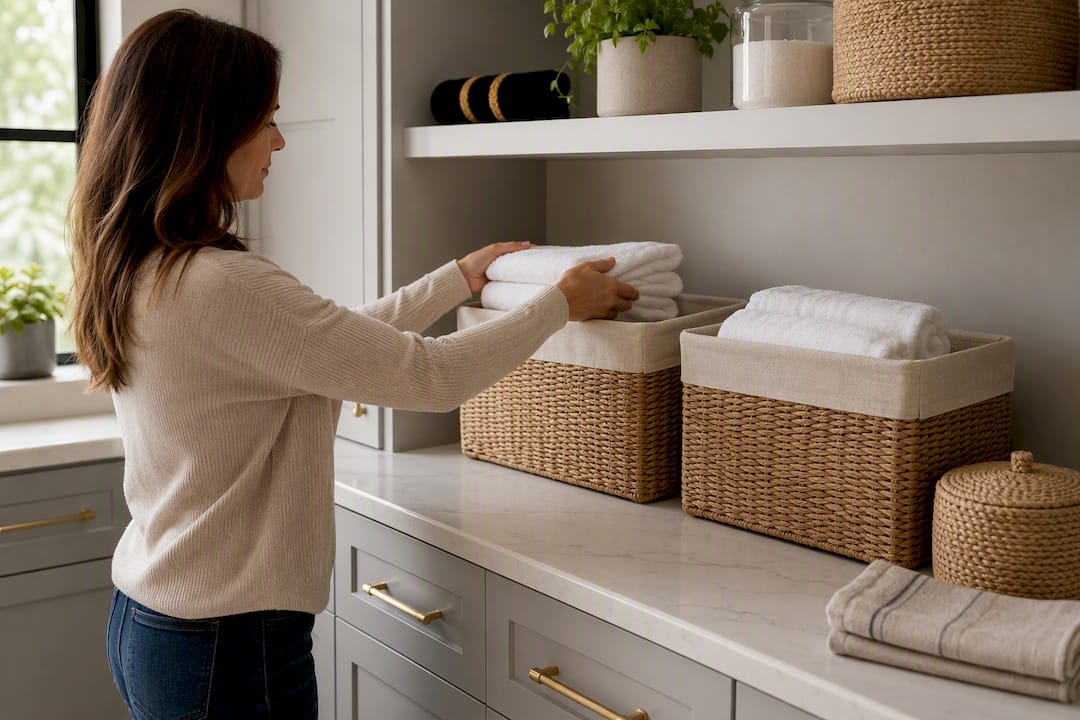
Maintenance is the part people skip, and it's the part that determines whether any of this lasts. A ten-minute weekly tidy, wipe the counter, return stray items, restock what's running low, keeps small messes from becoming a Saturday project. Keep a running restock list taped inside a cabinet door for detergent and dryer sheets. Once a season, pull everything off the shelves and purge what you no longer use.
Pro Tip: Buy one extra set of matching baskets when you first set up the room. Retailers discontinue laundry organization lines constantly, and mismatched bins six months later are the fastest way for a finished-looking room to start feeling thrown together again.
How a Professional Organizer Approaches a Laundry Room Project
A professional project starts before a single shelf goes up. Flawlessly Functional begins with an intake: measuring the space and asking how the household actually does laundry, who folds, where clothes pile up, how often supplies get restocked. That behavior survey shapes the plan more than the square footage does.
From there, the plan pairs a workflow map with a storage mix, sometimes custom cabinetry with a folding counter, sometimes curated pull-out hampers and modular shelving for a rental. Custom cabinetry coordination can include integrated hampers, sink placement, and renter-friendly temporary systems where permanent changes aren't an option.
Installation and orientation close out the project, walking the household through where everything lives so the system survives contact with real life. Clients consistently report faster laundry routines and less visual clutter, along with a kind of relief that's more emotional than logistical once the chaos actually clears.
Ventilation Considerations to Prevent Mold and Odors
A laundry room traps more moisture than almost any other room in the house, and organization alone won't fix a mold problem hiding behind a beautifully labeled shelf. Every wash and dry cycle releases humidity into a relatively small, often windowless space, which makes ventilation a functional requirement, not a finishing touch.
Start with the dryer vent itself. A vent that's clogged with lint or improperly routed pushes humid air back into the room instead of outside, and it's also a fire hazard worth checking at least once a year. If the room has a window, cracking it during and after loads helps, but most laundry rooms need mechanical help: an exhaust fan vented to the outdoors, not just recirculated indoors, keeps humidity from settling into drywall and cabinetry.
Storage decisions can make ventilation problems worse or better. Packing cabinets floor to ceiling with zero airflow gaps traps moisture against interior walls, especially in closet-style setups with bifold doors that rarely stay open. Leaving a small gap behind wall-mounted shelving, and choosing louvered or slatted cabinet doors over solid ones, lets air circulate instead of pooling.

Watch for the early signs: a musty smell that lingers after laundry is done, or condensation on the walls near the machines. Both point to airflow that isn't keeping pace with the moisture the room generates, and catching it early is far cheaper than dealing with mold remediation behind a wall of custom cabinetry later.
When Should You DIY vs. Hire a Professional Organizer?
Cosmetic and reversible changes are DIY territory. Swapping in matching baskets, adding wall hooks, mounting a tension shelf, none of that requires anything beyond a free afternoon and basic hand tools. If your laundry room's problems are mostly clutter and mismatched bins, you can solve most of it yourself this weekend.
Plumbing work, permanent cabinetry, and a full workflow redesign are a different category entirely. Those decisions are expensive to undo if the measurements or placement are wrong, and they benefit from someone who's planned dozens of these rooms rather than one.
If what you actually want is a lasting, high-end system with someone coordinating installation and the messier parts of a move at the same time, that's a direct case for hiring a professional organizing service rather than piecing it together solo.
— Steve
Ready for a Done-For-You Laundry Room? Here's How Flawlessly Functional Helps
If you've read this far and thought "I don't have a weekend for this," that's the entire reason done-for-you organizing exists. Professional organizing services handle the measuring, the sourcing, the installation coordination, and the cabinetry decisions that turn into hours of research if you tackle them alone.

A typical engagement includes an in-home assessment of your workflow and pain points, a custom storage plan tailored to your cabinetry and appliance layout, coordination with installers for any built-in work, and concierge touches if the project overlaps with a move. This approach suits busy homeowners who want a lasting system rather than a series of weekend projects that never quite get finished, and who'd rather hand off the decision fatigue than make forty small choices about basket sizes. If that sounds like your household, the next step is straightforward: book a consultation with Flawlessly Functional and walk through your space with someone who's solved this exact problem before.
Sources
- The Smart IKEA Storage Idea That Made This Small Laundry Room Feel Twice as Big
- Laundry Room Cabinet Ideas: Storage, Counters & Layout | Boise Cabinet Co
- 33 Small Laundry Room Ideas for the Tiniest of Spaces | Architectural Digest
FAQ
What Is the Best Way to Organize a Laundry Room?
Build the room around the actual workflow, sort, wash, dry, fold, store, and give each step a dedicated spot, then add vertical shelving and a folding counter to handle the volume without clutter.
How Do I Create a Functional Laundry Sorting System?
A three-bin system for whites, darks, and delicates, placed near wherever dirty laundry first enters the room, handles most households without any custom furniture required.
Does Adding Cabinets to a Laundry Room Add Value?
Custom cabinetry with a folding counter and hidden hampers presents the space as finished and functional, which is widely considered a meaningful upgrade for resale appeal.
How Do You Maximize a Tiny Laundry Room?
Stackable washer/dryer units free up floor space, a narrow rolling cart fills the gap beside a machine, and over-the-door organizers add storage without a single wall modification.
Should I Organize My Laundry Room Myself or Hire a Professional?
Cosmetic fixes like baskets and shelving are fine to DIY, but plumbing changes, permanent cabinetry, or a full workflow redesign are better handled by a professional organizing service that plans the whole system at once.