
Linen closet organization comes down to four moves: clear out what doesn't belong, assign each shelf one job using a zone system, choose breathable or clear containers based on what's inside them, and keep daily essentials at eye level. Get those four right and you'll grab a matching sheet set in ten seconds instead of digging through a pile. Everything else, from labels to risers, just supports that core structure.
TL;DR:
- Keep only two to four sheet sets per bed and two to four towels per person to avoid clutter in your linen closet.
- Use a zone system by assigning specific shelves for different categories, like bath towels at eye level and heavier blankets at the bottom.
- Fold linen sets inside pillowcases and file towels vertically to maintain neatness and prevent collapsing or toppling.
- Select breathable or clear storage containers suited to linen types and size shelves with measurement to avoid wasting space or crushing items.
- Regularly maintain your closet with seasonal declutters, proper rotation, and airflow management to prevent mustiness and prolong linen lifespan.
Table of Contents
- What Belongs in Your Linen Closet (And What Should Leave)
- How Do You Set Up a Zone System for a Linen Closet?
- What's the Best Way to Fold and Stack Linens So They Stay Neat?
- Baskets, Bins, or Dividers: Which Storage Container Actually Works?
- How Do You Organize a Small Linen Closet Without Renovating It?
- How Do You Fix a Deep Closet Where Things Get Lost in Back?
- How Often Should You Maintain a Linen Closet?
- How Do You Keep a Linen Closet From Getting Musty?
- What Materials Keep Linens From Getting Damaged in Storage?
- A Professional Organizer's Take on When DIY Isn't Enough
- Let Flawlessly Functional Handle the Linen Closet Overhaul for You
- Sources
What Belongs in Your Linen Closet (And What Should Leave)
Before buying a single bin, empty the closet completely. Wipe down the shelves, vacuum the corners, and lay everything out on your bed or floor where you can actually see it.
Sort into four piles: keep, donate, rag pile, and trash. Anything with a hole, a permanent stain, or a smell that survived the wash goes to rags or the trash, not back on the shelf.
As a starting benchmark, aim for two to four sheet sets per bed and two to four towels per person. If you're storing eight sets for a queen bed you've had since 2019, you're storing clutter, not linens.
While you're at it, pull out anything that migrated in over time but doesn't belong:
- Medications (heat and humidity in a linen closet can degrade them — move them to a dry, climate-stable spot)
- Craft supplies, gift wrap, or seasonal decor
- Luggage or overflow from the coat closet
- Expired first-aid items or half-used candles
Resist buying containers at this stage. Professional organizers decide zones before shopping for bins, because a beautiful basket bought for the wrong shelf just becomes new clutter.
How Do You Set Up a Zone System for a Linen Closet?
A zone-based approach where each shelf gets one category cuts down on the visual noise that makes closets feel chaotic even when they're technically clean. One shelf holds only bath towels. Another holds only sheet sets. Nothing crosses lanes.
Map zones to how your household actually lives, not how a magazine photo looks:
- Eye level (daily use): bath towels and everyday sheet sets
- Top shelf: guest linens, seasonal swaps, or bulk backstock
- Bottom shelf: heavier items like extra blankets, or a bin for kids' bedding
- Middle shelves: hand towels, washcloths, pillowcases
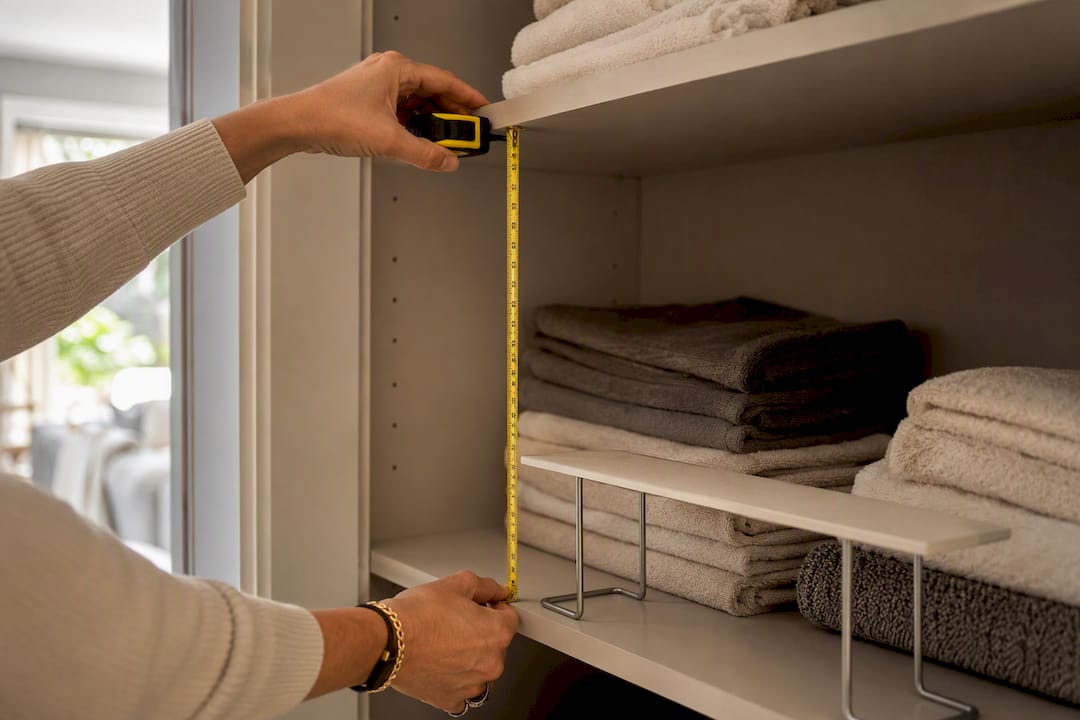
Spacing matters more than most people expect. Folded bath towels typically need moderate vertical clearance, while bulkier blankets or comforters require more height. If your shelves are fixed at one uniform height, you're either wasting space above short stacks or crushing tall ones.
That's the case for adjustable shelving or simple slide-in shelf risers. Before you touch a single item, measure your current shelf gaps with a tape measure and note which ones are too tight for your bulkiest items. Leave a couple inches of breathing room on the front edge of each shelf too. Cramming a stack flush to the edge is how folded towels start avalanching onto the floor.
What's the Best Way to Fold and Stack Linens So They Stay Neat?
Folding technique decides whether a shelf stays tidy for a week or collapses by Thursday. Two methods handle almost every linen category in a home.
- Bundle sheet sets inside their own pillowcase. Fold the fitted sheet by tucking the corners into each other to make a rough rectangle, then fold the flat sheet and one pillowcase to match its width, and stuff the whole bundle into the second pillowcase. Now a full set is one grab, not three loose pieces you're hunting for separately.
- File towels vertically instead of stacking them flat. Fold each towel into thirds, then in half, and stand it on its edge like a book in a shelf divider or bin. You see every towel at once, and pulling one from the middle doesn't topple the stack.
- Roll only where flat folding doesn't fit. Beach towels and throw blankets often roll tighter than they fold, especially in narrow bins.
Pro Tip: Pick one folding method and test it on a single shelf for a week before redoing the whole closet. Organizers routinely recommend this trial period because a system your household won't actually use isn't a system, it's a photo.
Baskets, Bins, or Dividers: Which Storage Container Actually Works?
The right container depends on what's going inside it, not what looks best on a shelf. Woven, natural-fiber baskets in seagrass or cotton rope let air move through the linens they hold, which matters for bedding that needs to breathe rather than sit sealed away. They also just look better on open shelving, if that's a factor for you.
Clear low bins earn their spot for a different reason: visibility. Small items like washcloths, travel toiletries, or anything prone to spilling belong in something you can see through without pulling it off the shelf first.
A rough shopping checklist before you buy anything:
- Measure shelf depth first. A bin that's an inch too deep won't slide, it'll jam.
- Pick one folding style per shelf so containers match what's actually inside them.
- Budget $30 to $60 for a starter set of matching bins or baskets; splurge on sturdier woven baskets if you want them to last through years of daily use.
- Add shelf dividers on any shelf holding loose stacks. They stop a leaning pile of towels from toppling into the next zone.
- Use risers on tall shelves to create a second usable layer instead of one tall, wasted gap.
Dividers and risers do the same basic job in different directions: they turn wasted vertical or lateral space into another shelf you didn't have before.
How Do You Organize a Small Linen Closet Without Renovating It?
Small entry closet ideas and narrow linen closets share the same fix: use the door and the walls, not just the shelves. An over-the-door organizer with fabric pockets holds hand towels, washcloths, or travel-size toiletries without eating an inch of shelf depth.
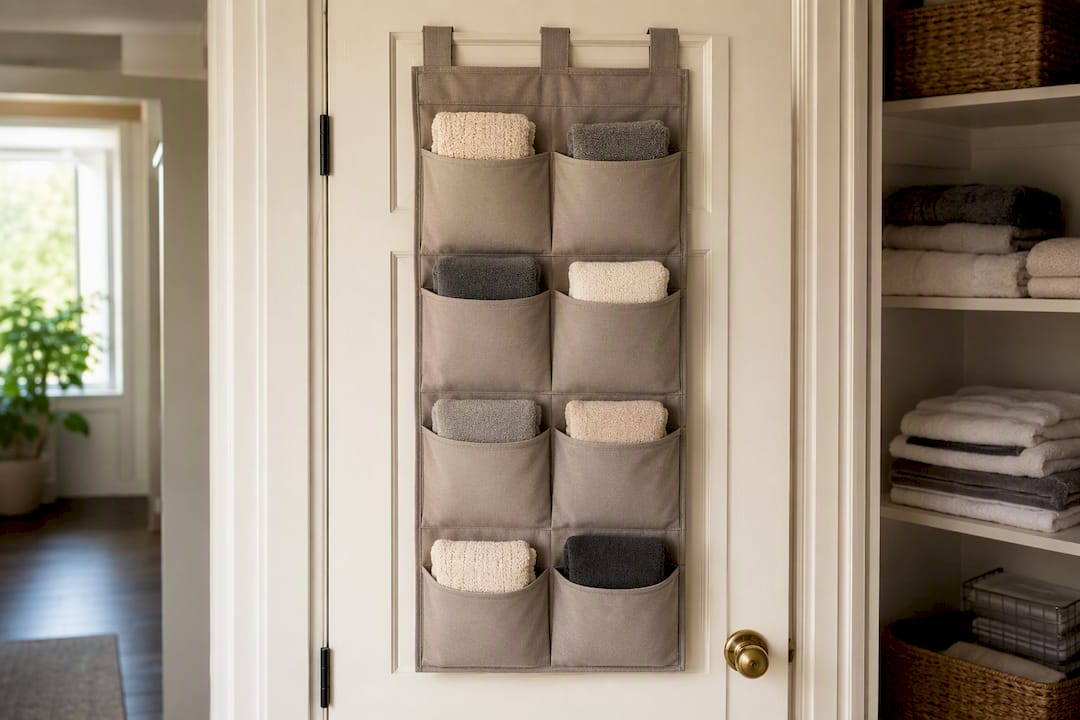
Slim adhesive hooks on the inside door work well for robes or a hanging laundry bag. Choose lightweight hardware for anything under a couple of pounds; save the heavy-duty, screw-mounted brackets for actual weight like a stack of towels in a hanging basket.
A few more compact fixes worth trying:
- Collapsible fabric hampers that fold flat when not holding overflow laundry
- Slim under-shelf wire baskets that hang from the shelf above, using dead air space
- One consistent fold width across every category, since matched dimensions stack tighter than mismatched ones and waste less depth
The homeowners who get the most out of a small linen closet aren't the ones with the fanciest bins. They're the ones who folded everything to the same width and stuck with it.
How Do You Fix a Deep Closet Where Things Get Lost in Back?
Deep shelves create what organizers call the black hole effect: stuff gets pushed to the back and never seen again. The fix isn't more storage, it's better front-to-back planning. Keep backstock the same category as the front row instead of stacking unrelated items behind each other.
A few low-cost fixes solve most deep-shelf problems:
- Low, clear bins let you see contents without unloading the shelf
- A turntable (lazy susan) works well for small folded items you'd otherwise lose in a corner
- Slide-out shallow drawers, borrowed from pantry organization, are the upgrade path if you're ready to invest in a retrofit
Label the front of each bin and orient folded edges facing out, so grabbing what you need doesn't require unstacking the whole row.
How Often Should You Maintain a Linen Closet?
Once the system is built, maintenance is light. Stick to two to four sheet sets per bed and two to four towels per person as your ceiling, and resist the urge to keep "just in case" extras beyond that.
A workable rhythm looks like this:
- Weekly: a 30 second glance to catch anything mis-shelved before it becomes a habit
- Seasonally: a 15 minute check to swap heavier bedding in or out and confirm zones are still holding
- Annually: a full edit where you repeat the declutter pass and reassess whether your household's counts have changed
Label shelves so kids and guests know where clean towels return, and set one house rule: folded laundry goes straight to its zone, not the top of the dryer.
How Do You Keep a Linen Closet From Getting Musty?
Moisture is the quiet enemy of a linen closet, and most people don't notice it until towels start smelling faintly sour straight off the shelf. The cause is almost always the same: linens packed too tightly, sealed in plastic, or stored damp.
Airtight plastic bins feel protective, but they trap whatever humidity is already in the fabric. An organized closet with breathing room, rotation, and breathable storage cuts mildew risk far more than sealed containers do. Leave a finger's width of space between folded stacks instead of jamming them shelf-to-ceiling.
A few habits make a real difference here. Never put towels or sheets away straight from the dryer while they're still warm; give them a few hours to fully cool and release residual moisture first. Crack the closet door for an hour once a week if the room tends to run humid, especially in a bathroom-adjacent closet in a warm climate. Consider a small moisture-absorbing packet or a few silica gel sachets tucked on a back corner of the top shelf, particularly if the closet backs onto an exterior wall.
Rotation itself helps too. Linens that sit untouched for months in the dark are more prone to that flat, musty smell than ones that get used and re-laundered regularly. If a section of your closet hasn't been touched since last winter, that's your seasonal edit's cue to check for smell and refold.
Ventilation beats fragrance sprays every time. A sachet can mask a musty smell temporarily, but airflow and proper folding prevent it from developing in the first place.
What Materials Keep Linens From Getting Damaged in Storage?
Fabric choice for the linens themselves matters less here than what you store them in and against. Cotton and linen sheets need to breathe, which rules out sealed plastic totes for everyday storage even though those bins look tidy on a shelf.
Woven, natural-fiber baskets, cotton canvas bins, or even simple cardboard boxes with ventilation holes let air circulate around folded stacks, which matters most for anything stored longer than a season. If you're tucking away out-of-rotation bedding, a breathable cotton storage bag beats a plastic zip tote for the same reason towels shouldn't go into plastic while still damp.
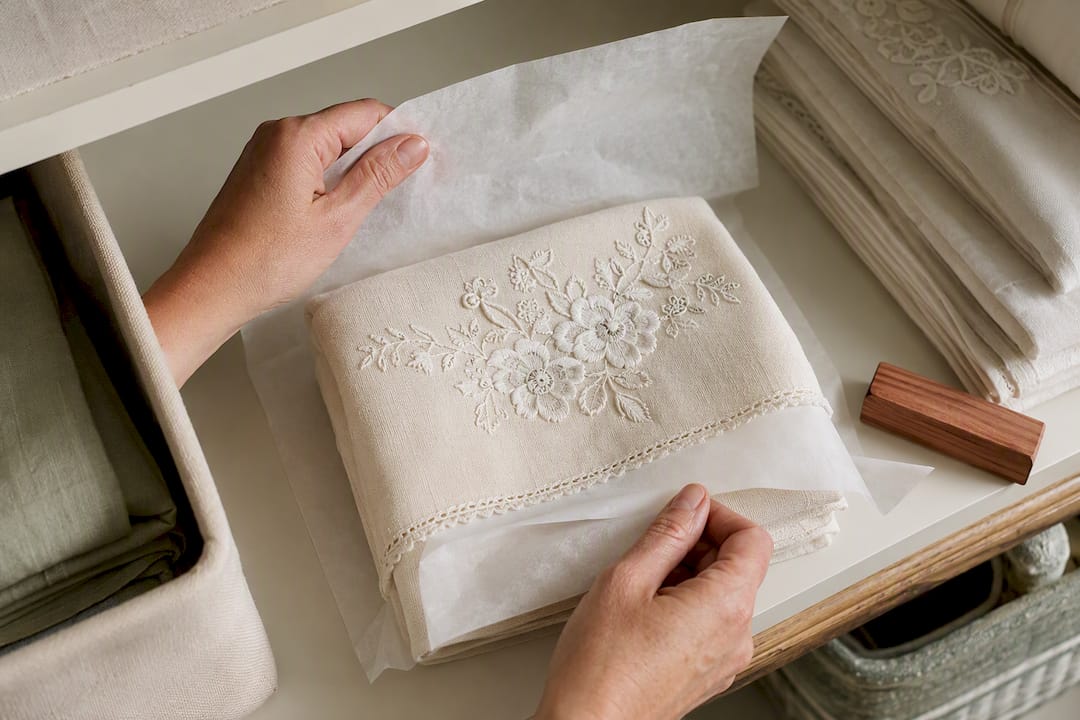
For genuinely delicate items, heirloom linens, embroidered guest towels, or anything vintage, acid-free tissue paper between folds prevents the yellowing and fabric breakdown that ordinary newsprint or colored tissue can cause over years of storage. Cedar blocks or lavender sachets add a mild moisture and pest deterrent without the chemical smell of mothballs, and they're safe near natural fibers in a way some sprays aren't.
Wood shelving itself can be a hidden risk. Untreated or freshly varnished wood can off-gas and discolor light fabrics over time, so a shelf liner, even a simple cotton or waxed canvas one, acts as a buffer between fabric and shelf. Skip plastic liners if the closet runs warm; they trap the same moisture you're trying to avoid.
A Professional Organizer's Take on When DIY Isn't Enough
Most homeowners can execute everything above in a weekend. What separates a linen closet that looks good on move-in day from one that still works two years later is whether the system accounts for how the household actually behaves, not just how it should behave in theory.
At Flawlessly Functional, the priority is function first, aesthetics second, because a beautifully styled shelf that collapses in three weeks isn't a lasting system. That mindset shows up most clearly during a move, where linens, towels, and bedding get boxed without any zone logic and then unpacked into a new closet with the same lack of structure.
Hiring a professional makes the most sense in three situations: you're short on time, you're downsizing and need to make hard calls about what to keep, or your closet's layout is awkward enough that shelving alone won't fix it. A 4.9 Google rating reflects clients who wanted the system built once and done right, not redone every few months.
— Steve
Let Flawlessly Functional Handle the Linen Closet Overhaul for You
If everything above sounds right but the idea of a full weekend gutting your closet doesn't, a professional can provide a custom zone layout, matched containers sized to your actual shelves, and small hardware upgrades like risers or dividers installed and ready to use from day one.

The linen closet organizing service covers the full process: decluttering with you, selecting containers suited to your specific shelves, installing any small upgrades your space needs, and leaving you with a maintenance plan so the system holds up long after the project wraps. If you're organizing because you're also moving, the concierge moving management service packs, unpacks, and reinstalls your optimized systems in the new home, so the closet doesn't revert to chaos the moment boxes arrive.
If your linen closet has been a source of daily frustration rather than daily ease, book a consultation and get a plan built around how your household actually lives.
Sources
For more on shelf spacing and container choices, see The Spruce's linen closet guide and Wirecutter's organizing recommendations. Homeowners tackling custom shelving upgrades may also find One Day Doors & Closets' guide to real-life closet design useful, and readers curious about the emotional payoff of a finished space can read Flawlessly Functional's piece on organized living.
- How to Organize a Linen Closet | Reviews by Wirecutter
- How to organize a linen closet and keep it tidy | HGTV
- Best place to store medication | GoodRx
- 15 Genius Ways to Organize Your Linen Closet Once and For All | The Spruce
- Linen Closet Organization Ideas That Survive Real Life