
If you're moving with a newborn, the priority order is simple: protect the sleep routine, pack a dedicated essentials bag that never leaves your side, and get someone else to lift the boxes. In the next 24 to 72 hours, call your pediatrician about records and travel timing, then assemble that essentials bag before you touch another box. Everything else in a move can wait a day. A baby's routine and your own recovery cannot.
TL;DR:
- Prioritize hiring professional movers or a concierge service to handle heavy lifting and nursery setup to protect your postpartum recovery and ensure a functional sleep space.
- Pack an essentials bag with diapers, wipes, feeding supplies, and comforting items, splitting supplies between the car and the first unpacked box to avoid shortages.
- Arrange childcare early and designate one adult as the baby's main point person on moving day to minimize stress and keep the baby in a quiet, safe space.
- Plan to unpack the nursery first, ensuring the crib, sleep surface, and safety items are ready before tackling other rooms to maintain bedtime consistency.
- Keep medical records accessible, confirm pediatric care at the destination before moving, and postpone travel if your baby shows signs of illness or if recovery is incomplete.
Table of Contents
- Planning a Move With a Newborn: How Far Ahead Should You Start?
- What Goes in Your Newborn Moving Day Essentials Bag?
- What Happens to the Baby on Moving Day?
- Should You Drive or Fly When Relocating With an Infant?
- Settling In: What to Unpack First With a Baby in the House
- Keeping Medical Care on Track After a Move
- Taking Care of Yourself While You Move With a Newborn
- An Organizer's Take on Moving With a Baby
- How Flawlessly Functional Makes Moving With a Baby Easier
- Where to Go for More Guidance
- Sources
- FAQ
Planning a Move With a Newborn: How Far Ahead Should You Start?
A planning period of several weeks ahead is commonly recommended by relocation guides and professional movers when moving with a baby, allowing time to arrange pediatric care transfers and organize moving logistics. It gives you time to line up a pediatrician transfer, hire movers instead of doing it yourself, and build a packing schedule that doesn't collapse into chaos during week two of a four-week newborn stretch.
If you have any flexibility at all, avoid scheduling the move during the early postpartum period, when physical recovery and newborn care are still very demanding. Lifting boxes after a C-section or a tough delivery is a real risk, and a newborn's sleep and feeding patterns are still consolidating during that stretch, which makes a chaotic move even harder on both of you.
Planning the move well in advance involves steps such as scheduling pediatrician visits, booking movers, updating addresses, and organizing packing in stages. The exact timing will depend on individual circumstances, but a structured timeline helps avoid last-minute stress.
Tell your movers up front that a baby is in the house. Ask them to load the crib, changing table, and any baby furniture last, and to prioritize a clear path for a car seat or bassinet during transit. A good moving crew treats that request as routine, not an inconvenience.
What Goes in Your Newborn Moving Day Essentials Bag?
Pack an essentials bag to keep with you that includes diapers, wipes, feeding supplies with proper storage, a digital thermometer, any approved medications, soothing items like a white noise machine, and a familiar blanket or toy, spare outfits, and cleaning supplies like burp cloths and a change pad.
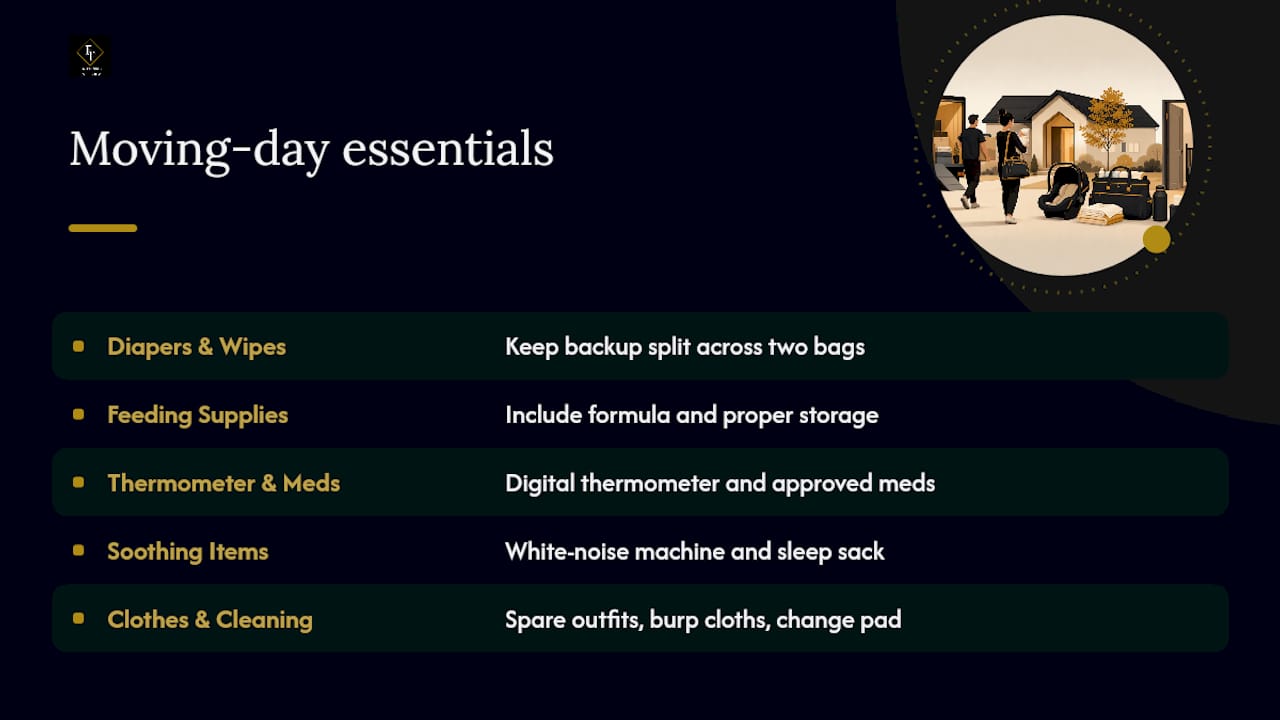
Pro Tip: Split your critical supplies across two bags, one in the car with you and one in the first box off the truck. If a suitcase gets left behind at a rest stop or a box gets buried in the truck, you still have backup formula, diapers, and a sleep sack within reach.
Pack the nursery dead last, after everything else in the house is boxed. Label the crib hardware in a clear bag taped to the crib rail itself, not tossed into a random toolbox, and keep your Allen wrench or screwdriver in the box you plan to open first at the new place. Parenting guides consistently recommend treating that first box as sacred: it should hold exactly what your baby needs for one full night and morning, no more.
Bringing a familiar board book or soft cloth book can also help cue sleep in an unfamiliar room, according to early-literacy resources that study infant comfort objects. Whatever crib or bassinet you set up at the new place, keep the sleep surface firm with no loose blankets, pillows, or bumpers, which matches long-standing pediatric safe-sleep guidance regardless of where the crib happens to be sitting.
What Happens to the Baby on Moving Day?
Moving day works best when your baby isn't in the middle of it. Here's the sequence that keeps both of you sane:
- Arrange childcare first. A grandparent, close friend, or a few hours of paid sitting removes the single biggest stressor: trying to soothe a newborn while wrangling a moving crew.
- Brief whoever is watching the baby. Give them the feeding schedule, nap windows, and a phone number for you that you'll actually answer.
- If the baby stays home, pick one quiet room and clear it first. Keep that room's door closed to movers until it's the very last space they touch, and assign exactly one adult as the baby's point person for the day.
- Use a carrier for transitions, not a stroller. A soft structured carrier keeps your hands free for last-minute tasks and keeps the baby against your body during the noisiest, most unpredictable hours of the move.
- Protect the longest nap of the day. If you know your baby sleeps two hours starting around 1:00 PM, plan the loudest part of the move around that window, not through it.
Pro Tip: Bring the white noise machine into whatever room the baby is napping in, even mid move. Consistent sound cues do more to protect a nap than a quiet house ever will, because moving trucks and stomping feet are not something you can fully control.
Set realistic expectations for stroller or car naps on a moving day. They'll be shorter and lighter than a crib nap, and that's fine for one day. Don't chase a perfect nap on the day everything else is in motion.
Should You Drive or Fly When Relocating With an Infant?
Driving gives you more control. Flying gets you there faster. That's really the whole tradeoff, and the right answer depends on distance and your baby's tolerance for a car seat.
If you're driving:
- Plan your route around naps and feeds, not mile markers. A four-hour drive with a newborn is really a series of 45 to 90 minute legs punctuated by stops.
- If you're staying overnight, confirm the hotel can provide a crib or pack and play, or bring a portable one. Don't assume.
- Keep the essentials bag in the back seat within reach of whoever is riding with the baby.
If you're flying:
- Call TSA Cares ahead of your trip. TSA provides dedicated support for families traveling with infants, including guidance on screening and what you can carry through security.
- Breastmilk and formula are allowed in reasonable quantities beyond the standard liquid limits, but tell the screening officer before you start the process.
- A lap infant under two saves the cost of a seat, but a dedicated seat with an FAA-approved car seat gives your baby a more stable, familiar sleep surface for a longer flight.
- Ask about gate-checking your car seat or stroller so you're not carrying either through the terminal.
The American Academy of Pediatrics notes that most healthy newborns can travel safely, but recommends checking with your pediatrician first if your baby was premature or has any ongoing health concerns. Keep medical records and your essentials bag in the cabin with you, not in checked luggage, no matter which mode you choose.
Settling In: What to Unpack First With a Baby in the House
Unpack the nursery first, full stop. Before you touch the kitchen or living room boxes, get the crib assembled, the sleep sack laundered if needed, and the first night box opened.
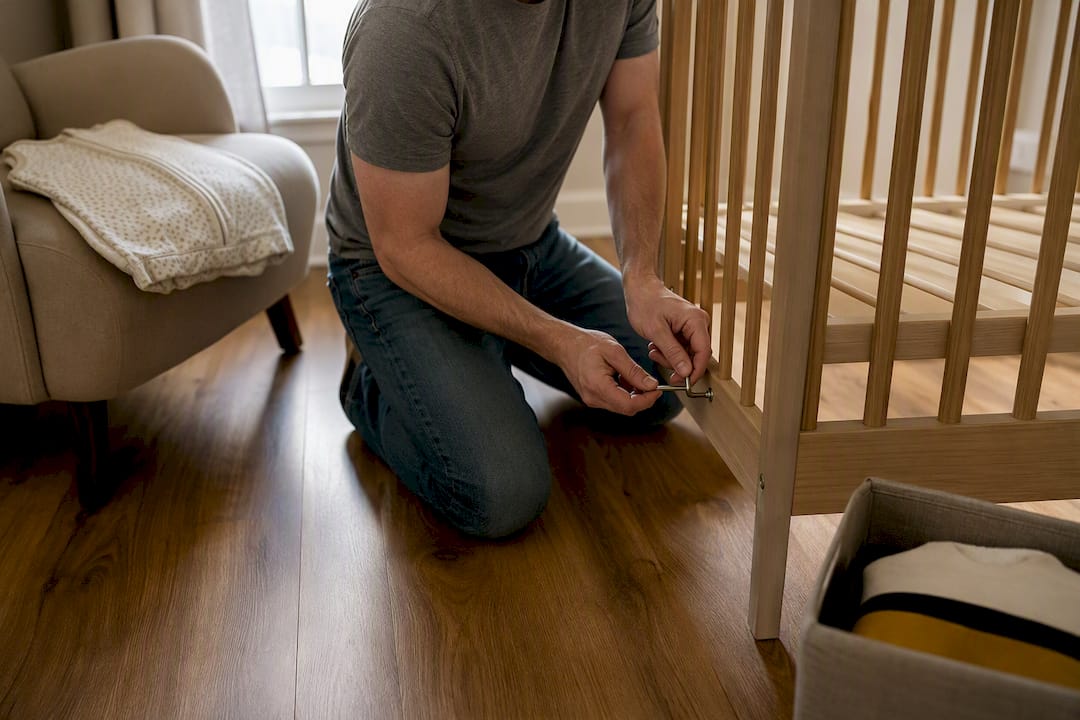
Try to keep bedtime cues identical for two nights before the move and two nights after, the same bath time, the same song, the same sleep sack. That consistency does more to ease the transition than a perfectly organized kitchen.
Once the nursery is functional, run through a fast safety pass on the rest of the house:
- Test smoke and carbon monoxide detectors, and install new batteries if you're not sure how old the current ones are.
- Cover accessible outlets in any room the baby will spend time in.
- Anchor tall furniture like dressers and bookshelves before the baby is mobile enough to test them, even if that's months away.
- Install stair gates if the new home has stairs the baby will eventually reach.
Pro Tip: Do the nursery and the safety pass before you unpack a single kitchen box. A functional sleep space and a safe house matter far more on night one than having your pots and pans in the right drawer.
Expect a short adjustment period. Babies commonly show a few days to two weeks of mild sleep or feeding disruption after a big environmental change, and that's a normal readjustment, not a sign something's wrong. A fussy evening or two doesn't mean the move was a mistake.
Keeping Medical Care on Track After a Move
Continuity of care is the piece parents most often underestimate. Handle it early, and it's a non-event. Ignore it, and you're scrambling for a pediatrician during a fever at 9:00 PM in an unfamiliar city.
- Request medical records from your current pediatrician at least a few weeks before the move, in writing if possible.
- Use a pediatrician referral service through HealthyChildren.org to find and register with a new provider before you arrive, not after.
- Confirm your baby's immunization schedule with the new pediatrician at the first visit so nothing slips.
- Pack a small travel health kit: thermometer, saline drops, a bulb aspirator, and any medication your pediatrician has already approved.
Postpone travel if your baby has a fever, a cold that's affecting breathing or feeding, or if you're still recovering from a difficult delivery yourself. HealthyChildren.org recommends checking with your pediatrician before travel any time you're unsure, and that advice holds for a move across town just as much as a flight across the country. If your baby develops a high fever, trouble breathing, or unusual lethargy during the move, treat that as an urgent care visit, not a "wait and see."
Taking Care of Yourself While You Move With a Newborn
You cannot run on empty during a move, and pretending otherwise just delays the crash. Build in small, non-negotiable resets: water within reach at all times, one 20-minute sit-down break somewhere in the day, and a snack schedule that doesn't depend on remembering to eat.
Delegate before you're desperate. Ask a friend or relative to take a specific task, like watching the baby for two hours or handling a grocery run, rather than a vague "let me know if you need anything." If hiring help fits your budget, a concierge moving and organizing service can absorb the physical labor entirely, which matters most in the weeks right after birth.
- Keep one bonding ritual constant through the move: same lullaby, same book, same sleep sack.
- Watch for red flags in yourself, persistent dread, inability to sleep even when the baby sleeps, or feeling disconnected from the baby, and reach out to your OB or a mental health provider if any of that shows up.
Pro Tip: Pair the move with one small ritual you keep exactly the same, a specific song at bedtime, a specific bath routine. Babies read consistency as safety, even when everything around them looks different.
An Organizer's Take on Moving With a Baby
Most people over plan the boxes and under plan the baby. In practice, the moving truck logistics almost always sort themselves out. The part that gets neglected is the nursery, the one room that should be the fastest to set up and is usually the slowest, because it's treated as low priority in the packing order.
A concierge approach flips that. Unpack the crib and sleep space first, and the parent's entire posture changes: less scrambling, more capacity to actually hold the baby instead of digging through boxes at 11:00 PM looking for a sleep sack. Outsourcing the heavy lifting, the truck loading, the shelf assembly, isn't about luxury. It's about giving a postpartum parent's body a break it genuinely needs, and giving their attention back to the baby instead of the drywall.
Clients who've hired that kind of help consistently report faster, calmer transitions, reflecting a high level of client satisfaction for services that provide exactly this kind of relief. That's not a small thing when you're running on newborn sleep.
— Steve
How Flawlessly Functional Makes Moving With a Baby Easier
Flawlessly Functional exists for exactly the moment described above: the point where a new parent needs the nursery functional tonight, not eventually, and cannot afford to spend the day lifting boxes. Our concierge moving management covers packing, unpacking, and nursery setup as its own priority, not an afterthought squeezed in after the kitchen.

That means a crib assembled and made up with a firm, bare mattress before you've unpacked a single kitchen box, a sleep space ready the moment you walk in, and fewer interruptions to feeding and nap schedules because someone else is handling the physical labor. If a partner, family member, or friend can't be there for the heavy work, that's exactly the gap this service fills.
Start with our moving and unpacking services page to see how a concierge move works, or reach out directly to talk through your timeline and get a plan built around your baby's routine, not a generic moving schedule.
Where to Go for More Guidance
- TSA Cares for screening support and rules on traveling with infants.
- Healthychildren from the American Academy of Pediatrics on when to delay travel.
- Healthychildren for finding and registering with a new provider.
- One Day Doors & Closets for practical tips on organizing storage once you're settled.
This article is general information, not a substitute for advice from a qualified doctor. Consult a qualified healthcare professional about your own circumstances before acting on anything here.
Sources
- TSA — Traveling with children / TSA Cares
- Healthychildren
- Healthychildren
- Bright Horizons — Tips for moving with a baby
FAQ
What Is the 5-5-5 Rule for Newborns?
The 5-5-5 rule refers to a postpartum recovery guideline: five days in bed, five days on the bed, and five days near the bed, giving a birthing parent roughly two weeks of deliberately low activity. It's a useful benchmark for deciding how much physical work, including moving boxes, a postpartum parent should actually be doing.
What Is the Hardest Part of the Newborn Stage During a Move?
For most parents, it's the sleep disruption stacking on top of moving chaos, since a newborn's routine is still forming and a new environment adds another layer of unpredictability. Protecting the sleep space and keeping bedtime cues consistent is the single most effective way to soften that stretch.
How Long Should a Newborn Stay Home After Birth Before Traveling or Moving?
There's no universal rule, but many pediatricians suggest limiting non-essential outings for the first few weeks while immunity and routines develop, and recommend a direct consult before longer travel or moving day if the baby was premature or has health concerns. HealthyChildren.org recommends checking with your pediatrician any time you're unsure.
What Is the 3-3-3 Rule for Newborns?
Definitions vary depending on the source, but one common version suggests limiting outings to roughly three visitors, three activities, or three hours away from home in the early weeks to avoid overstimulating a newborn. Treat it as a general pacing guideline rather than a strict medical rule.
Should I Hire Movers or Do It Myself When I Have a Newborn?
Hiring movers, or a concierge service that also handles unpacking, removes the heavy lifting a postpartum body shouldn't be doing and frees both parents to focus on the baby during the highest stress hours of the move. Services like Flawlessly Functional's concierge moving management are built specifically around getting the nursery functional first.