
Sort every piece of baby clothing by size before anything else, put the current size at hand-level, then add a second rod and labeled bins for the rest. That single move fixes most of the chaos in a nursery closet. This pattern is common in many homes: too much stuff, no order, and a caregiver digging through 6-month onesies looking for a newborn sleeper at 2 a.m.
TL;DR:
- Sorting clothes by size and placing current size at hand-level minimizes daily search time and prevents clutter from scattered storage.
- Installing a second rod and adjustable shelves maximizes vertical space, keeping frequently used items accessible and neatly organized.
- Using opaque bins for messy items and clear bins for seldom-touched essentials helps maintain a calm, clutter-free nursery environment.
- Labeling bins with specific sizes and establishing a seasonal swap routine ensures ongoing organization and easy accessibility of outgrown clothes.
- Professional organizing services are ideal for busy families or those with limited time, offering tailored systems and seamless setup.
Table of Contents
- How Do You Plan a Nursery Closet Before Buying Anything?
- Why Should You Organize a Nursery Closet by Size?
- Getting the Most Vertical Space in a Small Closet
- What Bins and Dividers Actually Work for Baby Clothes?
- Should You Use the Door and Walls for Storage?
- Labels, Seasonal Swaps, and a Weekly Tidy Routine
- Quick Setups for Every Nursery Closet Size
- When a Nursery Closet Needs a Professional Touch
- What Most Nursery Closet Advice Gets Backward
- Ready for a Nursery Closet That Stays Organized?
- Resources Worth Bookmarking
- Sources
- FAQ
How Do You Plan a Nursery Closet Before Buying Anything?
Pull everything out first. Every onesie, every bin, every wire hanger someone left behind from the dry cleaner. You cannot organize what you cannot see, and guessing at bin sizes while clothes are still crammed on the rod is how people end up with three unused organizers under the crib.
Once the closet is empty, make four piles: current size, next size up, storage or donation, and anything that does not belong to the baby at all (that includes the vacuum cleaner someone stashed in there last winter). Then grab a tape measure. Note the rod height, the shelf depth, and how much floor clearance you have before you shop for a rod doubler or custom closet system. This whole process, the pile method recommended by nursery design guides at Happiest Baby, takes 10 to 15 minutes for most reach-in closets.
- Empty the closet completely and sort into four piles
- Measure rod height, shelf depth, and floor clearance
- Note where outlets, vents, or low ceilings limit hardware placement
- List every organizer you already own before buying more
Pro Tip: Take a photo of the empty closet with a tape measure in frame. Pull it up on your phone while shopping so you're not guessing whether a bin will actually fit that shelf.
Why Should You Organize a Nursery Closet by Size?
Babies outgrow clothes faster than most parents outgrow their own wardrobe trends, which makes size sorting the single most useful organizing principle in the whole closet. A newborn is often out of their first outfits within six to eight weeks. If everything from preemie to 12 months hangs on one rod, you waste time every single morning hunting for what actually fits.
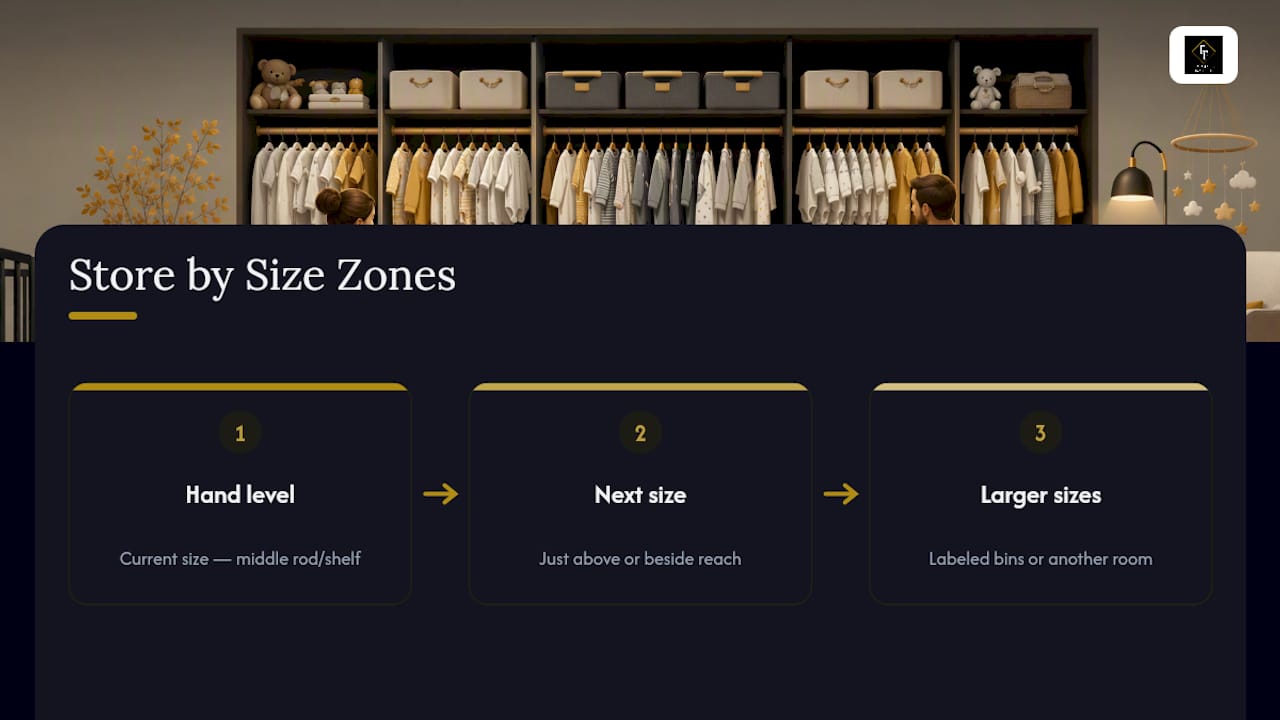
Put the current size at hand-level, whether that means the middle of the closet rod or the shelf you'd reach without stretching. The next size up goes just above or beside it, close enough to grab the week a growth spurt hits. Everything larger moves into labeled bins on higher shelves or in another room entirely.
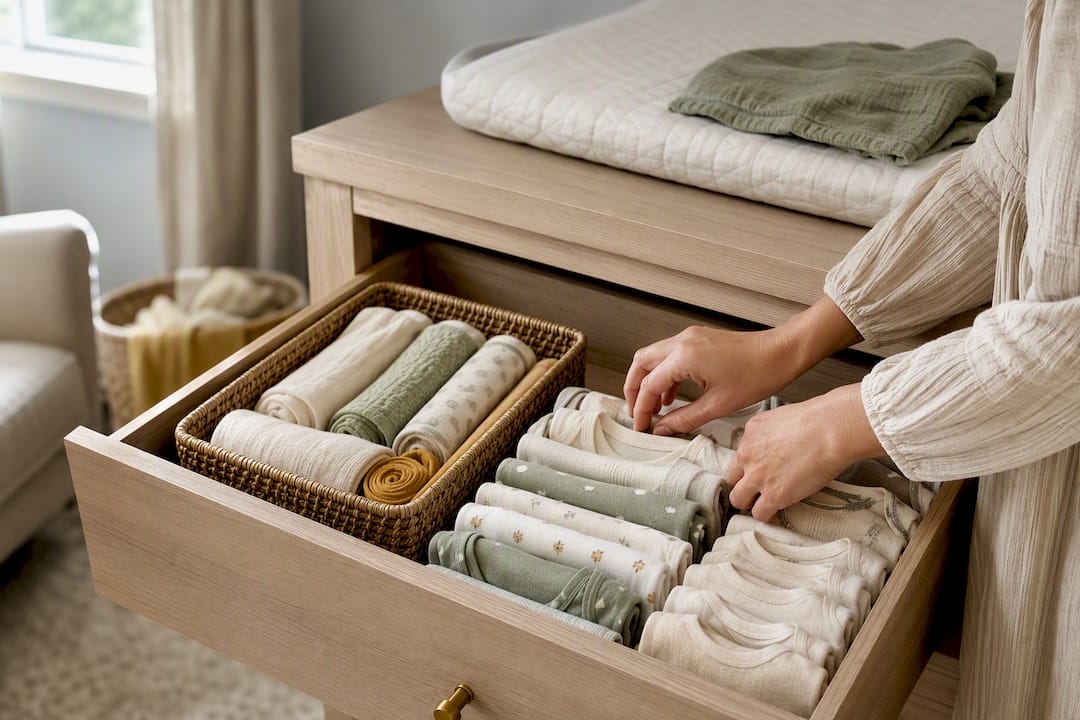
Folding technique matters here too. For drawers, file-fold the KonMari way so every onesie stands upright and visible at a glance instead of buried under a stack. For a closet shelf you're grabbing from quickly during a diaper change, rolling works better than folding flat. Hand-me-downs and outgrown pieces belong in a single, clearly marked bin, not scattered across three different totes.
Getting the Most Vertical Space in a Small Closet
Most nursery closets waste half their height. A single rod at adult-shirt level leaves three or four feet of dead air above it and an empty floor below.
- Install a rod doubler or add a second rod roughly 40 inches below the first, sized for baby and toddler-length hangers, not adult coats.
- Add adjustable shelving above the top rod for folded bins, diaper stock, and anything you don't need daily.
- Mount a hanging shelf organizer for sweaters, burp cloths, and swaddles that don't do well folded flat.
- Decide whether a small dresser belongs inside the closet (great for walk-ins) or in the room, saving the closet purely for hanging storage and bins.
Shelving depth matters more than people expect. Aim for roughly 6 to 8 inches of stack height for onesies and 10 to 12 inches for bulkier items like sweaters or bundled swaddles, and keep your most-used shelf around waist to eye level so you're not reaching overhead with a squirming baby on one hip.
What Bins and Dividers Actually Work for Baby Clothes?
Clear bins let you see contents without opening a lid, which sounds like a win until the bin gets messy and the whole closet suddenly looks cluttered from across the room. Clear storage works best for items that stay naturally tidy, like stacked diaper boxes or folded muslin blankets. For anything that gets pawed through daily, socks, mittens, loose accessories, opaque fabric bins hide the inevitable mess and keep the nursery looking calm.
Drawer dividers earn their keep in the smallest categories. A compartment roughly 3 by 4 inches handles socks and mittens; something closer to 6 by 8 inches suits folded onesies without wasting space. Measure your drawer before ordering, since off-brand dividers rarely match standard dresser dimensions.
- Use opaque bins for socks, mittens, and anything prone to looking messy
- Reserve clear bins for items you rarely touch and want to spot at a glance
- Choose bins with rounded edges and no small detachable hardware
- Look for CPC-compliant, child-safe materials on anything within a toddler's reach
A curated setup like this, a few labeled bins and drawer dividers, typically runs $40 to $50 for a 24-inch closet, which is a fraction of what most parents assume a full closet overhaul costs.
Should You Use the Door and Walls for Storage?
The back of the closet door is some of the most underused real estate in the entire nursery. An over-the-door pocket organizer with individual pockets works well for pacifiers, teething rings, and small grooming items. Assign one item per pocket, one pacifier, one nail file, so nothing gets lost or mixed with something it shouldn't touch.
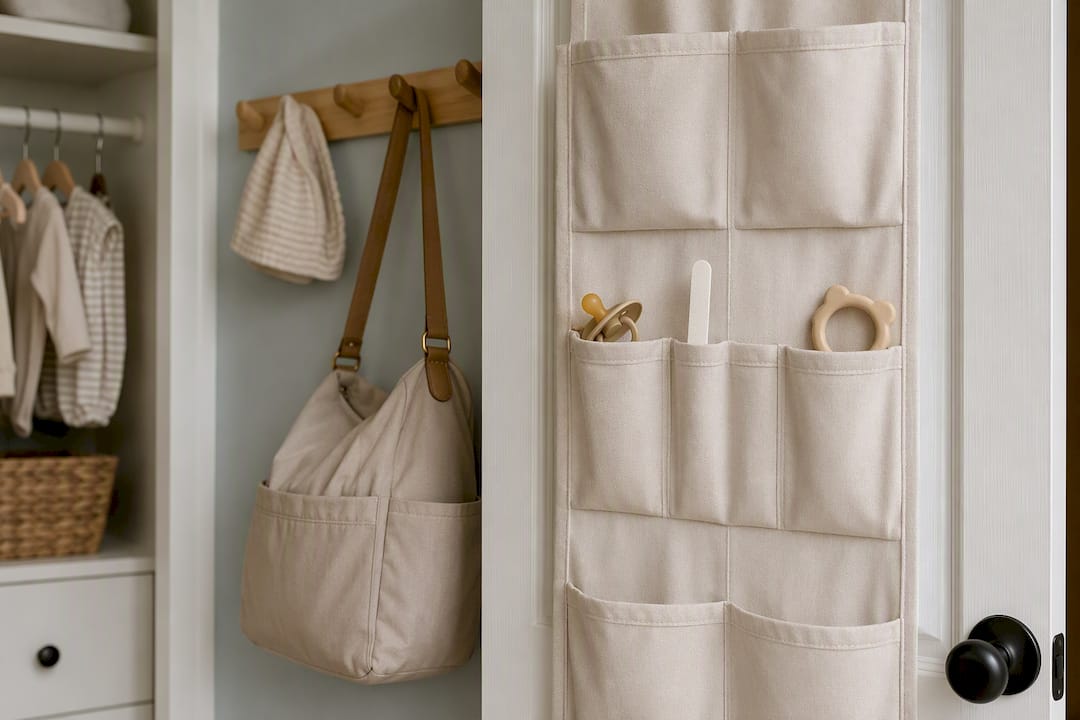
Hooks or a small pegboard on an open wall section handle hats, headbands, and diaper bags that otherwise pile up on the floor. Whatever you mount, secure it into a stud or with proper drywall anchors, and skip anything with sharp edges or small parts that could pull loose once a toddler starts climbing.
Labels, Seasonal Swaps, and a Weekly Tidy Routine
A good closet setup falls apart within a month without a maintenance habit behind it. The fix is simpler than most parents expect.
- Label bins with size plus a short descriptor ("12M sleepers," not just "12M"), placed at eye level so any caregiver, grandparent, sitter, or partner can find things without asking.
- Do a full seasonal swap twice a year, pulling outgrown sizes and rotating in the next range.
- Spend 10 minutes each week returning stray items to their bin and refolding anything that's slipped.
- Keep a dedicated "too small" bin by the closet door so outgrown clothes have one obvious landing spot instead of piling on a chair.
- Set up a simple donation or resale routine so that bin actually empties instead of becoming permanent storage.
Pro Tip: Photograph the finished closet layout and stick a printed copy inside the door. It turns your labeling system into something a tired babysitter can follow at 9 p.m. without texting you questions.
Consistent placement matters as much as the labels themselves. If the diaper bin moves every few months, nobody, including you, will remember where it lives.
Quick Setups for Every Nursery Closet Size
Not every nursery has the same closet, so the right setup depends on what you're working with.
A small reach-in closet needs the fewest pieces: one rod doubler, two to three fabric bins, a drawer divider set, and an over-the-door organizer. That's it. A standard closet can handle a double rod, two shelf-mounted bins, a floor basket for larger items like blankets, and an over-the-door pocket organizer for small essentials. A walk-in gives you room for a dresser inside the closet itself, mixed open shelving, and a labeled keepsake shelf up top for items you're saving, not using.
| Closet type | Core items | Estimated cost | Time to set up |
|---|---|---|---|
| Small reach-in | Rod doubler, 2 to 3 bins, divider set, door organizer | $40 to $50 | 1 to 2 hours |
| Standard | Double rod, 2 shelf bins, floor basket, door organizer | $75 to $120 | 2 to 4 hours |
| Walk-in | Dresser, open shelving, keepsake shelf, bins | $150 to $300 | Half a day |
When a Nursery Closet Needs a Professional Touch
Some households don't have a free weekend to gut a closet, especially when a move, a new baby, or a second child sharing a room is layered on top of everything else. That's where a service like Flawlessly Functional fits in.
Our approach favors tailored systems over generic bins and includes concierge moving management when a closet overhaul happens alongside a relocation. These services often focus on durability and fit rather than a quick, one-size-fits-all install.
What Most Nursery Closet Advice Gets Backward
Most nursery organizing content treats every closet as if it's the same shape, same size, same budget. It isn't. The advice that actually holds up is boring but effective: sort by size, keep what you use daily within arm's reach, and build in a maintenance habit before the closet gets cute with matching bins and coordinated labels.
Where conventional advice falls short is the aesthetic-first trap. Pinterest-perfect nurseries with color-coded everything look great in photos and fall apart in six weeks because nobody accounted for how fast babies grow or how tired parents actually are at 6 a.m. A system only works if it survives sleep deprivation.
Prioritize function first: size sorting, hand-level access, and a rod doubler if your closet is short on hanging space. Add the second rod before you add a fourth decorative bin. Aesthetics matter, and a calm-looking closet does reduce daily stress, but it's the last layer, not the first. Get the bones right, then make it pretty if you have the energy left over.
— Steve
Ready for a Nursery Closet That Stays Organized?
If a weekend project sounds good in theory but unlikely in practice, Flawlessly Functional builds the whole system for you instead of leaving you with a pile of bins and a Saturday you don't have. We handle the sorting, the hardware, the labeling, and the install, and if you're also relocating, our concierge moving management folds packing and unpacking into the same visit.

A typical engagement starts with a consultation where we walk your space and talk through how your family actually uses the closet day to day. From there we build a plan, install the system, and follow up to make sure it's holding up once real life hits it. If a full nursery isn't the only room on your mind, our organizing services cover the rest of the house too. Reach out through our San Antonio home organizing page to get a plan started.
Resources Worth Bookmarking
For deeper reading on specific pieces of this system: MiniMinors's budget nursery closet breakdown, Extra Space Storage's folding and accessibility guide, The Container Store's vertical storage ideas, and, for rod and closet system installs, One Day Doors & Closets in San Antonio.
Sources
- Nursery Closet Organization (Under $50) | MiniMinors
- How to Organize Baby Clothes | Extra Space Storage
- Baby Closet Organization Ideas | The Container Store
- Clear storage guidance | Wayfair
FAQ
How Often Should You Reorganize a Nursery Closet?
Plan on a full seasonal swap twice a year as your baby moves into new sizes, plus a quick 10-minute weekly tidy to keep bins and shelves from drifting into disorder. Between swaps, spot-check the current-size section whenever you notice clothes getting snug.
What's the Cheapest Way to Organize a Nursery Closet?
A basic setup with drawer dividers, two to three fabric bins, and an over-the-door organizer typically runs $40 to $50 for a 24-inch closet. Skip the dresser and the rod doubler until you've confirmed the basic system works for your space.
Should I Use Clear or Opaque Bins for Baby Clothes?
Use opaque bins for anything that gets handled often, like socks or mittens, since clear bins show clutter once contents get shuffled. Clear bins work better for items that stay stacked and tidy, like folded diaper boxes.
Do I Need a Second Closet Rod for a Nursery?
A second rod is worth adding whenever your current rod leaves three or more feet of empty space above it, which is true in most nursery closets. A rod doubler roughly doubles hanging capacity without any construction.
When Does It Make Sense to Hire a Professional Organizer?
Hiring help makes the most sense when you're moving, adding a second child, or simply out of time to tackle the project yourself. Flawlessly Functional builds tailored organizing systems designed to hold up long after the first install.