
Occupied home staging edits and refreshes the furniture already in your house instead of removing everything and installing new pieces, and it works: the tactic sharpens listing photos, helps buyers picture themselves in the space, and gets homes noticed faster. The trade-off is upkeep. You're maintaining a show-ready home while still living your life in it. Simple cases are DIY territory; cluttered rooms, awkward furniture scale, or a tight listing deadline are usually worth handing to a professional stager.
TL;DR:
- Occupied staging is more affordable and less disruptive than vacant staging because it involves editing existing furniture and adding small upgrades rather than full furniture rentals.
- Success depends on clear communication, with homeowners advised to prepare by decluttering, removing personal items, and scheduling quick resets before showings.
- The most effective room-by-room fixes include rearranging furniture for flow, decluttering counters and surfaces, and enhancing lighting and cleanliness to appeal to buyers.
- Costs vary based on the number of rooms needing attention and rental furniture, with a professional often offering a comprehensive plan that manages organizing, styling, and logistics.
- Homeowners should set realistic expectations about editing needs and plan for emotional detachment, especially regarding personal belongings, to facilitate a smooth staging process.
Table of Contents
- What Is Occupied Home Staging, and How Is It Different From Vacant Staging?
- How Does an Occupied Staging Consultation Work?
- Room-by-Room Staging Checklist
- How Do You Declutter and Store Items While Living in a Staged Home?
- What's the Fastest Way to Reset Before a Last-Minute Showing?
- What Does Occupied Staging Cost, and When Should You Hire a Pro?
- How Do You Manage Homeowner Expectations During the Staging Process?
- How Do You Handle Pets During Occupied Home Staging?
- What Lighting and Photography Tips Work Best for Occupied Homes?
- What a Professional Organizer Notices About Occupied Staging
- Ready for a Staging Plan That Fits Your Life?
- Sources
- FAQ
What Is Occupied Home Staging, and How Is It Different From Vacant Staging?
Occupied staging works with what's already in the house. A stager walks through your rooms, removes what's hurting the space, rearranges what's left for better flow, and adds a handful of targeted pieces where something is genuinely missing. Vacant staging starts from an empty shell and installs an entire furniture package, room by room, because there's nothing else to work with.
The choice usually comes down to three things: whether you're still living in the home, whether your current furniture is worth keeping, and what you're willing to spend. If you're staying put through the sale and your sofa, dining set, and bed frames are in decent shape and roughly the right scale for the rooms, occupied staging is the more sensible route. It respects your budget and your daily routine at the same time. Editing existing pieces rather than replacing them is the core mechanic that separates occupied staging from a full install, and it's why the cost usually lands lower.
Stagers commonly lean on a small set of supplemental items to round out a room without a full furniture swap:
- New area rugs to anchor a seating area or hide worn flooring
- Fresh throw pillows and blankets in a neutral, updated palette
- Updated or replacement artwork to depersonalize walls
- A statement mirror or lighting piece where a room feels flat
- One or two rental furniture pieces when a specific item is missing or wrong for the space
Those five categories cover most occupied staging jobs without touching the bigger furniture already in place.
How Does an Occupied Staging Consultation Work?
A professional consultation isn't a single afternoon. It typically breaks into three phases, and knowing what happens in each one helps you show up prepared instead of scrambling. Occupied staging consultations generally follow a pre-consult, consultation day, and post-consult structure, which keeps the process organized for both the stager and the homeowner.
- Pre-consult. Before anyone walks through your door, send photos of the rooms you're most worried about, list your priorities (a quick sale versus top dollar, for example), and decide which rooms actually need attention. Not every room requires a full treatment.
- Consultation day. The stager edits room by room: removing excess furniture, reconfiguring what stays for better flow, swapping accessories, and making sure each space reads clearly on camera. This is also when photo prep happens, since listing photos are often the single biggest driver of showing requests.
- Post-consult. Any rental furniture gets delivered and installed, items pulled from rooms go into storage, and small fixes (a scuffed wall, a loose cabinet handle) get addressed before the listing goes live.
Stagers often phase the work deliberately, tackling primary living areas first and secondary rooms second to keep disruption to your household as low as possible during the process.
Pro Tip: Take your consultation photos in the morning with blinds open and lights on. Stagers can spot lighting and flow problems from photos alone, which means less time spent walking you through issues you could have flagged in advance.
Room-by-Room Staging Checklist
Different rooms carry different weight with buyers, and each one has its own quick fixes.
- Living room. Arrange seating to create a clear conversation area and an obvious walking path. Pull out anything competing for attention, like oversized wall collections or mismatched throw blankets.
- Kitchen. Clear counters down to two or three intentional items, remove magnets and photos from the fridge, and set out one simple place setting or a bowl of fresh fruit.
- Primary bedroom. Swap in neutral, high-quality linens, clear both nightstands to a lamp and a single object each, and edit the closet so it reads as spacious rather than crammed.
- Bathrooms. Fresh towels folded the same way, toiletries tucked out of sight, and any scuff marks or water spots on tile and fixtures wiped clean.
- Entry and curb. Buyers form an opinion before they cross the threshold. Clear the entryway of shoes and coats, add a doormat, and handle quick exterior fixes like trimmed hedges or a swept walkway.
- Home office. Give the room one clear purpose. A desk with a closed laptop and a single stack of books reads as functional; cables, paperwork, and a second desk read as clutter.
Staged homes carry real weight with buyers. The National Association of Realtors reports that staged homes tend to sell faster and often for more than comparable unstaged listings, which is the strongest argument for putting real effort into these room-level details rather than treating staging as an afterthought.
How Do You Declutter and Store Items While Living in a Staged Home?
Editing beats adding almost every time. Practitioners generally recommend an aggressive first pass: remove personal collections, anything blocking a walking path, and anything cutting off natural light, since those three categories do the most damage to how a room photographs and how a buyer reads the space.
A short list of what to tackle first:
- Personal photos, trophies, and collections (buyers need to picture their own life here, not yours)
- Excess furniture that crowds a walking path or blocks a window
- Anything stacked on visible surfaces, like counters, dressers, or bookshelves
- Duplicate items (a second couch, three lamps in one room)
- Anything with strong personal style that won't appeal broadly
For items you're not ready to part with permanently, short-term storage is the answer, not a closet stuffed to the ceiling. Prioritize a storage unit or a moving company's short-term storage option for bulky items, and keep only what you use daily accessible in the home. A luxury home organizing service can help sort what leaves, what stays, and what goes into storage without the process turning into weeks of decision fatigue.
Pro Tip: Photograph each room before you start editing. It gives you a "before" reference so you're not second-guessing whether a space actually needs more paring down as you go.
What's the Fastest Way to Reset Before a Last-Minute Showing?
Showings booked with two hours' notice are a fact of life in occupied staging, and a repeatable routine takes the panic out of them. A short quick-reset routine of roughly 15 to 20 minutes is the industry standard for staying show-ready without living like a museum every single day.
- Make every bed and close closet doors.
- Clear kitchen and bathroom counters into one designated bin or drawer.
- Corral toys, pet bowls, leashes, and litter boxes into a closet or the car.
- Run a quick wipe on bathroom and kitchen surfaces.
- Open blinds and turn on lamps in main living areas.
- Light a low-scent candle or run an air purifier for a minute, then turn it off before buyers arrive.
Keep a bin by the door for pet and kid items specifically. Grabbing one bin on the way out is faster than chasing loose items through five rooms.
What Does Occupied Staging Cost, and When Should You Hire a Pro?
Cost tracks with how much work the space needs, not a flat rate per square foot. The main drivers are how many rooms need attention, how much site time the stager spends editing and rearranging, and whether the job requires rental furniture pieces to fill gaps.
Occupied staging is generally less expensive than a full vacant install since you're not renting furniture for every room, but pricing still varies widely depending on your market and how much rental furniture the job requires. Treat any quote as scoped to your specific home rather than assuming it matches a number you saw elsewhere.
A few signals that a DIY approach probably won't get you the result you want:
- Your furniture is noticeably oversized or undersized for the rooms it's in
- You have more than a light week's worth of decluttering to do before the space photographs well
- You're listing within days and don't have time to test what works
- Your rooms have awkward layouts that need a trained eye to solve
Given the NAR data on faster sales and stronger offers for staged homes, most sellers find that a professional consultation pays for itself, particularly when the home has more than one or two rooms that need real work.
How Do You Manage Homeowner Expectations During the Staging Process?
The biggest friction in occupied staging isn't furniture placement. It's emotional attachment to belongings, and that attachment is often the real obstacle standing between a cluttered room and a photo-ready one. Homeowners tend to underestimate how much editing actually needs to happen and overestimate how much a room can hold while still reading as spacious to a buyer.
Set expectations early and specifically. Walk through what "neutral" actually means for your home: not beige everything, but removing anything so personal or so specific to your taste that a buyer can't picture their own furniture in the room. Agree in advance on what's negotiable (accessories, artwork, rugs) and what's not (structural furniture you need daily, like your only dining table).
It also helps to separate staging decisions from moving decisions. Items pulled for staging don't have to be donated or sold immediately. Framing removal as "temporary relocation to storage" rather than "get rid of it" makes the process far less emotionally loaded, and it tends to speed up decision making because nothing feels permanent. A moving management concierge service exists partly for this reason: it separates the emotional weight of parting with things from the physical task of packing and storing them.
Revisit priorities halfway through the process. What felt essential to keep out on day one often feels unnecessary by week two, once the homeowner has lived with the edited version of the room.
How Do You Handle Pets During Occupied Home Staging?
Pets complicate staging in three predictable ways: odor, visible gear, and the risk of damage during showings. None of them require rehoming the dog, but all three need a plan.

Odor control starts with deep-cleaning carpets, upholstery, and pet bedding before listing photos happen, not after a buyer complaint. Litter boxes and pet beds should live somewhere that isn't visible or smellable from main living areas, ideally a closed laundry room or garage during showings. A quick air purifier run and cracked windows before photography day handle what deep cleaning misses.
Visible gear is the easier fix. Food bowls, leashes, toys, and scratching posts all go into a single bin that travels with you and the pet during showings. Keep that bin by the door alongside your other quick-reset items so grabbing it becomes automatic.
For showings themselves, plan to have pets out of the house entirely when possible. A dog barking at strangers or a cat darting underfoot doesn't just distract buyers, it can make a home feel harder to manage than it is. If removing the pet isn't practical, confine them to one closed room farthest from the main showing areas with a note on the door for the agent.
Scuffed baseboards, chewed corners, and pet stains on flooring are worth addressing before listing, since these details show up clearly in both photos and in-person walkthroughs.
What Lighting and Photography Tips Work Best for Occupied Homes?
Listing photos are often the first impression a buyer gets, and lighting decisions made before the shoot matter more than any prop you add afterward. Open every blind and curtain in the house before photography, even in rooms that feel more private day to day. Natural light photographs better than any staged lamp arrangement, and darker rooms read as smaller and less inviting on a screen.
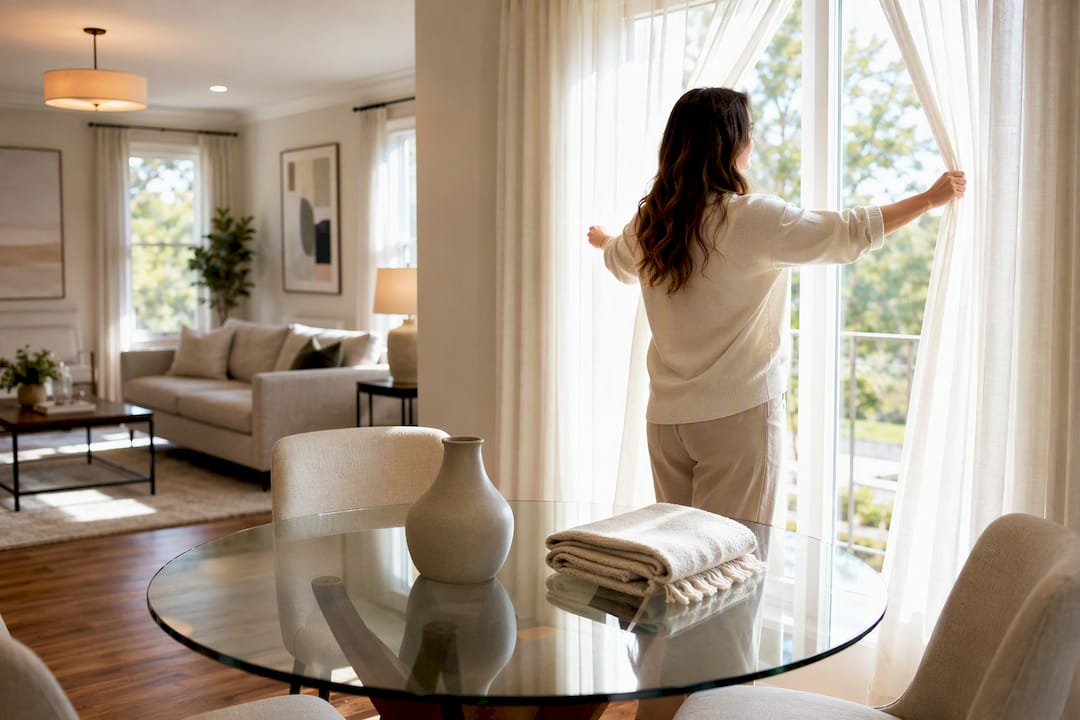
Turn on every interior light, including closet lights and under-cabinet fixtures in the kitchen, even during a daytime shoot. Mixed lighting sources even out shadows that a single light source leaves behind. Swap any bulbs that have drifted toward yellow or dim over time. Consistent, bright white light across every room keeps a listing gallery feeling cohesive instead of patchwork.
Shoot at the time of day when each room gets the best natural light, which sometimes means photographing the primary bedroom in the morning and the living room in late afternoon rather than doing the whole house in one pass. This is one area where occupied homes have a real advantage over vacant ones: you already know how the light moves through your house at different hours, and you can plan around it.
Clear reflective surfaces (mirrors, glass tables, dark screens) of photographer and camera equipment reflections before each shot, and pull chairs slightly away from tables to make rooms read larger in wide-angle shots.
What a Professional Organizer Notices About Occupied Staging
Editing beats adding almost every time. In one home, pulling half the items off a bookshelf and grouping the rest by color did more for how the room photographed than any new furniture would have. Flawlessly Functional works this way across San Antonio, pairing organizing know-how with styling instincts, and clients consistently reflect that in a 4.9 Google rating. Selling while living in your home is genuinely hard on your routine. Give yourself grace on the days it feels like too much.
— Steve
Ready for a Staging Plan That Fits Your Life?
Some staging companies hand you a checklist and a furniture invoice, then leave you to manage the rest of your life around it. A company that also handles editing, organizing, and styling can provide one point of contact instead of multiple vendors juggling your calendar.

A consult starts with a walkthrough of your home, a conversation about your timeline and priorities, and a plan that covers which rooms need staging attention and which just need a good edit. If you're facing more clutter than time, luxury home organizing can clear the decision fatigue before a stager ever walks in. If you need somewhere for displaced furniture and boxes to go without renting a separate storage unit, the moving management concierge handles that logistics piece. And for the staging itself, from furniture edits to accessory swaps to photo-day prep, the interior styling and home staging service covers the whole process. Book a consultation to get a plan specific to your home, not a generic checklist.
Sources
For more detail on the ideas covered here: staging while living in your home, the consultation process breakdown, NAR's staging data, and interior finish upgrades that can improve how a room reads to buyers.
- How to stage a house while living in it — HomeLight
- Step-by-step guide to occupied home staging consultations — Staging Studio
- 2024 home buyers and sellers generational trends — NAR
FAQ
How Much Should Staging a House Cost?
Cost depends on how many rooms need work, how much rental furniture is required, and how much site time the stager needs, so there's no single flat rate. Occupied staging tends to run less expensive than a full vacant install since most of your furniture is already in place. Flawlessly Functional's interior styling and staging pricing is available on request after a walkthrough of your home.
What Should You Avoid When Staging a House?
Avoid over-personalizing rooms with heavy collections, family photos, or bold color choices that narrow the room's appeal to buyers. Also avoid blocking natural light or walking paths with excess furniture, since both hurt how spacious a room feels in person and in photos.
Is Paying for Staging Worth It?
For most sellers, yes. NAR reports that staged homes tend to sell faster and often for more than comparable unstaged listings, and occupied staging delivers much of that benefit without the cost of a full furniture install.
What Is the Cheapest Way to Stage a House?
The lowest-cost approach is editing what you already own: removing excess furniture, clearing clutter, depersonalizing walls, and rearranging for better flow, all before spending on new pieces. Adding a few inexpensive items like rugs, pillows, or artwork usually delivers more visible improvement per dollar than furniture rentals.
Do I Need to Move Out to Stage My Home?
No. Occupied staging is built specifically for sellers who stay in the home through the sale, using upkeep habits like a quick daily reset to keep rooms show-ready between showings.