
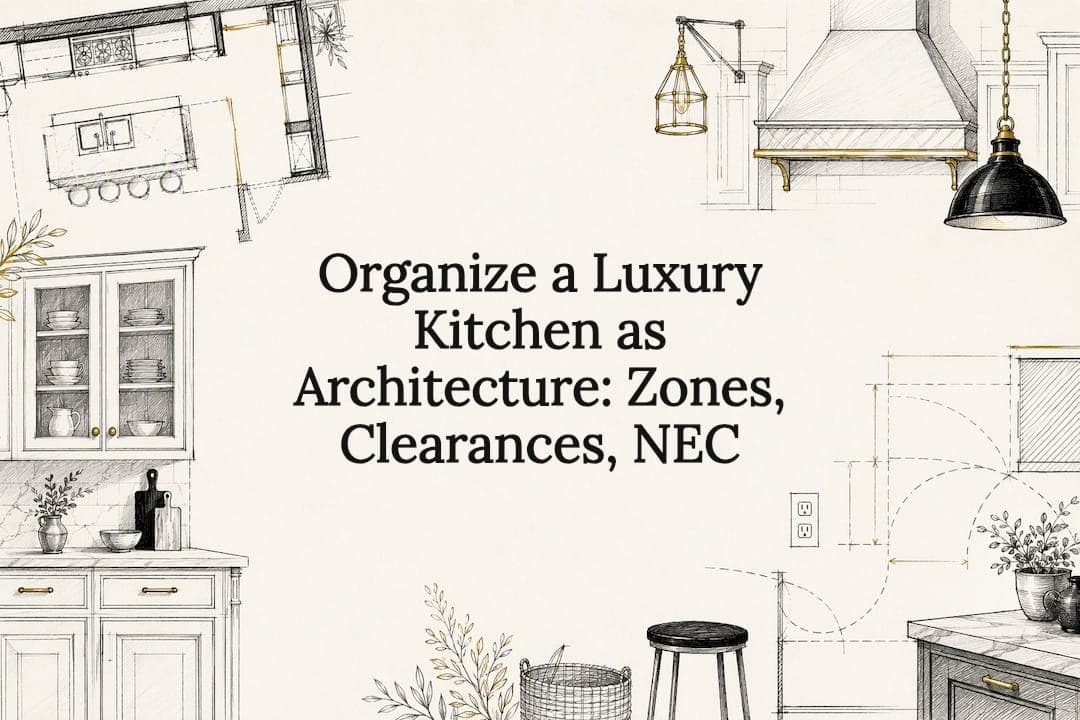
Organizing a luxury kitchen is fundamentally an architectural decision, not a shopping list. Storage gets mapped to specific work zones, and the systems that hold your gear disappear into millwork rather than sitting on countertops. The highest-impact moves are tall pantry cabinets, full-extension drawers, and panel-ready appliances that read as cabinetry, not machines.
TL;DR:
- Tall pantry cabinets are essential for vertical dry storage and can be customized to match existing cabinetry for a seamless look.
- Proper zone placement reduces walking distance and improves workflow, with about 48 inches of clearance recommended for main aisles.
- Built-in features like concealed appliance garages and glass-front display cabinets help maintain a clean, uncluttered aesthetic.
- Full-extension, soft-close drawers with custom inserts protect fragile items and keep everyday essentials organized and out of sight.
- Sustainable material choices such as FSC-certified wood and recycled countertops support durability and environmental goals without sacrificing style.
Table of Contents
- What Is the Zone System for Organizing a Luxury Kitchen?
- Which Built-In Storage Features Belong in a High-End Kitchen?
- What Drawer and Cabinet Systems Keep Everything Hidden?
- How Do Materials and Finishes Support an Organized Look?
- How Should You Plan Lighting and Electrical for a Luxury Kitchen?
- What Daily Habits Keep a Luxury Kitchen Organized?
- How Does Flawlessly Functional Bring These Principles to Life?
- What Smart Technology Actually Helps With Kitchen Organization?
- How Do You Store Fine China, Silverware, and Specialty Coffee Gear?
- What Ergonomics and Accessibility Features Matter Most?
- How Can a Luxury Kitchen Use Sustainable Materials?
- A Closing Thought on Organization as Architecture
- Ready to Organize Your Luxury Kitchen?
- Sources
- FAQ
What Is the Zone System for Organizing a Luxury Kitchen?
Forget the old work triangle. Modern kitchen planning divides the room into five functional zones: store, prep, cook, clean, and serve. Each zone gets its own dedicated storage, positioned exactly where the task happens, so a home chef stops walking across the kitchen mid-recipe to find a mixing bowl. This zone based approach outperforms the traditional triangle in kitchens with more than one cook, because it lets multiple people work in parallel without colliding.
The store zone sits near the entry, close to the pantry and refrigerator. Prep needs counter space adjacent to both storage and a water source. Cook obviously centers on the range and hood, with cookware and oils within arm's reach. Clean clusters the sink, dishwasher, and trash pull outs together. Serve lives near the dining path, holding china, glassware, and serving pieces.
Clearances matter more than most homeowners realize. Designers recommend roughly 48 inches for a working aisle, enough for two people to pass or for a cabinet and appliance door to open fully without a collision. Correct proportions do more for a luxury kitchen's feel than any single finish choice.
Zoning also fights clutter directly:
- Items return to their zone instead of landing on the nearest open counter.
- Entertaining flows better because guests and staff can use serve and clean zones without crossing into the cook zone.
- Multiple cooks can work simultaneously without a bottleneck at one sink or one prep surface.
Which Built-In Storage Features Belong in a High-End Kitchen?
Built-ins are what let a kitchen stay organized without looking organized. Nationally, 76% of renovating homeowners now include built-in storage features, and pantry cabinets top the list at 47%, followed by beverage stations at 24% and wine fridges at 17%.
Tall pantry cabinets make sense for most kitchens because they concentrate dry goods vertically without eating floor space. A true walk-in pantry or butler's pantry becomes worthwhile once a household regularly entertains or needs a staging area away from the main cooking zone.
A few specifics worth planning for early:
- Beverage stations with undercounter drawers keep morning routines out of the main workflow.
- Wine columns should sit away from heat sources and get their own dedicated climate zone.
- Concealed appliance garages hide small appliances behind a tambour or lift door, right at counter height.
- Panel-ready refrigeration and dishwashers take cabinet fronts so the run of cabinetry reads as continuous, not interrupted by stainless steel.
A custom millwork partner can build these features to match your existing cabinetry exactly, which matters more than people expect once you're trying to hide an entire refrigerator behind a door front.
What Drawer and Cabinet Systems Keep Everything Hidden?
The drawers do more organizational work than any other single element in a luxury kitchen. High-end builds specify full-extension, soft-close drawers with hardwood or dovetail construction, which holds up to daily use far longer than particleboard boxes with basic glides. Interior fittings then determine whether the drawer actually functions.
- Felt-lined stemware drawers protect crystal and fine glassware with cutouts sized to the exact piece, preventing chips during the inevitable rushed unloading after a dinner party.
- In-drawer knife docks replace the countertop block, keeping blades out of sight and out of reach of small hands.
- Vertical spice pull-outs put every jar at eye level in a narrow cabinet, which beats a lazy Susan for anything used mid recipe.
- Modular dividers adapt to sheet pans, cutting boards, and small appliances as your inventory changes over the years.
As a rule, anything fragile or used daily belongs in a drawer with a custom insert. Anything meant to be seen, like a curated stack of serving platters or a collection of cookbooks, belongs behind glass or on open shelving instead. High-end interior fittings exist specifically to protect the pieces you'd never risk in a standard cabinet.
How Do Materials and Finishes Support an Organized Look?
Flush overlay panels and consistent reveals are what make a kitchen look uncluttered even when it's fully stocked. When every cabinet door sits flush with a uniform gap, the eye reads the wall as one continuous surface instead of a row of individual boxes, and that visual calm is what people actually mean when they say a kitchen looks "luxury."
Countertops and backsplashes reinforce the same effect. A full-height slab backsplash in a material that matches or complements the counter eliminates the grout lines and seams that draw attention to a busy wall. Durable stone or quartz surfaces also resist the daily wear that would otherwise force visible repairs or replacement.
A few finish decisions worth getting right the first time:
- Choose a transitional palette (warm whites, taupes, soft woods) that won't look dated in ten years, unlike a trend-driven color.
- Match cabinet hardware finish across the whole kitchen, including appliance pulls, so nothing draws an odd eye.
- Reserve open shelving or glass fronts for one curated display zone rather than scattering them throughout.
- Pick a hood or range finish that can age with light patina rather than showing every fingerprint.
How Should You Plan Lighting and Electrical for a Luxury Kitchen?
Luxury kitchens run four lighting layers: task lighting under cabinets for prep work, ambient ceiling light for general use, accent lighting inside glass cabinets, and decorative fixtures over an island. Aim for 90+ CRI bulbs and a consistent color temperature across every layer, usually 2700K to 3000K, with dimming on task and ambient circuits.
Electrical planning has changed recently, too. Updated NEC guidance is pushing island receptacles away from vertical side panels toward countertop-integrated pop-up outlets, which stay flush until needed and disappear when not. Bring your electrician and cabinet maker together during the design phase, not after cabinets are ordered, so cord routing and pop-up placement get built in rather than retrofitted.
What Daily Habits Keep a Luxury Kitchen Organized?
Systems only work if someone runs them. A five-minute nightly reset, wiping counters, loading the dishwasher, and returning anything out of place, prevents the slow creep that turns a beautiful kitchen chaotic by Thursday.
- Do a nightly five-minute counter clear before bed.
- Run a Sunday reset: check pantry stock, wipe down high-touch cabinet fronts, restock the beverage station.
- Designate one landing zone, ideally near the entry or garage door, for mail, deliveries, and grocery bags before they hit the counter.
- Book a seasonal organizer refresh or a concierge unpacking session after major holidays or a big shopping trip.
Pro Tip: Keep an empty bin or basket in your landing zone specifically for items that don't have a home yet. Sorting that single bin once a week is far easier than tracking down stray items scattered across three rooms.
How Does Flawlessly Functional Bring These Principles to Life?
These systems are built into real kitchens from the initial planning stages to ensure functionality from day one. The team's Luxury Home Organizing service works through a collaborative process, mapping zones to your actual cooking habits before a single drawer insert gets ordered, backed by a 4.9 Google rating from clients who've lived with the results.
The company treats speed as the wrong metric entirely. Their approach favors experience over rushed timelines, coordinating cabinetry, lighting, and electrical decisions early so the finished kitchen avoids the common mistake of gorgeous cabinets with no real plan for where the coffee gear lives. That coordination is exactly what prevents the retrofit headaches homeowners hit when electrical and millwork get planned separately.
What Smart Technology Actually Helps With Kitchen Organization?
Smart kitchen tools earn their place only when they reduce decisions, not add another app to manage. Inventory tracking, whether through a smart refrigerator's internal camera or a simple barcode scanning habit, tells you what's actually in the pantry before you shop, cutting down on the duplicate jars of cumin that clutter every spice drawer eventually.
Smart refrigerators with interior cameras let you check contents from a phone while standing in the grocery aisle, which sounds like a gimmick until it saves you from buying milk you already have. Voice-activated controls handle the small stuff, setting timers, converting measurements, adding items to a shopping list, without forcing you to touch a screen with sauce-covered hands.
Automated lighting and climate zones for wine storage also count as organizational technology, even though they don't look like it. A wine column with app-based temperature monitoring protects an investment collection the same way a fireproof safe protects documents.
The mistake most people make is over-automating. A voice assistant on every appliance and a sensor on every drawer creates its own kind of clutter, just digital instead of physical. Choose two or three integrations that solve a real recurring friction point, inventory tracking for a large pantry, climate control for wine, maybe voice control at the main prep station, and skip the rest. A kitchen with fewer, well-chosen smart features feels calmer than one wired for everything.
How Do You Store Fine China, Silverware, and Specialty Coffee Gear?
Specialty items need storage built around their exact dimensions, not generic shelving. Fine china calls for padded, adjustable shelving in a display or butler's pantry cabinet, with plate holders that keep pieces from touching and chipping during the daily jostle of a busy household.
Silverware deserves a lined drawer insert sized to the specific flatware set rather than a one-size-fits-all tray. Formal sets used only a few times a year belong in a felt-lined chest inside a dedicated cabinet, while everyday flatware stays in an easily accessible drawer near the dishwasher.
Specialty coffee setups have exploded in popularity, and they deserve their own micro-zone. A dedicated coffee station with a built-in grinder, pull-out shelf for the espresso machine, and drawer organizers for pods, filters, and beans keeps that entire ritual contained instead of sprawling across the main counter. Pair it with a small water line hookup if your machine supports one, so it doesn't compete for sink access during morning rush.

The same logic applies to any collection: label makers, specialty knives, a stand mixer with a dozen attachments. Each deserves a purpose-built drawer or cabinet insert sized to the actual pieces, not a generic bin where things get lost. That precision is what separates a kitchen that merely has storage from one that's actually organized around how you live in it.
What Ergonomics and Accessibility Features Matter Most?
Adjustable shelving is the single easiest accessibility upgrade, letting pantry and cabinet interiors shift as your needs change, whether that's a growing family, a knee injury, or simply wanting the everyday plates lower and the seasonal serveware higher. Pull-out shelves and drawers under counters bring items forward instead of forcing a reach and bend to the back of a deep cabinet.

Toe-kick drawers, the thin drawers built into the base of cabinetry near the floor, add storage for baking sheets or step stools without sacrificing usable cabinet space above. Lowered counter sections at 30 to 32 inches instead of the standard 36 support seated food prep or shorter household members, and they work particularly well near a baking station.
Lever-style cabinet hardware and touch-to-open drawer fronts reduce the grip strength needed to access storage, which matters for aging homeowners planning to stay in their home long term. D-shaped pulls are easier to grasp than small knobs for anyone with arthritis or limited dexterity.
Universal design principles also shape appliance placement. Wall ovens set at counter height, rather than below the counter, eliminate bending to lift a heavy dish. Dishwasher drawers positioned higher than a standard under-counter unit reduce back strain during daily loading and unloading. None of these choices look "accessible" in the finished kitchen. They just look thoughtfully designed, which is the whole point of building accessibility into architecture rather than retrofitting it later.
How Can a Luxury Kitchen Use Sustainable Materials?
Sustainable organization starts with materials that last decades instead of years. FSC-certified wood cabinetry, low-VOC finishes, and formaldehyde-free plywood boxes all reduce environmental impact without sacrificing the custom look that defines a high-end kitchen.
Reclaimed wood works beautifully for open shelving or a butler's pantry accent wall, adding character while keeping virgin lumber demand down. Recycled glass countertops and terrazzo surfaces made from stone waste offer the same visual weight as quarried stone with a smaller footprint.
For interior fittings, look for drawer inserts and organizers made from bamboo or recycled aluminum rather than standard plastic, which degrades and needs replacement far sooner. Cork-lined drawers, less common but growing in luxury applications, resist moisture and cushion glassware naturally without synthetic padding.
Water and energy efficiency count as organizational choices too. A well-planned recycling and composting zone, built into cabinetry rather than added as an afterthought bin, keeps sorting effortless and prevents the countertop pile of items waiting to be dealt with. Induction cooktops and ENERGY STAR appliances reduce the kitchen's operating footprint while fitting seamlessly into the panel-ready aesthetic already discussed.
None of this requires sacrificing the calm, uncluttered look a luxury kitchen is known for. Sustainable choices simply extend the same architectural precision to material sourcing, so the kitchen that looks timeless in photos also holds up structurally and environmentally for the next thirty years.
A Closing Thought on Organization as Architecture
The best luxury kitchens are planned like buildings, not decorated like showrooms. Get the zones, clearances, and built-ins right at the architectural stage, and daily life gets easier, not just prettier.
— Steve
Ready to Organize Your Luxury Kitchen?
You've seen what zone-based planning and concealed built-ins can do on paper. Flawlessly Functional turns that plan into a working kitchen, starting with Luxury Home Organizing that maps every drawer, pantry cabinet, and beverage station to how your household actually cooks and entertains. If your kitchen project is tied to a relocation, the Moving Management Concierge service handles packing, unpacking, and setup so your new kitchen is organized from the first day, not six months later.

The process starts with a consultation, either in person or over a video call, where the team walks through your current kitchen, discusses pain points, and identifies which zones need the most work. From there, expect a site visit to take precise measurements before any drawer inserts or pantry systems get designed. Reach out through the Flawlessly Functional site to schedule that first conversation and see what a kitchen built around your actual routine could look like.
Sources
FAQ
What Are the Must Haves for a Luxury Kitchen?
The non-negotiables are zone-based storage, full-extension soft-close drawers, and at least one built-in feature like a pantry cabinet or beverage station. Houzz's kitchen trends research found pantry cabinets are the single most requested built-in feature among renovating homeowners, followed by beverage stations and wine fridges.
What Is the 3x4 Kitchen Rule?
The 3x4 rule generally refers to keeping key work zones within roughly three to four feet of each other so a cook isn't walking long distances between the sink, range, and prep counter. Definitions of this rule vary somewhat by designer, but the core idea supports the same zone-based logic covered above: storage and appliances should sit close to where they're actually used.
How Do You Make a Kitchen Look Luxury?
Consistency does more than expensive materials. Flush cabinet panels, matched hardware finishes, a slab backsplash, and layered lighting at 90+ CRI create the calm, uncluttered look that reads as high-end, according to designer guidance on luxury kitchen proportions. A well-proportioned layout with correct aisle clearances matters more than any single splurge finish.
Where Should Plates and Cups Go in a Kitchen?
Everyday plates and cups belong in the serve zone, ideally in a cabinet near the dishwasher and dining path so unloading and table setting both take the shortest path. Fine china and rarely used pieces are better suited to a padded, adjustable-shelf cabinet in a butler's pantry or display area, away from daily traffic.
How Much Does It Cost to Organize a Luxury Kitchen With a Professional?
Pricing depends on kitchen size, the number of zones involved, and whether the project includes a full pantry buildout or specialty storage. Flawlessly Functional provides project-specific quotes after an initial consultation, so current pricing details are available directly on their Luxury Home Organizing page.