

Professional packers typically run $50 to $100 per hour per person, with most full-service jobs landing between $600 and $2,500 depending on home size and how much stuff you own. Materials are sometimes bundled into that price and sometimes billed on top. The sample estimates below break costs down by home size so you can budget with real numbers instead of guessing.
TL;DR:
- Item density, such as full closets or storage areas, affects packing costs more than home size or square footage.
- Packing specialty items like artwork or pianos adds significant fees on top of standard labor estimates.
- Booking during peak season or with short notice can increase costs by 20% to 30%, so planning ahead helps save money.
- In-home walkthroughs provide more accurate quotes by revealing actual content density, avoiding inflated estimates from virtual assessments.
- Using hybrid packing methods or decluttering beforehand can substantially reduce total costs, especially when handling fragile or valuable possessions.
Table of Contents
- Packing Services Cost: Typical Ranges and Quick Budgeting Numbers
- How Packing Companies Charge: Hourly vs. Flat-Rate vs. Per-Box
- What Actually Drives Your Packing Quote Up or Down
- Sample Packing Estimates by Home Size
- Packing Materials and the Extras That Sneak Into Your Bill
- Realistic Ways to Cut Packing Costs Without Cutting Corners
- Getting Accurate Quotes: What to Ask Before You Book
- Behind This Guide: Local Moving Expertise From Flawlessly Functional
- Why Item Density Beats Square Footage Every Time
- A Calmer Way to Handle Your Next Move
- Sources
- FAQ
Packing Services Cost: Typical Ranges and Quick Budgeting Numbers
If you want a single number to plan around, here it is: most homeowners pay somewhere between $280 and $2,200 or more for professional packing, scaled to the size of the home and the density of belongings inside it. Hourly rates for a single packer generally run $25 to $100, with $60 to $80 an hour being the number you'll see quoted most often by companies operating in mid-sized metro markets.
That hourly figure multiplies fast once you add crew members. A two-person team at $70 an hour isn't $70. It's $140 an hour combined, which is why total job cost matters more than the per-hour rate when you're comparing packing service quotes.
Full-service packing averages break down roughly like this:
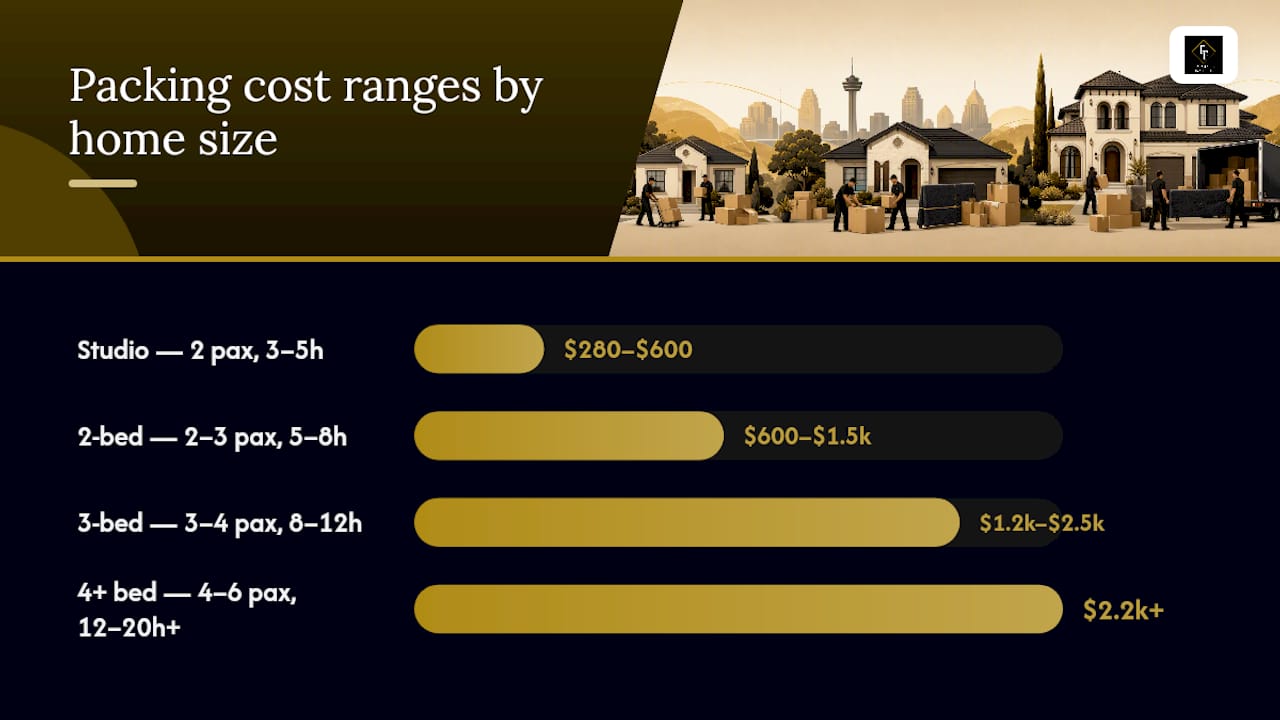
- Studio or 1-bedroom: $280 to $600
- 2-bedroom home: $600 to $1,500
- 3-bedroom home: $1,200 to $2,500
- 4+ bedroom or larger homes: $2,200 and up, sometimes well beyond depending on inventory
Location moves these numbers around too. Packers in Dallas, Houston, or San Antonio tend to bill closer to the middle of the national range, while packing service pricing in New York City, San Francisco, or Boston often runs 20% to 40% higher because of labor costs and higher overhead for moving companies operating there.
Timing matters just as much as geography. Book during May through September, or on a weekend, and expect a premium of 20% to 30% over off-peak pricing. Every range above is a starting point, not a promise. The only way to know your real number is an itemized quote based on your actual home and move date.
How Packing Companies Charge: Hourly vs. Flat-Rate vs. Per-Box
Most companies price packing services one of three ways, and each one shifts risk between you and the crew.
- Hourly billing. You pay per packer, per hour, and the meter runs until the job's done. This rewards efficient crews and can punish you if the job runs long. Always ask whether the quoted rate is per packer or per crew. A "$70/hour" quote for a two-person team means something very different than $70 total.
- Flat-rate pricing. The company walks your home (in person or virtually), estimates total time and materials, and gives you one number. This protects against surprises, though it can run slightly higher than hourly if your crew turns out to be faster than estimated.
- Per-box pricing. Less common for full-service jobs, but sometimes used for partial packing. You pay a set fee per box type packed, which works well if you're only handing off your kitchen or a few fragile rooms.
Flat-rate and per-box structures generally require an in-home or virtual walkthrough before the company will commit to a number, because guessing at inventory from a square-footage figure alone is unreliable.
The standard formula behind almost every quote: (hourly rate × number of packers × hours) + packing materials + travel or specialty fees. Every company arrives at your total this way, even when they present it as a single flat number. Knowing the formula lets you back into whether a flat-rate quote is actually competitive.
What Actually Drives Your Packing Quote Up or Down
Home size sets a baseline, but it's rarely the biggest factor in your final bill. Item density, how full your closets, garage, and shelves actually are, tends to matter more than square footage. A sparsely furnished 2,000 square foot home can pack up faster than a cluttered 1,200 square foot one packed floor to ceiling with books, kitchenware, and collectibles.
Pro Tip: Before requesting quotes, do a five-minute walkthrough of your own home and count "dense zones," rooms with full closets, bookshelves, or storage bins. That number predicts your packing time better than your listed square footage does.
Beyond density, several other factors swing pricing:
- Fragile and specialty items. Artwork, pianos, wine collections, and antiques often require custom crating, which adds a separate line-item fee on top of standard hourly packing.
- Access challenges. Stairs, no elevator, long carries from the truck to your door, or tight parking all slow crews down and can add time-based charges.
- Timing and notice. Packing during peak season or booking with less than a week's notice tends to trigger premium pricing from most movers.
- Regional labor rates. What a crew charges in San Antonio differs from what the same size job costs in Chicago or Los Angeles, purely based on local wage rates.
- Travel fees. Some companies charge a flat trip fee to get the crew and truck to your address, separate from the hourly packing rate.
None of these factors are surprises to an experienced crew. They should show up as separate line items on your quote, not buried into a vague "estimated total."
Sample Packing Estimates by Home Size
Numbers help more than ranges when you're trying to actually budget, so here's what realistic crew hours and totals look like across common home sizes. These assume a moderately furnished home, not a minimalist apartment or a hoarder's dream.
Studio or 1-bedroom apartment Crew of 2 packers, 3 to 5 hours, materials often included. Typical total: $280 to $600.
2-bedroom home or townhouse Crew of 2 to 3 packers, 5 to 8 hours. Typical total: $600 to $1,500, materials sometimes included, sometimes billed separately.
3-bedroom home Crew of 3 to 4 packers, 8 to 12 hours across one or two days. Typical total: $1,200 to $2,500, with materials frequently itemized apart from labor.
4+ bedroom or larger home Crew of 4 to 6 packers, 12 to 20+ hours, often spread across two days. Typical total: $2,200 and up, with high-end homes carrying dense collections easily pushing past $3,500 once specialty crating and full material kits get added.
These are baseline assumptions for full-service packing, meaning the crew packs everything. Partial packing (just the kitchen, or just fragile items) runs significantly less because you're paying for a fraction of the hours. On the flip side, homes with extensive collectibles, wine cellars, home offices full of electronics, or large art collections routinely blow past these ranges regardless of square footage, because density and specialty handling drive the real cost, not the number of bedrooms.
Packing Materials and the Extras That Sneak Into Your Bill
Materials are where a lot of quotes get murky. Some companies fold supplies into the hourly or flat rate. Others itemize every box and roll of tape separately, which can add several hundred dollars to your total depending on home size, generally $180 on the low end up to $750 or more for a larger home with a full kit.
Typical material costs you should expect to see on a quote:
- Standard moving boxes (small, medium, large): $1 to $6 each
- Dish pack (heavy-duty box for kitchenware): $6 to $10 each
- Wardrobe boxes: $10 to $20 each
- Packing paper and bubble wrap: $20 to $50 per roll or bundle
- Custom crating for art, mirrors, or furniture: $75 to $300+ per item, depending on size
Always ask directly whether materials are included in your quote or billed separately. Supplying your own boxes can shave a modest amount off the total, but it also shifts packing time back onto you and can slow the crew down if boxes aren't packing-grade.
Realistic Ways to Cut Packing Costs Without Cutting Corners
You don't have to choose between paying full price or doing everything yourself. A hybrid approach usually gets you the best value.
- Hand off only what's worth protecting. Let pros handle fragile, heavy, or awkward items, artwork, electronics, glassware, while you pack clothes, books, and everyday items yourself. This alone can cut hours off the quote.
- Move during the off-season. Booking October through April, or on a weekday, sidesteps the 20% to 30% peak-season premium most companies apply between May and September.
- Supply your own basic boxes. Save the professional-grade materials budget for dish packs and wardrobe boxes, and use your own boxes for books, linens, and closet items.
- Bundle services. Some companies discount packing when it's bundled with the actual move, rather than booked as a standalone service.
- Get multiple itemized quotes. Comparing three quotes side by side, using the same formula, hourly rate × packers × hours + materials + fees, usually reveals which company is padding its number.
Pro Tip: If you're downsizing or decluttering before a move, doing that work first can shrink your packing quote significantly, since crews bill by volume and density, not by square footage. A lighter home packs faster.
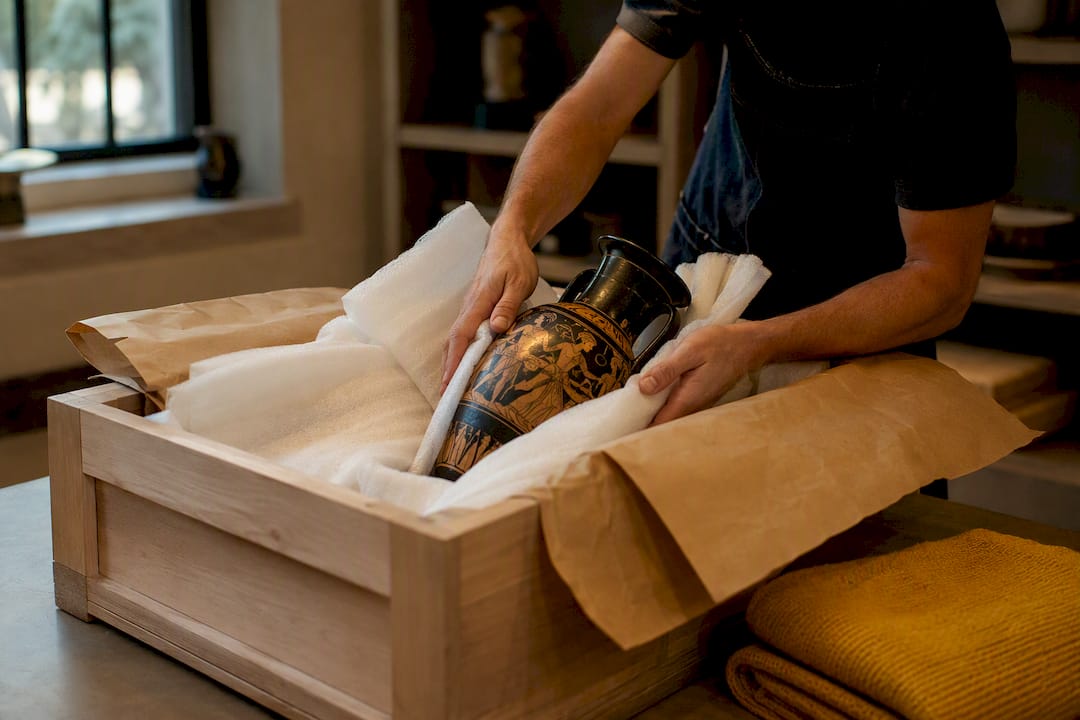
Professional packing earns its cost fastest on high-value, fragile, or irreplaceable items. Paying $70 an hour for someone who crates antiques for a living is a lot cheaper than replacing a shattered heirloom.
Getting Accurate Quotes: What to Ask Before You Book
The single biggest lever you have over pricing accuracy is the walkthrough. An in-home walkthrough produces the most reliable estimate, because an estimator can actually see what's in your closets and cabinets. Virtual walkthroughs work as a fallback but tend to miss hidden density, packed drawers, garage shelving, attic storage, that inflate the final bill beyond the initial quote.
Before accepting any quote, ask for specifics on:
- Whether packing materials are included or billed as a separate line item
- Exact crew size and estimated hours, not just a lump total
- Fees for specialty items like pianos, art, or wine collections
- Travel or trip fees added on top of hourly labor
- Insurance or valuation coverage, and what it actually covers if something breaks
- Cancellation or rescheduling policies and any fees attached to them
For interstate moves, ask specifically whether you're getting a binding estimate (locked-in price) or a non-binding estimate (subject to change based on actual weight and time). Binding estimates cost more upfront but protect you from surprise charges on moving day. Once you have several quotes, run each one through the formula, hourly rate × number of packers × hours + materials + fees, to see who's actually offering the better deal once every line item is accounted for.
Behind This Guide: Local Moving Expertise From Flawlessly Functional
This guide is written from the perspective of Steve, working alongside, and informed by Flawlessly Functional's work managing moves for homeowners across San Antonio.
Flawlessly Functional holds a 4.9 Google rating, reflecting a client base that consistently returns for concierge moving and organizing work. For high-value homes, the packing approach shifts meaningfully: it's not just about wrapping items, it's about pre-sorting what stays, what moves, and what gets donated before a single box gets taped shut. That upfront organizing work is often what separates a chaotic move from a smooth one.
Why Item Density Beats Square Footage Every Time
The most overlooked number in packing cost conversations isn't bedroom count. It's how full your home actually is. Most cost calculators default to square footage because it's easy to measure, but that's a lazy proxy for what actually predicts labor hours: volume of stuff.
Conventional moving advice tells you to get "a few quotes and compare." That's incomplete. The better move is comparing quotes after doing a rough density audit of your own home, because a quote based on square footage alone, without an in-home walkthrough, is basically a guess dressed up as a number.
If there's one thing homeowners should prioritize first, it's decluttering before requesting quotes, not after booking a crew. A lighter, better-organized home doesn't just cost less to pack. It moves faster, insures more easily, and lands in your new space in better shape. Concierge-style moving support, the kind that treats organizing and packing as one connected process rather than two separate jobs, tends to produce a calmer move precisely because it front-loads that decision-making instead of leaving it for moving day.
— Steve
A Calmer Way to Handle Your Next Move
The company offers concierge packing and unpacking services for homeowners who prefer to hand off the logistics rather than manage a crew themselves.

Instead of juggling hourly quotes, material lists, and specialty-item fees on your own, the company handles the in-home walkthrough, the packing plan, and specialty-item handling—such as art, wine collections, or delicate heirlooms—as one coordinated service. That matters most for homeowners who don't want to spend a week comparing per-box pricing against per-crew hourly rates just to move safely. If pre-move decluttering makes sense for your situation, organizing services can shrink your packing scope before a single box gets taped.
If you're planning a move in the area and want a quote based on your actual home rather than a generic square-footage estimate, request an in-home consultation for moving services and get a plan built around what you actually own.
Sources
- Movers
- Packing & Unpacking Service Cost - HomeAdvisor
- How Much Do Professional Packers Cost? - Extra Space Storage
- Moving
FAQ
How much do packers charge per hour?
Professional packers typically charge $25 to $100 per hour per packer, with $60 to $80 an hour being the most common range quoted nationally.
How much does a full packing service cost?
Full-service packing generally costs between $280 and $2,200 or more, with 2-bedroom homes averaging $600 to $1,500 and 3-bedroom homes averaging $1,200 to $2,500.
How much does it cost to pack and move a 2,000 square foot house?
A home around 2,000 square feet, typically a 3-bedroom, usually falls in the $1,200 to $2,500 range for packing alone, though item density can push that higher regardless of square footage.
How much should I pay for packers if I'm on a budget?
Hybrid packing, where you handle basic items yourself and hire pros only for fragile or specialty pieces, can cut costs significantly compared to full-service packing, and booking off-peak avoids the typical 20% to 30% seasonal premium.
Are packing materials included in the price?
It depends on the company. Some bundle materials into the flat or hourly rate, while others itemize them separately, adding anywhere from $180 to $750 or more depending on home size, so always ask before booking.