

Slatwall wins for heavier, mixed-use, permanent garage walls, holding bikes, bins, and sports gear on one coordinated system. Pegboard wins for budget setups, rentals, or a light tool wall above a workbench. Both need to hit studs to hold real weight, and both have simple upgrade paths, locking hooks for pegboard or a French cleat for the heaviest loads.
TL;DR:
- Pegboard is suitable for small, lightweight items, and its lower cost makes it ideal for renters or quick-organizing projects.
- Slatwall provides a higher load capacity and a broader accessory ecosystem, making it better for full garage walls with bikes, bins, and heavy tools.
- Proper installation of slatwall always requires screwing panels into studs, not just drywall anchors, to handle heavier loads safely.
- The total cost for a full, fully equipped slatwall setup often exceeds $500, with accessories forming the largest part of the budget.
- For the heaviest items or a large, permanent wall, a French cleat system surpasses both pegboard and slatwall in load capacity and DIY flexibility.
Table of Contents
- Slatwall vs Pegboard: What Slatwall Actually Delivers in a Garage
- Pegboard or Slatwall: How to Make Pegboard Actually Hold Up
- Slatwall vs Pegboard Comparison: Cost, Load, and Ease of Install
- Which Is Better, Slatwall or Pegboard, for Your Project?
- Slatwall Installation Tips: Studs, Anchors, and Common Mistakes
- What a Full Garage Wall Actually Costs
- A Professional Organizer's Take on DIY Wall Storage
- Skip the Guesswork: Turnkey Wall Storage Done Right
- Sources
- FAQ
Slatwall vs Pegboard: What Slatwall Actually Delivers in a Garage
Slatwall works on a groove system. Horizontal channels run across a panel, usually spaced 3 inches apart, and accessories, hooks, baskets, shelves, bike arms, slide into those grooves and lock in place. That's the entire mechanism, and it's why slatwall feels less like a pegboard upgrade and more like a modular shelving system that happens to hang on a wall.
Most residential slatwall comes in one of two materials: PVC panels or MDF panels with metal groove inserts. PVC holds up better against garage humidity and won't swell if your door lets in rain during a Texas downpour. MDF with metal inserts costs a bit less up front but needs a drier environment to stay flat over years of use.
Cost is where slatwall separates from pegboard fast. A 4×8 PVC panel typically runs $70 to $150, roughly two to three times what a pegboard panel costs. The real spending happens after the panels go up. Populating a wall with hooks, baskets, and bike mounts usually adds another $150 to $400, depending on how many specialty accessories you buy.
That extra spend buys real capability. When accessories are anchored into the groove and the panel is screwed to studs, a standard slatwall hook or bracket handles 20 to 50 pounds without flexing. That's enough for a mountain bike, a full set of hand tools in a basket, or a folding chair rack. The studs part isn't optional. Slatwall's load rating assumes the panel itself is fastened into framing, not just floating on drywall anchors.
Slatwall makes the most sense in a few specific situations:
- A full garage wall that needs to hold a mix of items: bikes, seasonal bins, sports equipment, and small tools all in one system
- A finished garage or workshop where appearance matters, since slatwall reads more like retail store fixtures than shop scrap
- A permanent installation you don't plan to tear out when you move
- A household with kids' sports gear, since the accessory ecosystem includes baskets and bins built for irregular shapes
The tradeoffs are just as real. The higher accessory cost adds up quickly if you're outfitting an entire wall, and because the panels are heavier and stiffer than pegboard, you'll want at least one other set of hands during installation. Slatwall also demands stud attachment across the whole panel, not just at a few anchor points, so it rewards careful planning before you ever pick up a drill.
Pro Tip: Buy your slatwall accessories as a coordinated kit rather than piecing together hooks from different brands. Groove tolerances vary slightly between manufacturers, and a mismatched hook can slip out under load even when the panel itself is mounted perfectly.
Pegboard or Slatwall: How to Make Pegboard Actually Hold Up
Pegboard is the original wall organizer, and its hole grid is the whole idea. Standard boards use a grid of 1/4-inch or 1/8-inch holes spaced on a regular pattern, and hooks, tool holders, and bins insert directly into two or more holes to stay put.
Three materials dominate the market. Hardboard, the classic brown perforated panel, is the cheapest and most common. Plastic pegboard resists moisture and won't splinter, making it a reasonable pick for a laundry room or craft space. Metal pegboard holds heavier tools than either alternative, but it sometimes locks you into hooks made for that specific product line, which limits your accessory shopping later.
Thickness is the detail most first-time buyers skip past, and it's the one that determines whether pegboard actually works for tools instead of just craft supplies. Thin 1/8-inch hardboard flexes under any real weight and tends to bow between studs over time. Quarter-inch pegboard is the practical minimum for hanging actual tools, wrenches, drills, hand saws, rather than lightweight household items.
The second fix matters just as much: locking hooks. Standard pegboard hooks are held in place by gravity and friction alone, which means pulling a wrench off the board can pop the hook forward and send it to the floor with the tool. Locking hooks clip into place and stay there when you remove an item, which solves the single most common complaint about pegboard systems in daily use.
Statistic Callout: A 4×8 pegboard panel typically runs $20 to $60, roughly a third of what a comparable slatwall panel costs, and locking hook upgrades add a small additional cost per bag.
Pegboard fits a narrower but very real set of scenarios:
- Renters or anyone who expects to move within a few years, since panels are light and easy to remove
- A small above-bench zone for hand tools, rather than a full garage wall
- Hobbyists organizing craft supplies, jewelry-making tools, or kitchen gadgets
- Anyone working with a tight budget who still wants real organization
The downsides are worth naming plainly. Maximum load per hook falls well short of slatwall's range, even with a quarter-inch board and locking hardware. Accessory variety is also narrower; pegboard hooks come in fewer shapes and sizes than the slatwall accessory ecosystem, and specialty holders (bike arms, deep baskets) are harder to find. Unsupported spans between studs can warp over time, especially with hardboard in a humid garage.
Bob Vila's rundown of household pegboard projects makes the same point from a different angle: pegboard's real strength is versatility across the whole house, not just the garage. It shows up behind kitchen counters, inside closet doors, and above craft tables just as often as it does over a workbench.
Slatwall vs Pegboard Comparison: Cost, Load, and Ease of Install
Numbers tell the story faster than descriptions do. Here's how the two systems stack up on the factors that actually drive a buying decision.
| Factor | Pegboard | Slatwall |
|---|---|---|
| Material cost (per 4×8) | $20–$60 | $70–$150 |
| Accessory ecosystem cost | $5–$10 per bag of locking clips | $150–$400 to fully populate a wall |
| Load per hook/mounting point | Lower; improves with 1/4-in board and locking hooks | 20–50 lbs typical with stud mounting |
| DIY installation difficulty | Easy; light panels, simple layout | Moderate; heavier panels, precise stud alignment |
| Reconfigure speed | Fast; hooks lift out and reinsert instantly | Fast; accessories slide along the groove |
| Finished look | Utilitarian, shop-like | Sleek, retail-fixture quality |
| Long-term durability | Good with proper thickness; hardboard can warp unsupported | Strong; PVC resists humidity swelling |
A few concrete examples make the abstract numbers real. Hanging a bike on pegboard is a bad idea even with locking hooks. The weight and the swinging motion of a bike stress a single hook point in a way pegboard wasn't built for, and slatwall's wider load range handles it comfortably. Hanging an impact wrench, by contrast, sits well within pegboard's range once you've upgraded to a quarter-inch board with a locking holder. And for storing a set of small hand tools, screwdrivers, pliers, a tape measure, pegboard is arguably the better fit anyway, since its dense hole grid lets you cluster small items tightly in a way slatwall's wider groove spacing doesn't match as efficiently.
Reconfiguration speed is close to a tie. Both systems let you rearrange a wall in minutes rather than hours, which is the real advantage either one has over built-in shelving or cabinetry. The difference shows up in how items feel once they're hung: pegboard hooks can rattle loose over time with vibration, while slatwall's groove lock tends to hold its position through more use.
One option outperforms both for the heaviest jobs. If you're planning to hang a full set of power tools, a table saw stand, or anything approaching the upper limits of wall storage, a French cleat system offers the highest load capacity and the most DIY flexibility of the three, since you build the cleats yourself out of plywood strips. It's not as polished-looking as slatwall and not as fast to shop for as pegboard, but for pure strength per mounting point, it's hard to beat.
- For light tools and tight budgets, pegboard with a quarter-inch board and locking hooks covers most needs.
- For a full garage wall with bikes, bins, and mixed gear, slatwall's load range and accessory ecosystem earn the higher price.
- For the heaviest single items, a French cleat beats either system on raw capacity.
Which Is Better, Slatwall or Pegboard, for Your Project?
Answer four questions honestly before you buy anything, and the right system usually becomes obvious.
-
Is this permanent or temporary? Renters and anyone expecting to move soon should lean pegboard. It's cheap enough that walking away from it isn't a real loss.
-
What's the heaviest single item going on the wall? A bike, a table saw accessory, or a full tool chest points toward slatwall or a French cleat. A screwdriver set and some clamps point toward pegboard.
-
What specific items need storage? Bikes, bins, and sports gear all have purpose-built slatwall accessories. If your list is mostly hand tools, pegboard's dense hole grid handles it just as well for less money.
-
What's the actual budget, including accessories? Price out the full wall, panels plus hooks plus baskets, not just the panel cost, since accessories are where slatwall's price gap widens the most.
If you're buying through a contractor or a store associate, three questions separate a good install from a wall that fails in two years. Ask about stud spacing in the specific wall you're mounting to, since older garages sometimes have studs on 24-inch centers instead of the standard 16. Ask what warranty covers the panel versus the accessories, since those are often sold separately with separate coverage. And ask directly whether the accessory line is proprietary to that panel brand or works with generic hardware, since getting locked into one supplier's hook system limits your options later.
A few shopping habits pay off regardless of which system you pick. Buy pegboard locking clips in bulk from the start rather than upgrading hook by hook after something falls. Buy slatwall accessories as a matched kit instead of mixing brands. And measure your stud layout with a stud finder before you cut a single panel to size, so your cuts line up with framing instead of forcing you to patch and re-mount later.
Pro Tip: Sketch your wall layout on paper before shopping, marking where studs actually fall. It takes ten minutes and saves you from buying a panel size that puts a seam right where you needed a solid mounting point.
Slatwall Installation Tips: Studs, Anchors, and Common Mistakes
The single rule that overrides every other installation detail: panels carrying real tool weight get screwed into studs, not just fastened to drywall. For a full 4×8 panel, that means hitting a stud roughly every 16 inches, which is the standard framing spacing in most American homes built after the mid-20th century.
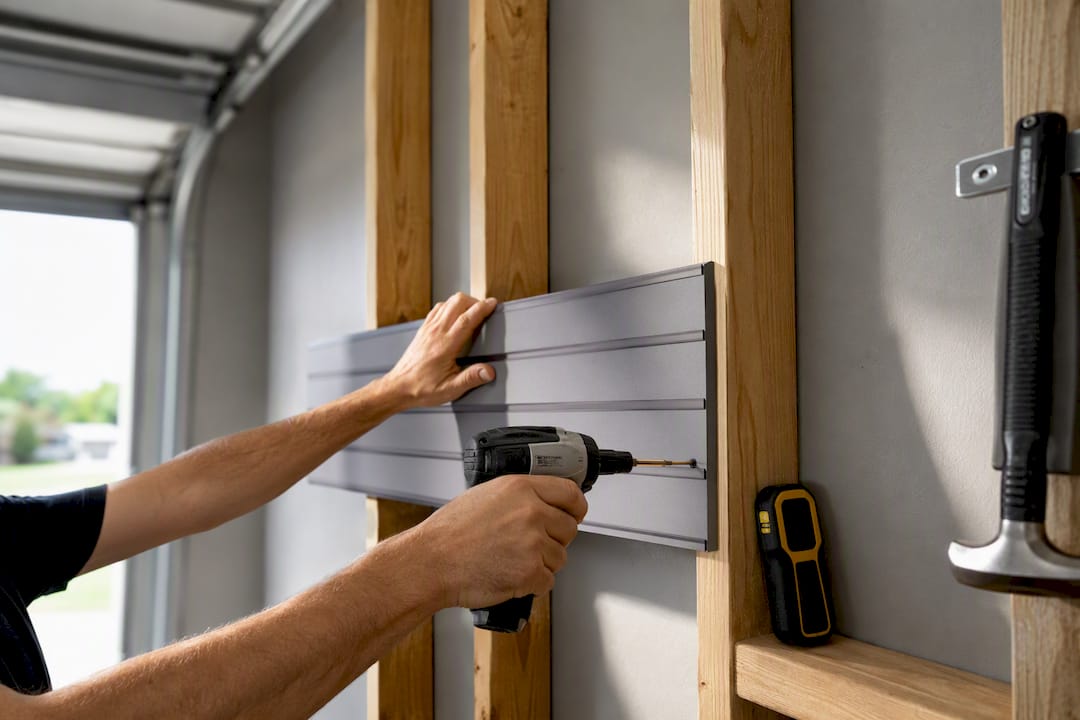
Hollow-wall anchors, the plastic or metal expanding kind sold in the same aisle as drywall screws, simply aren't rated for the loads a loaded pegboard or slatwall panel puts on a wall. They work fine for a picture frame. They fail under a wall full of tools, sometimes gradually as the drywall crumbles around the anchor, sometimes all at once when someone leans on a shelf. If a stud doesn't line up where you need one, the fix is a lag screw into a horizontal furring strip or a threaded wall anchor rated for the specific load, not a longer drywall anchor.
Three mistakes account for most pegboard and slatwall failures reported by DIYers:
- Buying thin 1/8-inch pegboard for a wall meant to hold actual tools instead of craft supplies
- Relying on standard gravity hooks instead of locking hardware, then being surprised when a wrench pulls the hook off the board
- Skipping the stud-finder step and discovering mid-install that the layout doesn't match the panel's mounting points
Before you buy anything, walk the wall with a stud finder and mark every stud in pencil. Measure the wall's full width and height, and compare that against standard panel sizes so you know how many panels you actually need and where the seams will fall. That five-minute prep step is the difference between an install that goes up in an afternoon and one that turns into a second trip to the hardware store.
What a Full Garage Wall Actually Costs
Real budgets are more useful than abstract price ranges, so here's what three common projects actually run.
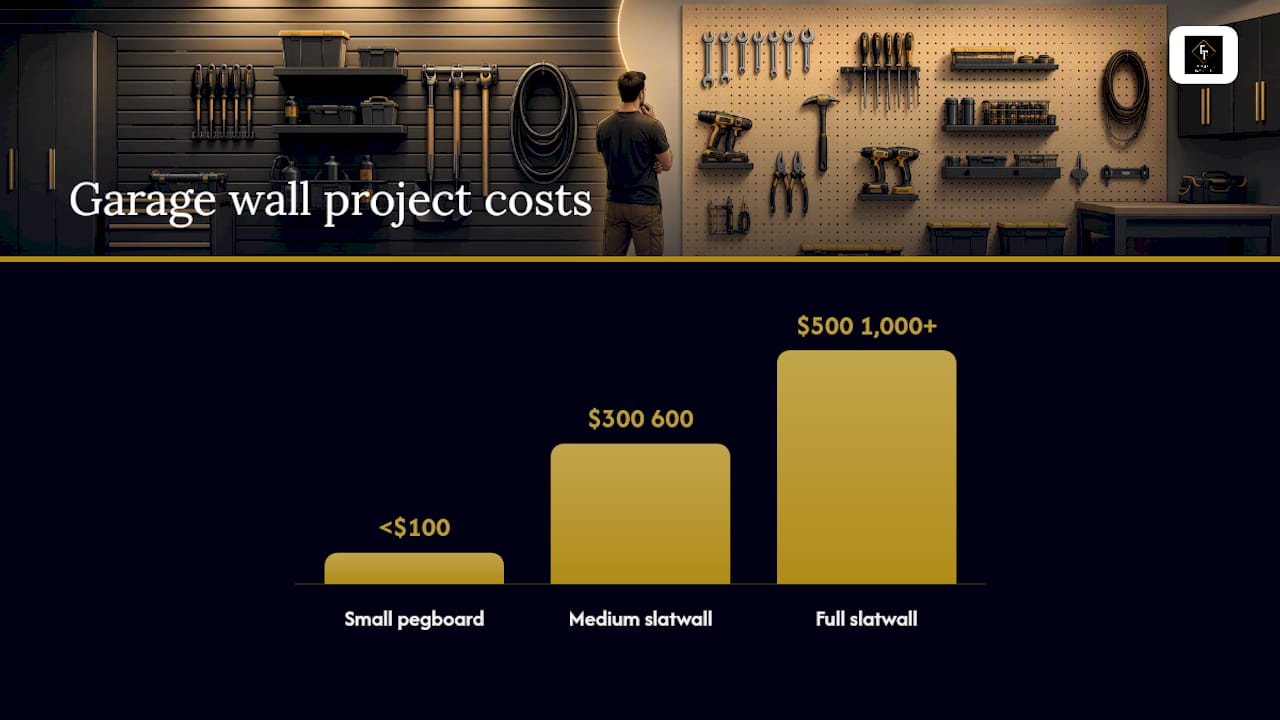
Scenario A: A small above-bench pegboard. One 4×8 panel at roughly $30 to $50, a dozen basic hooks, and a bag of locking clips keeps this project under $100 total. This is the setup for someone organizing hand tools above a single workbench with no ambition to expand.
Scenario B: A medium slatwall installation. One or two PVC panels plus an entry-level accessory set, a handful of hooks, one basket, one shelf, lands in the $300 to $600 range. This covers a partial wall meant to handle bikes and a modest amount of gear.
Scenario C: A fully populated slatwall wall. Covering an entire garage wall with panels and a complete accessory lineup, bike arms, multiple baskets, bins, specialty holders, typically runs $500 to $1,000 or more, depending on how many specialty pieces you add.
Statistic Callout: The gap between Scenario A and Scenario C, roughly $100 versus $1,000, is almost entirely accessory cost, not panel cost. The panels themselves rarely account for more than a third of the total budget once a wall is fully outfitted.
Unit pricing helps you build your own estimate. Locking clips for pegboard run $5 to $10 per bag. Slatwall bike hooks typically cost more than a basic pegboard hook, and dedicated bins or baskets add the most to a slatwall budget line by line. Price out your specific item list, bikes, bins, tool holders, before committing to a system, since the accessory total is usually the number that decides whether slatwall fits your budget.
A Professional Organizer's Take on DIY Wall Storage
Most homeowners treat this as a hardware decision. It's really a planning decision. The mounting system matters less than whether you've actually mapped what's going on the wall before you buy anything, and that's the step almost everyone skips.
Professionals lean toward permanence and finish for a reason: a wall that looks temporary tends to get treated as temporary, and clutter creeps back in within months. When time is tight, when the finish needs to match the rest of a renovated home, or when storage needs span a garage, a closet, and a mudroom as one coordinated system, a DIY weekend project stops being the efficient option. That's usually the point where hiring a professional organizer earns back its cost in avoided redos and wasted accessory purchases.
— Steve
Skip the Guesswork: Turnkey Wall Storage Done Right
Reading through cost ranges and stud spacing is one path. Handing the whole project to someone who does this for a living is another. Custom storage system designers help homeowners who want a finished garage wall without spending three weekends measuring studs and returning mismatched hooks.

The honest case for hiring out: time, precision, and a finished result that looks intentional rather than improvised. A professional install accounts for your actual stud layout, your real inventory of bikes and gear and tools, and the accessory mix that will hold up for years, not just the first month. That's the same customization approach behind Flawlessly Functional's organizing services, extended to garage and workshop walls as part of a broader home organization plan. If your storage needs stretch beyond one wall, into closets, a garage, or a home office, a coordinated organizing system handles all of it at once instead of room by room. For a local example of what turnkey slatwall installation looks like in practice, One Day Doors & Closets offers a useful reference point. The first step is simple: book a consultation and walk through your space with someone who plans it for a living.
Sources
- These Are the Best Ways to Use Pegboard Around Your House | BobVila
- Ultimate Pegboard Guide: How to Improve Your DIY Game With a Pegboard | MakeUseOf
- Slatwall Panels Guide: Types, Accessories & Installation | TXSF
FAQ
Is a Slat Wall Worth It?
For a full garage wall holding bikes, bins, and mixed gear, yes. Slatwall's higher accessory cost buys a wider load range and a finished look that pegboard doesn't match, though for a single light-duty zone, pegboard often delivers the same result for less money.
Can You Use Pegboard Hooks on Slatwall?
No. Pegboard hooks are made to insert into round holes, while slatwall accessories are made to slide into a horizontal groove, and the two mounting systems aren't interchangeable.
What Are the Disadvantages of a Pegboard System?
Standard pegboard has a lower maximum load per hook than slatwall, a narrower range of accessory shapes, and thin hardboard can warp if it isn't fully supported against the wall. Upgrading to a quarter-inch board with locking hooks addresses most of these issues without switching systems.
What's Better Than Pegboard?
For heavier, mixed-use walls, slatwall offers a wider accessory ecosystem and higher load capacity per mounting point. For the single heaviest items in a workshop, a French cleat system offers even higher load capacity and more DIY flexibility than either pegboard or slatwall.