
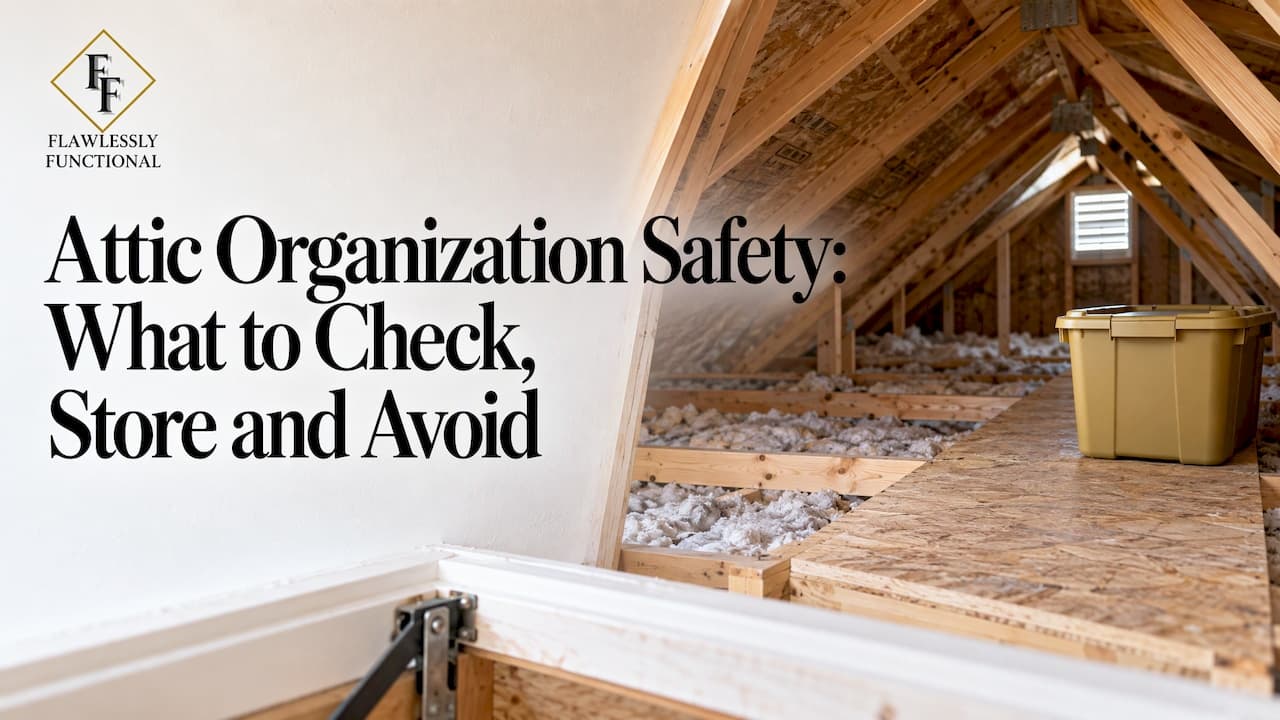
Safe attic organization comes down to four things: a floor that can carry the load, clear airflow, a safe way up and down, and storing only what survives the heat. Check the structure and look for leaks and pests first. Then keep vents, wiring and heat sources uncovered, and move the heavy items out of the daily climb. Everything else is labeling and layout.
The rest of this guide goes through each step in order, with the official guidance behind it.
TL;DR
- Inspect before you store: look for roof leaks, damaged framing, pests, exposed wiring and blocked ventilation.
- Step only on confirmed framing or a properly supported platform, never on drywall or insulation.
- Keep food, photos, documents, electronics, candles, instruments, fabrics and wooden furniture out of the attic. Heat and humidity swings damage them.
- Never block soffit or ridge vents, bury wiring, or pile items against flues, chimneys or hot equipment.
- Climb without carrying a load. Use a helper, a hoist or a lift for heavy bins.
Table of Contents
- Is your attic safe to use for storage at all?
- What not to store in an attic
- Heat, moisture and airflow: protecting both the house and your things
- Moving through the attic without falling
- Fire safety in the attic
- How to lay out an attic you can actually use
- Perspective: why we move things out of the attic
- Let us take the attic off your list
- A short safety checklist to keep
- FAQ
- Sources
Is your attic safe to use for storage at all?
Some attics are, and some are not. The answer depends on what is under your feet and over your head. A home storage guide from Rosie on the House says to check for pests, heat, lighting, safe movement, floor strength, ventilation and roof leaks. It also says to reinforce the floor before storing heavy items and to repair leaks before storing anything.

Floor strength is the one most people skip. Attic floors are often built for the ceiling below, not for boxes. The International Residential Code's Table R301.5 lists 10 pounds per square foot for uninhabitable attics without storage and 20 psf for uninhabitable attics with limited storage. It lists 30 psf for habitable attics and attics served by fixed stairs. Local codes adopt their own versions of these tables, so a framing question about your house belongs with a licensed contractor or structural engineer.
Two practical consequences follow:
- Exposed joists are not a floor. Do not lay plywood over them and load it up until someone has confirmed the structure can carry storage.
- Heavy items such as filled bins, books and small appliances are the first to exceed what an unrated attic floor was designed for.
A pre-storage inspection you can do in 20 minutes
Walk the access area with a flashlight, staying on the hatch landing or on framing you can see. You are looking for:
- Water stains or damp insulation. Moisture is the attic's biggest enemy. The Department of Energy's Consumer Guide to Durable Attics names roof leaks, improperly installed flashing, water vapor and ice dams as the sources that damage the roof and undermine insulation.
- Pests. Droppings, chewed insulation, nests and shredded cardboard all mean the space needs treating before it holds anything you care about.
- Exposed or damaged wiring. Note where junction boxes sit. They must stay reachable.
- Blocked vents. Look for soffit vents covered by insulation or boxes, and for a clear path to the ridge or gable vents.
- Cracked or notched framing. Anything structural gets a professional's eyes before you load it.
If you find a leak, fix it first. Not sure which trade to call? This breakdown of a plumber or a roofer for ceiling leaks helps you work out who to ring. Damp is also why exhaust ducting matters: the DOE guide says bathroom, kitchen and dryer exhaust should vent outdoors and not into the attic. For a wider look at how venting supports a safe house, see this piece on plumbing ventilation in safe homes.
What not to store in an attic
The attic is the most extreme room in the house. Temperature and humidity swing hard, and pests find their way in. HGTV's list of things to avoid storing in an attic points to food, paper documents and photographs, artwork, wooden furniture, electronics, musical instruments, clothing and fabrics, candles, cardboard, and delicate or irreplaceable items.
Here is why each group belongs somewhere else:
| Item | What goes wrong in an attic | Better home |
|---|---|---|
| Photos, documents, artwork | Heat and humidity cause curling, fading, mold and sticking | Interior closet or climate-controlled space |
| Electronics and instruments | Heat stresses components; humidity swings affect wood and finishes | Interior closet away from exterior walls |
| Wooden furniture | Expands and contracts, warps and cracks | Spare room or climate-controlled unit |
| Clothing, linens, fabrics | Absorb moisture and odors; attract pests | Sealed totes in a bedroom or hall closet |
| Food, pet food | Spoils, attracts rodents and insects | Pantry or garage cabinet with sealed lids |
| Candles | Soften and deform in heat | Interior drawer or cabinet |
| Cardboard boxes | Wick moisture and give pests a place to nest | Lidded plastic totes |
Then there is fire risk. Paint, aerosol cans, propane and other flammable or pressurized items do not belong in a hot, enclosed space, and many local fire departments publish household hazardous waste guidance if you need to get rid of them. Check your city's disposal program rather than leaving them up there.
What actually belongs in the attic
The best attic items are durable, light and low-stakes: holiday decorations that are not fragile, empty luggage, seasonal sports gear in sealed totes, and spare bedding in gasket-lid containers. If you would be upset to lose something, it does not go up. We cover the keepsake side of this in our guide to seasonal decor storage for homeowners, and if you are weighing a unit for sensitive items, our comparison of climate controlled vs regular storage walks through the cost question.
Heat, moisture and airflow: protecting both the house and your things
Storage should never get in the way of how the attic breathes. The DOE guide recommends sealing gaps around ducts, wires, plumbing, lighting and the attic entry, and keeping soffit and ridge ventilation and rafter baffles working. That has direct consequences for how you shelve:
- Leave the soffit edges clear. Stacks pushed to the eaves can cover intake vents and squash the insulation.
- Keep items off the insulation. Compressed insulation does less work, and you cannot see what is happening under a box.
- Do not move or add insulation to make room. Storage should be built around the insulation, not the other way around.
- Use gasket-lid totes. They keep damp air and pests out better than cardboard, which wicks moisture.
In a Texas summer, the attic can run far hotter than the outdoor air. That is the practical reason to treat the space as seasonal storage only, and to keep the sensitive categories above downstairs.
Moving through the attic without falling
Falls are the injury risk most people underestimate. The steps up are a hazard, and so is the first step onto the framing.
The climb
The OSHA ladder safety guidance is plain: maintain three points of contact, secure the ladder, avoid carrying tools or materials while climbing, do not use the top rung, and keep footing stable and level. It also suggests considering something other than a ladder when you are holding heavy items.
For attic storage, that translates to:
- Hand bins up and down with a helper, or use a rope or hoist from the hatch, rather than climbing with a load.
- Carry only what you can manage while keeping both hands free on the way up. A headlamp beats a flashlight in your hand.
- Install a rated pull-down stair or lift if you go up more than a few times a year. A wobbly spring-loaded folding ladder is the weakest link in most attics.
- Keep the hatch area clear so you are never stepping around stuff on the landing.
The walk
ENERGY STAR's tips for working in the attic advise walking only on designated floor panels or joists, never on exposed ceiling drywall or insulation. A foot through the ceiling is an injury, and it is also a repair bill. The same principle covers any platform you build: it should sit on confirmed framing and be fastened properly.
Build a single clear aisle from the hatch to your storage zones. Wide enough to turn around with a bin, lit well enough to read labels, and never used as a shelf.
Fire safety in the attic
Attic fires are hard to catch early. The U.S. Fire Administration's report on residential attic fires notes they can go unnoticed until smoke or flames are visible from outside. Delayed detection lets them grow, and they may be concealed under insulation. The same report points out that firefighters risk falling through ceilings when fighting them.
What that means for how you organize:
- Keep a clearance around hot things. Flues, chimneys, recessed lights, furnaces, air handlers and water heaters should have open space around them.
- Leave electrical components accessible. Junction boxes, wiring and HVAC equipment should never be buried under or boxed in by storage.
- Keep the walkway open and lit. A clear path is also your escape route and a firefighter's access.
- Think about detection. Ask an electrician or your fire department whether a smoke alarm near the attic access makes sense for your home's layout.
What about the "7 and 7 rule"?
You may see this phrase in search results. It is a building-code shorthand for habitable attic space, tied to ceiling height and minimum floor area under an IRC-based code, as explained in this guide to attic convertibility and the 7-and-7 rule. It matters if you plan to finish the attic as a room. It is not a storage safety rule. For storage, the questions are floor load, airflow, access and what you put there. If a finished room is on your list, your local building department can tell you which rules apply.
How to lay out an attic you can actually use
Once the space is safe, the organization is straightforward. A good layout means you rarely have to be up there, and when you are, you are not rummaging.
- Declutter before anything goes up. Attics collect things people have not decided about. Sort into keep, donate, discard and relocate-downstairs. Most of what is sensitive moves out of the attic at this stage.
- Group by category. Seasonal, holiday, luggage, kids' keepsakes and household overflow each get a zone.
- Choose clear, stackable, gasket-lid totes. You can see the contents, and they resist damp and pests.
- Label top and side. Add a date and a one-line content list. If you want inventory beyond that, a simple spreadsheet or photo log of each bin works.
- Put heavy bins low and over supported framing. Lighter items go higher and further from the hatch.
- Use shelving that suits the roof structure. Nothing should be attached to roof framing unless a professional confirms it is safe to do so.
- Add lighting. A switch at the hatch and a fixture over the main aisle make a big difference to safety.
- Keep a short list at the hatch. Knowing where things are means fewer trips.
The same logic of zones, labels and a clear route applies to any room. Our seasonal closet switch guide for San Antonio homeowners shows how it works downstairs, where most seasonal things are better off living.
Perspective: why we move things out of the attic
Most attic problems we see are not organizing problems. They are decisions that were never made. Boxes went up because the stairs were closer than the sorting.
When we organize a home, we start by asking what each item needs. A box of wedding photos needs a stable room. A set of holiday lights needs a bin and a label. Once those are separate, the attic becomes a small, tidy, seasonal space that you rarely have to enter, and that is the safest attic there is.
Our approach is built around your household's routines and a system that lasts, with minimal disruption. That means we plan the zones, the labeling and the traffic flow with you, and we say so when an item belongs in a different space. We also keep the aesthetics in view, because a system you like looking at is a system you keep up.
If a structural, roofing or electrical question comes up, we want you to hear from the right licensed professional first. Then we can organize with confidence.
Steve
Let us take the attic off your list
If you are in the San Antonio area and the attic has become the place everything goes to wait, our luxury home organizing service sorts, relocates and sets up storage that fits how your household lives. We plan the zones, containers and labels, and we coordinate the details so you do not have to haul bins up a ladder.

Moving soon? Our moving management concierge handles packing, unpacking and downsizing, which is the ideal time to decide what should never go in an attic in the first place.
A short safety checklist to keep
- Roof, vents and insulation checked, with any leaks repaired
- Floor confirmed for storage, or storage limited to a supported platform
- Clear, lit aisle from hatch to zones
- Sensitive items relocated downstairs
- Totes sealed, labeled and dated; no cardboard
- Vents, wiring, flues and equipment clear of storage
- Ladder or stairs rated and stable, with a plan for heavy loads
FAQ
What should not be stored in an attic?
Avoid food, paper documents, photographs, artwork, wooden furniture, electronics, instruments, clothing and fabrics, candles and cardboard. Heat, humidity swings and pests damage them. Keep paint, aerosols and propane out too, because of fire and burst risk.
Can I use my attic as storage?
Often yes, but only after you check the roof for leaks, look for pests, confirm the floor can carry the load and make sure ventilation is clear. Exposed joists are not a safe walking or storage surface by themselves. A contractor can confirm the structure.
How do I get heavy items up to the attic safely?
Do not carry them while climbing. OSHA advises keeping three points of contact on a ladder and considering alternatives when holding heavy items. Use a helper, a rope or hoist, or an attic lift, and keep the hatch area clear.
Is the 7 and 7 rule about attic storage?
No. It is a building-code shorthand for whether an attic qualifies as habitable space, based on ceiling height and floor area. It matters for conversions, not for deciding what to store. Your local building department can explain the rules where you live.
Sources
- Can I Convert My Attic to Usable Storage Space? (Rosie on the House)
- Table R301.5, 2012 IRC changes (International Code Council)
- Consumer Guide to Durable Attics (U.S. Department of Energy)
- 10 Things You Should Never Store in an Attic (HGTV)
- Falling Off Ladders Can Kill: Use Them Safely (OSHA)
- Tips for Working in the Attic (ENERGY STAR)
- Topical Fire Report Series: Attic Fires in Residential Buildings (U.S. Fire Administration)
- Ceiling Leak: Call a Plumber or a Roofer First?
- The Role of Plumbing Ventilation in Safe Homes
- Is My Attic Convertible? The 7-and-7 Rule