
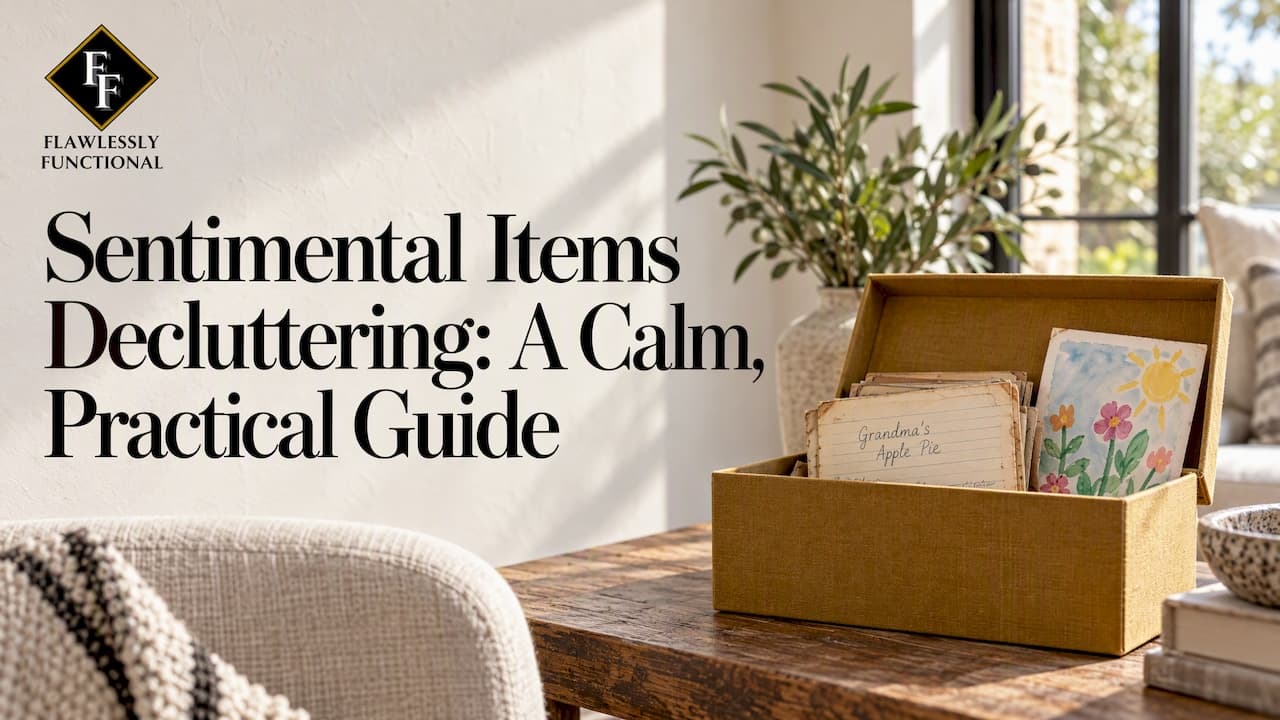
Decluttering sentimental items is hard because you aren't sorting objects. You're sorting memories, relationships and sometimes grief. The way through is to set a limit on how much you will keep, sort in a sensible order, keep the memory in a smaller form when the object doesn't need to stay, and store what remains so it lasts. This guide walks through each of those steps.
TL;DR
- Decide how much space you are willing to give sentimental items before you sort, then let that limit guide every choice.
- Warm up on easier categories, start with one drawer, and bring in a trusted person for the emotional pieces.
- Photograph, repurpose or display an item when the memory matters more than the object.
- Store what you keep cool, dry and in archival containers, never in a garage, damp basement or hot attic.
- If the volume or the emotion feels too big, a professional organizer can do the sorting alongside you.
Table of Contents
- Why sentimental clutter is harder than ordinary clutter
- Set your limit before you start
- A step-by-step method for sorting sentimental items
- Keep the memory without keeping the object
- Keepsake storage ideas that protect what you keep
- When the sorting is tied to a move, a loss or a life change
- Our perspective
- Working with a professional organizer
- A simple plan for this weekend
- FAQ
- Sources
Why sentimental clutter is harder than ordinary clutter
A worn-out kitchen gadget is easy to donate. A box of your late mother's recipe cards, your kids' preschool art or a wedding guest book is not, because each carries a person or a period of your life. Letting go can feel like betraying that person or forgetting that time.
That feeling is normal, and it is not a sign that you are bad at organizing. It does explain why the usual advice ("if you haven't used it in a year, toss it") fails here. Sentimental items need their own rules, a slower pace and a different question. The question is not "do I use this?" It is "what does this hold for me, and is there a smaller way to keep it?"
Common categories include:
- Childhood items: school projects, trophies, stuffed animals, baby clothes
- Items from a loved one: clothing, jewelry, letters, recipe cards, tools
- Inherited furniture and dishes you have never actually used
- Gifts you feel guilty about, even though you will never use them
- Photos, albums, videos and old devices
- Memorabilia from travel, weddings, school and sports
Set your limit before you start
The most useful move is also the least emotional one: choose the space first. NPR's Life Kit advice on childhood belongings is to decide before sorting how much storage you are willing to devote to those items, because that tells you how much you can keep.
This turns an impossible question ("which of these 400 things matter?") into a manageable one ("which of these things earn a place in these two boxes?"). A few ways to define the limit:
- One box per person. Each family member gets one labeled container for keepsakes.
- One shelf or one closet section. Everything sentimental lives there, and nowhere else.
- One bin per category. For example, one for school years, one for travel, one for a parent's belongings.
When the container is full, something has to leave before something new enters. That rule is what keeps the collection meaningful instead of endless.
A step-by-step method for sorting sentimental items

1. Start small and sort sentimental items last
Professional organizers quoted by The Spruce suggest starting with one drawer, taking breaks when you need them and saving sentimental items for last, so you have practice making decisions by the time you reach the hard ones. Clear a junk drawer, a coat closet or the bathroom first. By the time you open the memory boxes you will already have made fifty easy decisions.
2. Use three boxes
The three-box method uses one box for keep, one for donate or sell, and one for undecided. The undecided box matters most for sentimental items. It gives you permission to postpone without stalling the whole project. Seal it, date it and set a reminder. If you haven't missed anything in it six months later, you have your answer. When you do reach the donate pile, simple on-site tests for what to donate or trash can help you sort the practical leftovers quickly.
3. Hold the item and notice what you feel
Some organizers recommend a sensory approach: hold the item, look at it closely and even smell it, to find out which specific emotions it brings up. Sometimes the feeling is joy. Sometimes it is guilt, obligation or sadness. An item that only brings guilt has told you something.
4. Ask better questions
Instead of "could I ever need this?", try:
- Does this make me feel connected to someone or something I love?
- Would I choose to buy storage space for this?
- Is there another item that holds the same memory better?
- Would the person who gave it to me want it to sit in a box?
- Is it in good enough condition to display or use?
If you have five of something that stands for one memory (ten of your father's ties, twenty of your child's drawings), keep the best one or two.
5. Bring someone with you
Having someone you trust beside you can help you honor the memories tied to objects and still let go. A friend, family member or a professional can hear the story behind an item, and often telling the story is the real goal. Choose someone patient who won't push you, and who won't be offended by what you keep.
Keep the memory without keeping the object
This is the part most people want to hear. Research reported in The Conversation found that when people photograph an item, they feel less loss of identity and are more willing to donate it, because they no longer fear losing the memory itself.

Photographing is only one option. NPR's Life Kit lists several ways to hold on to the meaning, including sewing old T-shirts into a quilt, making a scrapbook of saved holiday cards, or displaying special items in a shadow box. The same source suggests turning a loved one's clothes into one or two keepsake items.
Here is how to match the approach to the item:
| Item | Smaller way to keep it |
|---|---|
| Kids' artwork | Photograph every piece, keep a few favorites, bind the photos into a book |
| Loved one's clothing | Keep one or two meaningful pieces, or make a quilt or pillow |
| T-shirts from school, sports or trips | Quilt, or photograph and donate |
| Holiday and greeting cards | Scrapbook of the most meaningful ones |
| Small collectibles and trinkets | Shadow box on a wall |
| Handwritten letters and recipes | Scan them, keep the originals in one archival folder |
| Sports trophies | Photograph the group, keep one or two |
The goal is a smaller, more intentional collection that you actually see. A shadow box on a wall honors a memory more than a box in the attic you haven't opened in ten years.
Keepsake storage ideas that protect what you keep
What you keep deserves proper storage. Many family treasures are damaged not by time but by where they sit. The National Archives recommends keeping family papers and photographs below 75°F and below 65% relative humidity, and avoiding very dry conditions under 15%. It advises against damp basements, garages and hot attics, which is where most of us put the boxes.
Practical choices:
- Location: A bedroom closet or a shelf in a climate-controlled part of the house beats the garage every time. In San Antonio, where summer heat is intense, attic and garage storage is especially risky.
- Containers: Use acid-free or buffered boxes and folders. For photographs, the National Archives says containers should pass the Photographic Activity Test (PAT).
- Cleaning: For photographs and textiles, the Smithsonian's National Museum of African American History and Culture advises using a soft, lint-free cloth, avoiding rubbing, and skipping harsh commercial cleansers or solvents. For framed paper pieces, a gentle dry method for cleaning posters and prints follows the same do-no-harm idea.
- Fragile or valuable heirlooms: A conservator has extensive training in art history, science and studio art, and can be hired to help preserve family heirlooms. Consider one for a quilt, a painting or a document that matters to your family.
- Labeling: Write the owner, the year and one line of context on each box. Future you, and your kids, will thank you.
If you store holiday decorations that have family history, our guide to seasonal decor storage that preserves heirlooms covers how to pack them so they come out intact. For loose papers, four piles and a fast first pass will separate the documents from the memories.
When the sorting is tied to a move, a loss or a life change
Sentimental decluttering rarely happens in calm moments. It happens when someone is downsizing, selling a parent's home, moving across town or going through a divorce. In those cases the emotional load and the deadline collide.
A few suggestions:
- Take it in short sessions. Our approach to downsizing before a move is 20 to 30 minutes a day, one room at a time. Sentimental rooms deserve the same gentle pace.
- Protect what you can't replace first. If you are packing, our guide to packing a wardrobe and preserving heirlooms shows how to keep special garments intact.
- Be gentle with grief. If you are downsizing after a major loss, the first 30 days after a divorce offer a framework for protecting both money and emotions. Don't make irreversible decisions in the first weeks.
- Use the undecided box freely. It is better to store a box for six months than to regret a decision for ten years.
Once the heavy sorting is done, you may find the home feels different too. We wrote about the emotional relief of a thoughtfully organized home and why it extends beyond the closets.
Our perspective
In our work with homeowners in San Antonio, we see the same pattern again and again: people are rarely overwhelmed by the stuff itself. They are overwhelmed by the decisions the stuff demands. A good organizing project removes as many of those decisions as possible without removing the person's say in what matters.
That is why we don't believe in one-size-fits-all rules for sentimental items. We start with how your household lives, what you want to see, and what you want to protect. Then we build a system around it: a defined place for keepsakes, containers that suit the items, and a display for the pieces worth showing. We let you set the pace, and we keep the work quiet and unhurried, so your home isn't turned upside down.
We also believe the best system is one you can maintain. A keepsake shelf with a clear limit is easier to live with than a promise to "deal with it someday." And a home that looks beautiful and functions well doesn't require you to give up the things that hold your story.
— Steve
Working with a professional organizer
You can do all of this alone. But if you are facing a whole house of memories, a parent's belongings or a deadline, support makes a difference. Our luxury home organizing service is designed for this: we sort alongside you, create a place for what you keep, and set up storage that fits your home and routines. If the sorting comes with a relocation, our moving management concierge handles packing, unpacking and downsizing so the pieces you care about arrive safely. Prices are quoted per project, so get in touch to talk through yours.
A simple plan for this weekend
- Saturday morning: Choose your limit (one box, one shelf) and gather three boxes and a marker.
- Saturday, 30 minutes: Clear one junk drawer to warm up.
- Saturday afternoon: Open one sentimental container. Sort only that one. Photograph anything you release.
- Sunday morning: Store what you kept in labeled, acid-free containers in a cool, dry room.
- Sunday afternoon: Donate the donate box before you can change your mind. Seal and date the undecided box.
Stop when you are tired. Progress that feels kind is progress that continues.
FAQ
How do I let go of sentimental clutter without feeling guilty?
Separate the memory from the object. Photograph the item, write down the story, or keep one small piece that represents it. Research shows that capturing a photo makes people more willing to donate, because the memory feels safe. Donating something to a person who will use it can also feel like honoring it.
What are examples of sentimental items?
Typical examples are childhood toys and artwork, a loved one's clothing or jewelry, letters, photos, wedding items, trophies, travel souvenirs, inherited furniture and dishes, and gifts you feel obligated to keep. The category is personal: anything that connects you to a person or a time can qualify.
Where should I start when it all feels overwhelming?
Start with one drawer, not one room, and leave sentimental items for last so you have practice. Take breaks and invite someone you trust, as professional organizers recommend. Use an undecided box for anything you can't resolve today.
What is the best way to store keepsakes?
Use acid-free or buffered containers in a cool, dry, climate-controlled room. The National Archives advises temperatures below 75°F and humidity below 65%, and warns against basements, garages and attics. Label each box with the owner, the year and a short note.
Sources
- Cherishing stuff with a photo can help you let go of it (The Conversation)
- How to Get Rid of Sentimental Clutter Without Losing Memories (The Spruce)
- How to Get Rid of Sentimental Items Without Feeling Guilty (Real Simple)
- What to do with your childhood stuff (NPR Life Kit)
- How to Preserve Family Archives, papers and photographs (National Archives)
- Family Treasures Toolkit (Smithsonian NMAAHC)
- On-site tests to decide what to donate or trash
- Gentle dry method for cleaning posters and prints