
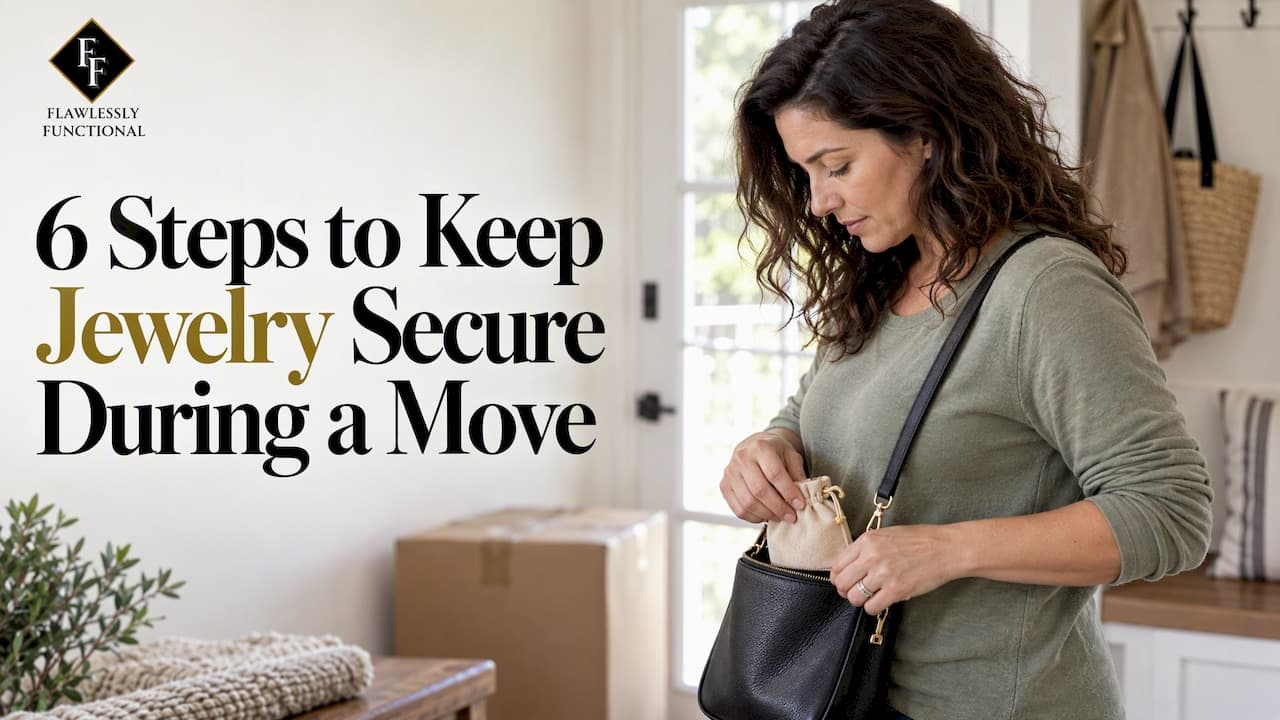
Keep your valuable and sentimental jewelry with you, in a carry-on, a locked personal bag, or on your person, never on the moving truck. The TSA advises the same for travelers. Before you pack, photograph every piece and schedule coverage for anything above standard homeowners limits. Then protect each item with straws, pill organizers, and soft pouches.
TL;DR:
- Standard homeowners policies often cap jewelry theft coverage at approximately $1,500, while movers may exclude high value items, so confirm both limits in writing.
- Keep pearls in soft pouches rather than plastic, and protect them from heat, harsh chemicals, and extreme humidity to prevent surface damage.
- For collections too large to carry, use a bank safe deposit box or secure temporary storage; document every handoff with names and dates.
- Photograph existing wear before packing, have loose settings tightened by a jeweler, then compare each piece with your inventory immediately after arrival.
- If jewelry is missing or damaged, record the date and time, take photos, and contact both your insurer and mover promptly.
Table of Contents
- What should be on your moving-day jewelry checklist?
- How do you pack necklaces, rings, bracelets, and earrings?
- Which transport and storage option is safest for jewelry?
- How do you document value and get the right insurance?
- What should you inspect before packing and after unpacking?
- Why trust this guide?
- Where conventional moving advice falls short
- How can our Moving Management Concierge protect your jewelry?
- FAQ
- Sources
What should be on your moving-day jewelry checklist?
Print this and tape it to your packing station. It covers the decisions that matter most, in the order you will face them.
- Decide which pieces travel with you and which, if any, go into secure temporary storage.
- Photograph every item in good light, note serial numbers, and save the inventory off-site or in the cloud.
- Pack by type: travel cases for necklaces and bracelets, pill organizers for studs, original boxes for rings.
- Call your insurer and your mover to confirm what each one covers, and schedule a floater if you need one.
- Pack a small "open first" pouch for the pieces you want back on day one.
- Keep the bag within arm's reach from the first box to the last.
How do you pack necklaces, rings, bracelets, and earrings?
Tangles and scratches cause most moving-day jewelry damage, and both are easy to prevent with items from your kitchen drawer and bathroom cabinet.
- Necklaces: Thread each chain through a drinking straw and fasten the clasp so it stays in place. For chunkier links, a cardboard tube from a paper towel roll gives more room.
- Rings and bracelets: Wrap each piece separately in microfiber cloth or soft tissue, then place it in a padded slot or a pill organizer compartment. Use the original ring box when you still have it.
- Earrings: Keep pairs together on earring cards, in foam, or in pill box sections. Secure the latch backs first so nothing slips loose.
- Pearls and opals: Skip plastic bags. GIA guidance says to keep pearls in soft pouches and protect fragile stones from heat, harsh chemicals, and extreme humidity. Plastic can dull the surface of pearls over time.
- Original boxes: Seal each one with tape, pad the outside, and nest them in a small, cushioned box that rides in your personal bag.
Pro Tip: A hard-shell sunglasses case or a travel jewelry case with padded, crush-resistant sides adds a second layer of protection if your bag gets squeezed under a seat.
Which transport and storage option is safest for jewelry?
Your best choice depends on how much you own and how you are traveling.
- Carry-on or on your person: This is the safest option for small and moderate collections. You keep control, and at an airport you can request private screening, as the TSA notes.
- Personal vehicle: Fine for a road move. Keep the bag concealed and lock it in the glove box or trunk whenever you step away.
- Bank safe-deposit box or short-term secure storage: A good fit for large collections, or when you cannot carry everything yourself. Insurance industry experts suggest a safe-deposit box as a place to keep your inventory, and a box also works as a holding spot for the pieces themselves during the transition.
- Trusted custody: Leave pieces with a friend or relative only when you have a written list and a clear record of who held what and when.
Never write "jewelry" or "valuables" on a box, and consider professional advice on how to organize your home for back to school to maintain secure storage and smooth transition. It tells everyone who handles it where to look. Industry professionals also warn that "fragile" and "handle with care" labels are not security measures.
How do you document value and get the right insurance?
If a piece goes missing, paperwork decides how fast you recover its value. Build the file before the boxes come out.
- Create an itemized inventory with high-quality photos, purchase dates, serial numbers, and distinguishing marks.
- Store a copy off-site or in the cloud. The Insurance Information Institute notes that moving is an ideal time to create a home inventory and recommends keeping it somewhere separate from the home.
- Schedule high-value items on a floater, and expect your insurer to ask for professional appraisals.
- Ask about trip transit coverage, which can cover personal property against theft, disappearance, or fire while in transit.
- Get your mover's declared valuation and claims timeline in writing, and photograph any damage right away.
Standard homeowners insurance often caps jewelry theft coverage at approximately $1,500. For expensive or hard-to-replace pieces, special coverage for jewelry is usually an option. Mover agreements typically carry very limited liability, and many exclude high-value items entirely, so confirm well in advance. If you are still choosing a mover, our guide on how to choose a moving company walks through verification and estimates.
What should you inspect before packing and after unpacking?
Run these checks in order. They catch problems early and give you evidence if you need to file a claim.
- Before packing, check every setting, clasp, and prong, and take close-up photos that record any existing wear.
- Have a jeweler tighten any loose setting before the move, not after.
- On arrival, unpack the jewelry first and inspect each piece against your inventory and photos. Our unpacking guide explains which items to open early.
- If you find damage or a missing piece, note the date and time, photograph the issue, and contact your insurer and mover promptly.
Why trust this guide?
We write about luxury home organizing and concierge moving management. We at Flawlessly Functional offer concierge moving management and luxury organizing designed to protect valuables and reduce disruption in the San Antonio area. Hiring a professional makes the most sense for very large collections, complex moves, or any situation where a secure chain of custody is critical.
Where conventional moving advice falls short
Most moving advice treats jewelry as a packing problem. I think it is a custody problem first. A perfectly wrapped bracelet is still gone if the box it sits in is handed off, mislabeled, or left in a hot truck overnight.

The evidence in this guide points to two priorities that beat any wrapping technique: keep the pieces that matter most within reach, and make sure your coverage matches their value. A policy capped near $1,500 will not replace a collection, and a mover's limited liability will not either.
What is overrated? Fancy organizers. A straw, a pill box, and a soft pouch do the same job for pennies. Spend your effort on the inventory and the insurance call instead, because those are the steps people skip and regret.
— Steve
How can our Moving Management Concierge protect your jewelry?
If you would rather not manage every handoff yourself, our Moving Management Concierge service takes the logistics off your plate while you stay in control of your valuables.

-
Packing support during your move
-
Coordination during your move
-
Unpacking support during your move
This suits busy homeowners and anyone with a large or high-value collection. Visit the page to learn more and send us an inquiry for your move.
FAQ
What is the best way to pack jewelry for a move?
Pack each piece separately, then keep the whole set with you rather than on the truck. Use straws for chains, pill boxes for studs, and microfiber cloth for rings and bracelets. Original boxes and travel jewelry cases add crush protection.
What is the 2:1:1 rule for jewelry?
We could not find a standard, sourced definition of a "2:1:1 rule" for jewelry, and versions of it vary by retailer. For moving, a more reliable rule is to carry your most valuable pieces yourself and back them with an inventory and scheduled coverage.
What can I use instead of a jewelry box?
Pill organizers, soft pouches, and microfiber cloth all work well. A hard-shell sunglasses case or a padded travel jewelry case gives extra crush resistance. Keep everything in a bag that stays with you.
Is it okay to store jewelry in Ziploc bags?
Plastic bags are fine for sturdy metal pieces for a short time, but they are a poor choice for pearls. GIA advises keeping pearls in soft pouches instead of plastic. Soft, breathable pouches are the safer default for delicate stones.
Sources
- Jewelry | Transportation Security Administration
- Iii
- Traveling in Style: A Guide to Traveling with Jewelry