
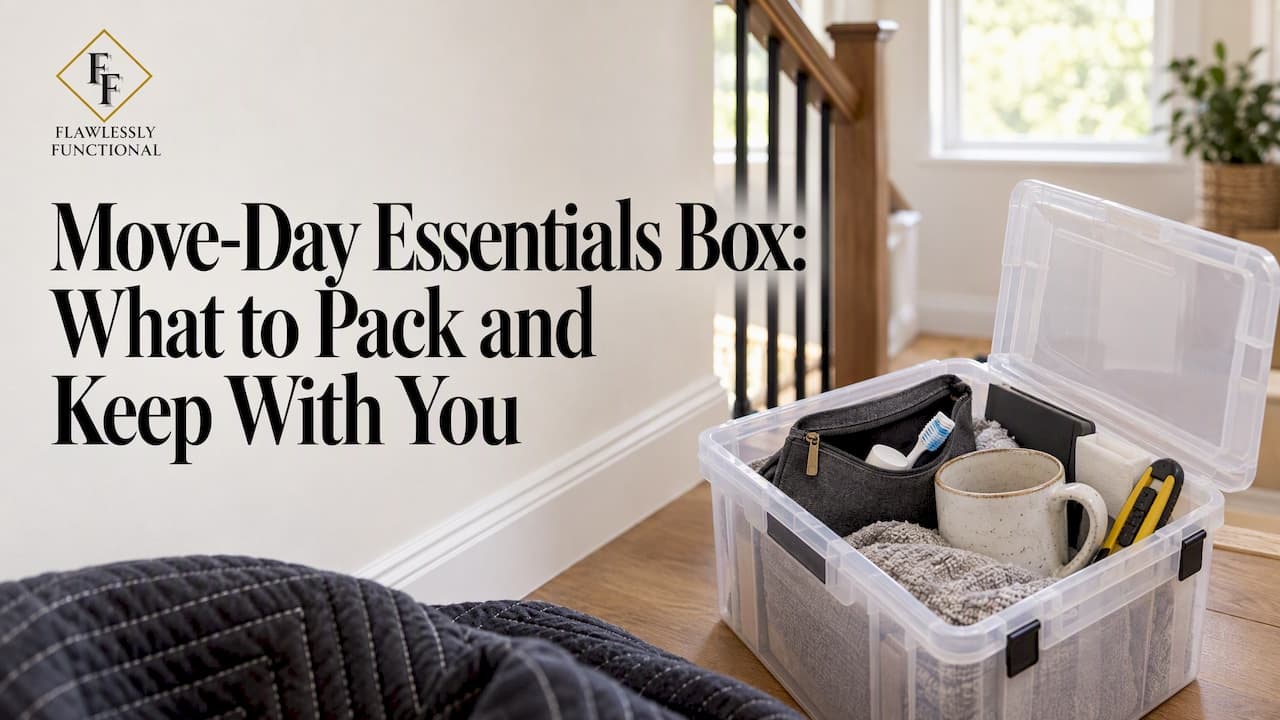
A move-day essentials box is the one container, or small set of containers, that holds everything you need from the moment packing ends until your new home is livable. Fill it with toiletries, medications, chargers, basic tools, cleaning supplies, snacks, bedding and a change of clothes. Label it, and keep it with you in your own car, never on the moving truck.
That is the short version. The rest of this guide covers what to put in it, how to build it a week early, and the small decisions that separate a calm first night from a frantic search for a box cutter at 9 p.m.
TL;DR
- Plan the box to cover at least 24 to 48 hours of normal life, because trucks run late and utilities don't always cooperate.
- Build it about a week before moving day, so you don't pack away something you still use every morning.
- Toilet paper, hand soap and a box cutter are the three items people forget most often. Pack them first.
- Documents, medications, jewelry and keys ride with you in your car. See the FTC's moving guidance on protecting your paperwork.
- Use bright tape and write "OPEN FIRST" on every side so nobody mistakes it for ordinary cargo.
Table of Contents
- What a move-day essentials box actually is
- How long it needs to last
- When to build it
- What goes in the box: a category checklist
- The things that must ride with you
- Labeling and containers
- Adapting the box to your household
- Our perspective: the box is a design problem
- Common mistakes
- First-day sequence once you arrive
- When a professional makes sense
- FAQ
- Sources
What a move-day essentials box actually is
People call it an essentials box, an open-first box, a first-night box or a moving day survival kit. The idea is the same in each case. Your household will be split in two for a stretch of time: the things on the truck and the things with you. The essentials box is the second group, and it exists so that you can function while the first group is in transit, stacked in a hallway or still waiting to be unwrapped.
It is not a box of everything you might want. It is a box of what you would be annoyed to be without in the first day or two. That distinction matters, because the most common failure is the opposite one: a box so overstuffed that you can't find the toothbrush inside it.
For most households, one box is not enough. A couple with no children can often manage one large bin plus a bag. A family with kids, a pet and a home office needs several smaller containers, each with a clear job.

How long it needs to last
Moving companies commonly design the kit to support the household for a minimum of 24 to 48 hours. That buffer covers the usual surprises: the truck arrives late, the electricity isn't switched on, the internet technician is booked for Thursday, or a loading dock is blocked.
For a local move across San Antonio, you may be sleeping in the new house the same night. For a long-distance move into Texas, the truck can take days. Pack for the longer scenario. An extra pair of socks costs you nothing, and a missing one costs you an evening.
When to build it
Don't assemble the box on moving morning. By then you are tired, the crew is at the door, and every drawer looks equally important. A better rhythm:
- One to two weeks out: Choose the containers and start a running list on your phone. Every time you reach for something and think "I'll need that on day one," write it down.
- One week out: Pack the things you don't use daily: spare linens, extra towels, a basic toolkit, cleaning supplies, light bulbs.
- The night before: Add the daily items you used that evening: phone charger, medications, glasses, toothbrush.
- Moving morning: Add the coffee maker's last use, the final wipe-down supplies and the keys, then seal the box and put it in your car yourself.
This one-week lead also fits the broader timeline. Mayflower suggests starting general packing about two months before your move, partly because sorting and reducing what you own lowers the weight of the shipment, and many estimates are based on weight. If you are still deciding what comes with you, our guide to downsizing before moving breaks the work into 20 to 30 minutes a day.
What goes in the box: a category checklist
Start with the person, then the house, then the tools. The table below is the master list. Adjust it for your household.
| Category | What to pack | Why it earns a place |
|---|---|---|
| Bathroom | Toilet paper, hand soap, toothbrushes, toothpaste, face wash, deodorant, a towel per person, shower curtain and rings | The first things you need and the most often forgotten |
| Health | Prescription medications, glasses or contacts, pain reliever, bandages, any daily supplements | Replacing these on a Sunday evening is hard |
| Tech | Phone and laptop chargers, power strip, extension cord, portable battery, router and modem | Power and connection run the first evening |
| Tools | Box cutter, scissors, screwdrivers, hex keys, tape measure, hammer, pencil, marker, extra tape | You can't unpack what you can't open |
| Cleaning | All-purpose spray, paper towels, trash bags, sponge, dish soap, a small broom | Wipe shelves and counters before you load them |
| Kitchen | Paper plates, cups, utensils, a knife, a can opener, a kettle or pot, coffee, snacks, bottled water | Dinner without hunting through ten boxes |
| Bedroom | Sheets, pillows, a light blanket, pajamas, a change of clothes per person, an air mattress if beds will be late | Sleep sets up the next day |
| Comfort | A favorite mug, a book, a small speaker, a candle | Moving is draining, and small comforts help |
| Home basics | Light bulbs, a flashlight, a night light, batteries, a fresh HVAC filter | Not glamorous, but the house works from hour one |
A few notes on the trickier rows.
The kitchen row
Resist the urge to pack a real kitchen. You want food and drink for one or two meals, and tools to eat them: paper plates, a few utensils, one good knife, a can opener, a pot or kettle. If you want a fuller view of what a new kitchen needs once the boxes open, this list of kitchen essentials for a new home is a good place to plan your first shopping trip. Keep the essentials box itself lean.
The tools row
A box cutter is the most useful object in the entire move. A basic toolkit with screwdrivers and hex keys lets you put a bed frame back together on night one instead of sleeping with the mattress on the floor. Moving professionals also suggest putting a fresh HVAC filter in the kit, since replacing it early is an easy way to start the house on the right footing, especially in a property that hasn't been cleaned since the last occupants left.
The comfort row
This one is easy to skip and shouldn't be. Moving is a physical and emotional load, and people who plan a little downtime and personal care into the kit tend to settle better than those who run on adrenaline until they crash. A phone charger and a familiar mug are not frivolous.
The things that must ride with you
Some items should never go near the truck. Keep these in your personal vehicle, ideally in a separate bag from the main essentials box so they are easy to track:
- Wallets, IDs, passports and travel documents
- Birth certificates, Social Security cards and other vital personal records, which the FTC advises storing securely
- Closing papers, lease or mortgage documents and moving contracts
- Prescription medications
- House and car keys, garage remotes and gate codes
- Jewelry, watches and small high-value items
- Laptops, external drives and anything with irreplaceable data
The FTC's advice on hiring a mover is a reminder to read your contract and check the mover's registration before moving day. Read the coverage terms too, because a standard policy may not make you whole for sentimental or hard-to-replace items. Carrying them yourself removes the question.
If you own pieces you would never want out of your sight, we walk through a method in our guide to securing jewelry during a move. Heirloom clothing and wardrobe items have their own approach, which we cover in packing a home wardrobe.
Labeling and containers
The best-packed box fails if a tired crew treats it like any other carton. A system that works:
- Pick one bright tape color that you use for nothing else. Neon green or orange is easy to spot across a room.
- Write "OPEN FIRST" in large letters on all four sides and the top. Boxes get stacked, and a label on one side only gets buried.
- Number multiple containers ("Open First 1 of 3") so you notice if one goes missing.
- Use clear bins or sturdy bags for the items you need to see, such as chargers and toiletries.
- Keep a one-page contents list taped inside the lid or saved on your phone.
For larger households, split the load by purpose rather than packing one giant bin. A bathroom-and-health container, a kitchen-and-cleaning container, a tools-and-tech container and a bedding bag are all easier to carry and easier to unpack than a single heavy box.
Adapting the box to your household
Families with children
Add snacks, a favorite stuffed animal, a few quiet activities, spare clothes for accidents, and anything needed to recreate the bedtime routine. Children settle faster when bedtime looks the same. If you are moving with a baby, the nursery comes first. Our newborn moving plan lays out a 24 to 72 hour sequence.
Pet owners
Pack food, bowls, medication, leash, waste bags, a bed or blanket and a familiar toy. Keep the vet's contact information with the documents.
Remote workers
If you work from home, the box should include your laptop, chargers, headset, a mobile hotspot if internet isn't live yet, and the router. A usable desk matters more than a finished one, and our guide to a home office setup after a move shows how to get there in under an hour.
Texas heat
If you are moving in a San Antonio summer, add more water than you think you need, a cooler with ice, sun protection and a few extra towels. Heat is hard on food, on people and on anyone carrying furniture. A small fan can make the first night more comfortable if the air conditioning needs attention. Check that cooling works as soon as you arrive, not at bedtime.
Our perspective: the box is a design problem
We organize and move homes in San Antonio for a living, and we look at the essentials box the way we look at any storage system: it should match how you actually live. The generic list is a starting point. The useful version reflects your mornings, your evenings and the things your household reaches for without thinking.
Here is what we tell clients.
Walk your own day. Spend one ordinary weekday noticing what you touch: the coffee setup, the medication shelf, the charging spot, the kids' backpack routine. That is your list, and it is better than anything you will copy from a website.
Pack in zones, not in one pile. A box that has a bathroom section, a kitchen section and a tools section can be unpacked in minutes. A jumble takes an hour and leaves you frustrated.
Make the first night feel finished. We care about function and appearance together. Made beds, a lamp that works and a towel on a hook change how a house feels on night one. Clients who have those few things in place tend to approach the rest of unpacking with more energy.

Don't let the box grow. It is tempting to add "just one more thing." Keep it to the first day or two. Everything else belongs in labeled boxes, unpacked room by room. Our walkthrough on unpacking after a move shows how to finish the core rooms in three to seven days.
Take the load off yourself. Moves go better when one person owns the plan. Whether that is you, a partner or a professional, decide who is responsible for the box, the car and the keys.
— Steve
Common mistakes
- Packing it on moving morning. You will forget something, or you will pack away something you still need.
- Letting it go on the truck. Once the truck is loaded, the contents are out of reach until delivery and unloading are done.
- Forgetting toilet paper and soap. These top the list of items people regret leaving out.
- Skipping the tools. No box cutter means you will be opening cartons with house keys.
- Labeling one side. Boxes are stacked. Label the top and all four sides.
- Putting it in the trunk under everything. Keep it where you can reach it, on the back seat or in the cargo area, not under suitcases.
- Ignoring the first morning. Add coffee, a mug and breakfast items. The first morning in a new home is easier with a hot drink.
First-day sequence once you arrive
With the box in hand, a short routine keeps the day from spiraling:
- Do a safety check: smoke detectors, locks, water and electricity. Our first 48 hours checklist covers the essentials.
- Check the air conditioning or heat and swap in the fresh HVAC filter.
- Stock the bathroom with toilet paper, soap and towels.
- Make the beds before the truck crew leaves, or before you are too tired.
- Set up chargers in one spot so devices stay powered.
- Eat a simple meal on paper plates and stop for the day.
- Put the box cutter, tape and marker somewhere central and begin opening boxes the next morning.
For a calmer plan for those early days, see our list of day one tasks to settle into a new home.
When a professional makes sense
Some households don't want to build the box, label it, coordinate the crew and then unpack. If your schedule is crowded, you are downsizing, or you are moving into a larger home and want it to feel ready quickly, a concierge service can do the heavy lifting.
Our Moving Management Concierge service handles packing, unpacking, downsizing and organizing during a relocation in the San Antonio area, with a personal, white-glove approach and minimal disruption to your household. If you want your new pantry, closets and storage set up in a way that lasts, our luxury home organizing work picks up where the essentials box leaves off. We don't publish prices because each project is customized, so the best step is to reach out through our site and describe your move.
FAQ
What do you need on move-in day?
You need the items that let you wash, sleep, eat a simple meal, charge your devices and open boxes: toiletries, bedding, medications, chargers, paper goods, snacks, cleaning supplies and a box cutter. Add your documents and keys, which travel with you. Plan for at least a day or two of normal life.
Should the essentials box go on the moving truck?
No. Keep it in your own vehicle, because once the truck is loaded, you can't reach anything on it until delivery and unloading are complete. Trucks can arrive late, and boxes can be buried under the main shipment.
How long before moving should you start packing?
For the general household, Mayflower recommends starting around two months before the move. The essentials box itself should come together about a week out, with last-minute daily items added the night before.
What items will movers not pack?
Policies vary by company, so ask your mover for the written list. Hazardous materials, perishables and plants are commonly excluded. Irreplaceable valuables, documents and medications should go with you in any case, as the FTC advises when you are choosing and contracting a mover.
Sources
- Secrets to Surviving a Move, Mayflower
- Avoid scams when you hire a moving company, FTC Consumer Advice
- Ultimate List of Kitchen Essentials for a New Home