
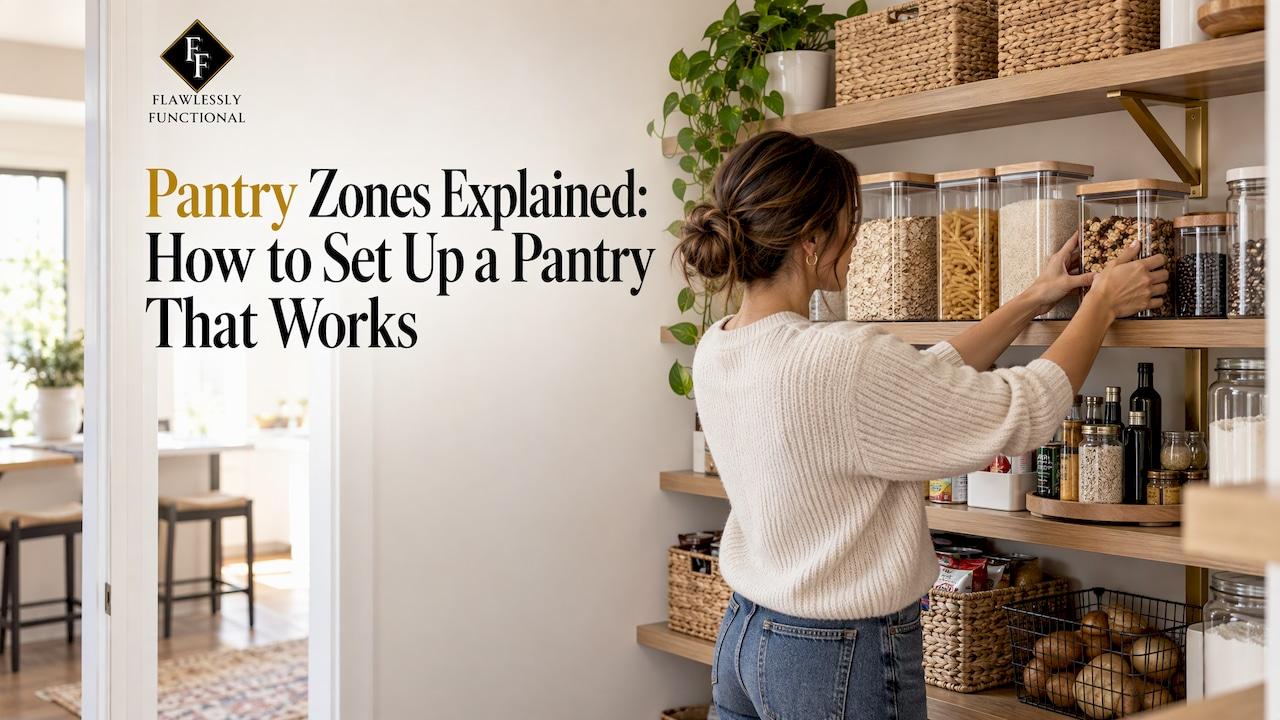
A pantry zone is a designated home for one category of food, placed according to how often you reach for it. Daily items sit at eye level, weekly items one shelf away, and occasional or bulk items high or low. Done well, zones mean you can find anything in seconds and never move one item to reach another. Done for you, they are built around your household's routines, which is what we do for homeowners in San Antonio through our home organizing service.
TL;DR
- A zone is a labeled spot for one category of food, positioned by how quickly you need the items, per Wirecutter.
- Group by how you cook and eat (breakfast, baking, weeknight meals), not by package type, then place each group by frequency of use.
- A common layout has five zones: daily essentials at eye level, cooking staples nearby, snacks low, specialty items high, bulk stock on the floor.
- Keep the pantry cool, dry and dark, roughly 50 to 70°F, and away from heat sources, per Texas A&M AgriLife Extension.
- A pantry system lasts only if it matches your routines, which is why a custom setup holds up better than a copied layout.
Table of Contents
- What a pantry zone actually is
- Two ways to build zones: by function or by frequency
- A five-zone layout you can start from
- How to set up your zones, step by step
- Zones for different households
- What belongs in a pantry, and what does not
- Common mistakes that undo a zoned pantry
- What pantry organization costs
- Our perspective on pantry zones
- Let us build your pantry zones
- FAQ
- Sources
What a pantry zone actually is
Wirecutter describes a zone as a spot set aside for each food category. It can be a shelf or two, or a single bin. Its location depends on how fast you need the items: the things you use constantly go where you can grab them without looking, and a miscellaneous zone catches seasonal or hard-to-classify items (Wirecutter).
That gives you two decisions for every item: which group it belongs to, and where that group lives. Most pantries fail because they answer only the first question, or neither. Everything is stacked wherever there was room on the day of the grocery run.
Zoning also forces priorities. Organizer Gabai, speaking to The Kitchn, points out that many people give every object equal importance. Zoning puts the most-used things in the most convenient place and makes you question duplicates (The Kitchn).
Two ways to build zones: by function or by frequency
You will see two logics in pantry advice, and the best pantries use both.
Function: how you cook and eat. Naeemah Ford Goldson told Wirecutter that food should be sorted into themed categories rather than by size or shape, and that ingredients for frequently made dishes can be grouped together (Wirecutter). The American Buyer's testing team goes further: organizing by cooking function rather than food type was the most important step they found. Keeping all cans together looks orderly, but cooking one meal sends you to several shelves (The American Buyer). A "staple meal" zone, with pasta, canned tomatoes and breadcrumbs side by side, is a good example.
Frequency: how often you reach for it. Within the zone map, position follows usage. Everyday items go at eye level. Weekly items go on middle shelves. Occasional items such as holiday baking supplies go up high, and heavy items stay low.

A third approach borrows from the grocery store: rice next to pasta, soup with canned goods, condiments together. The Kitchn reports organizer Godding using exactly this aisle logic, with popular labeled categories including baking, condiments, breakfast, snacks, grains, canned goods and beverages (The Kitchn).
A five-zone layout you can start from
The American Buyer tested a five-zone layout across six households. It reports that placing daily essentials at eye level cut the average time to find an item from 12 seconds to under 3 (The American Buyer). Here is that structure with examples of what goes in each zone.
| Zone | Where it sits | What goes in it |
|---|---|---|
| Daily essentials | Eye level | Coffee, tea, cereal, rice, pasta, cooking oil |
| Cooking staples | One shelf above or below eye level | Canned tomatoes, beans, sauces, flour, baking ingredients, spices |
| Snacks and quick meals | Lower shelves, at children's eye level | Granola bars, crackers, easy lunches |
| Specialty and occasional | Highest shelves | Specialty flours, holiday baking supplies, serving pieces |
| Bulk and backup | Floor level | Extra cases of canned goods, water, paper goods |
The examples for daily and weekly items follow the frequency tiers described by an organizing resource that suggests heavy items live on low shelves. That is also common sense: lifting a case of tomatoes overhead is how people get hurt.
Gabai's version for The Kitchn uses numbered priority zones. Zone 1 is the most-used items at eye level, Zones 2 and 3 hold less frequent items, Zone 4 is for important but rarely reached items, and Zone 5 is only for storage you rarely see (The Kitchn). It is the same idea with different labels. Pick the version that matches how you talk about your kitchen.
How to set up your zones, step by step
1. Empty the pantry and sort by category
Take everything out and group it on a counter. Discard what is expired and what you know you will not eat. This is the step where most people stall. Sorting hundreds of items in one afternoon is tiring, and decisions get worse as the day goes on. When we organize a pantry for a client, we handle the sorting and the editing alongside you, so the day moves quickly and the decisions stay yours.
2. Name your zones from how you actually cook
Watch your own habits before you assign anything. Look at what you reach for at breakfast, on a weeknight, and when the kids come home. Keep a few days of notes if you can. A child's daily snacks may deserve an easy-to-reach home even if adults rarely eat them, and your layout should serve each person in the household.
Typical zone names: breakfast, grains and pasta, canned goods, baking, snacks, oils and condiments, beverages, and a miscellaneous zone. Keep the list short. Eight to ten clear zones are plenty for most pantries.
3. Assign each zone a position
Put the most-used zones at eye level and within easy reach. Place heavy and bulky items low. Place light, rarely used items high. Liquids such as oils and vinegars are best low and on a tray or mat, so a drip never reaches the shelf below.
If your shelves are deep, items in the back disappear. Our guide to deep pantry organization covers how to make shelves over 16 inches usable.
4. Decant and contain
Wirecutter recommends airtight, transparent, stackable containers sized to your shelf depth for dry goods. In its tests, its top pick, the Rubbermaid Brilliance Pantry Food Storage Containers, kept Goldfish crackers crunchy for three weeks, longer than any other canisters tested (Wirecutter). Clear containers let you see levels at a glance, and a defined bin edge tells you where a zone ends.
Measure before you buy. Containers that do not fit the shelf depth waste space and break the zone lines. This is one reason we plan storage around your actual shelves rather than a generic product list: our work is customized storage solutions for all home spaces.
5. Label every zone
A zone that nobody can read becomes a pile again within a month. Labels also help guests, house help and kids put things back. For ideas that suit a polished kitchen, see these pantry label ideas.
6. Put a maintenance habit in place
A zone system stays tidy when returning an item is as easy as grabbing it. Keep a small restock list, and check the front-to-back order when you shop. Older items go in front and new ones behind. The goal is a system that survives a busy week, not one that looks good for the photo.
Zones for different households
Families with children. The lowest shelf is a natural zone for self-serve snacks, a suggestion Wirecutter attributes to NABPO founder Naeemah Ford Goldson (Wirecutter). The American Buyer reports parent estimates that child-height snack zones cut "what can I eat?" interruptions by 60 to 70 percent (The American Buyer). That is parent reporting, not a controlled study, but the logic is easy to see: kids who can reach their own food stop asking for it.

Households with allergies or gluten-free needs. Give those foods their own zone and container color, so that nobody has to read labels at speed. Keep the zone separate from shared baking supplies.
Small pantries. Use door-mounted racks and stackable bins, and trim the number of zones. Combine breakfast with snacks, or canned goods with sauces, rather than squeezing a dozen tiny zones into four shelves.
Walk-in pantries. You can give each zone a full shelf, add a beverage station and keep a bulk area on the floor. Walk-ins often become overflow storage, so decide in advance what belongs there. If the pantry sits inside a bigger kitchen plan, our piece on organizing a luxury kitchen shows how zones, clearances and storage fit together.
What belongs in a pantry, and what does not
What to keep depends on your cooking, but a common staple set includes canned tomatoes, beans, tuna and broth, dried pasta, rice and grains, vegetable oils, baking soda, flour, sugar and cocoa. Hardy vegetables such as potatoes, onions and garlic go in separate baskets and are never refrigerated, with potatoes and onions kept apart (Martha Stewart).
The conditions matter as much as the layout. Texas A&M AgriLife Extension advises a dry, cool, dark pantry at 50 to 70°F, away from the range, oven, water heater, dishwasher or hot pipes. It recommends foods in clean metal, glass or plastic containers, stored off the floor and away from walls, and it advises cleaning the pantry periodically to remove food particles that attract pests (Texas A&M AgriLife Extension). In Texas heat, that means a pantry on an exterior wall or next to the oven deserves extra attention.
Oregon State University Extension adds that pantry storage should stay below 85°F, with the best range at 50 to 70°F, and that tight-fitting lids protect against insects and humidity. It notes that many insects can infest flours, cereals, grains, dried fruit and nuts kept longer than two months. It also says bulging cans signal spoiled food that must be discarded, and dented cans with damaged seams may leak invisibly (Oregon State University Extension).
Practical takeaways for your zones:
- Keep flour, grains and nuts in sealed containers and rotate them within a couple of months.
- Never park potatoes or onions under the sink.
- Put a date on decanted items so rotation is automatic.
- Check cans when you restock and discard any that bulge.
Common mistakes that undo a zoned pantry
- Zoning by container type. All the cans together looks tidy but scatters a single meal across the shelves.
- Too many zones. If you cannot name each zone from memory, there are too many.
- Ignoring who uses the pantry. A layout built for one adult fails the family.
- Buying containers first. Measure shelves and sort food before you shop for bins.
- Skipping the miscellaneous zone. Without one, odd items end up everywhere.
- No restock habit. The system drifts the moment new groceries are shoved in anywhere.
What pantry organization costs
The cost depends on the size of the pantry, how much needs sorting and which storage pieces the space calls for. Containers, labels and shelf liners are the smaller part. The larger one is your time, and the quality of the plan behind the purchases. Our organizing services are charged per project, and we do not publish a price list, because a compact reach-in and a walk-in with custom storage are different jobs. To scope your pantry, start from our organizing page.
Our perspective on pantry zones
A pantry is the room where a household's routines show most plainly. The zones are the easy part. The harder part is knowing who opens the door at 6 a.m., who packs lunches, and what gets cooked on a Tuesday.
That is why we do not hand every client the same layout. We build the system around the household's own routines, keep it functional first and make it look good second, and we aim for something that lasts rather than something that photographs well for a week.
If a move is part of the picture, the pantry is where good planning pays off most. Packing a pantry by zone means unpacking it by zone, and the new kitchen is working on day one.
Steve
Let us build your pantry zones
Flawlessly Functional provides luxury home organizing for homeowners in San Antonio, Texas. We take a collaborative, detail-oriented approach, design each system around how your household lives, and aim for minimal disruption while we work. Pantry zoning is one part of a wider service that covers every space in the home.

If you are also relocating, our moving management concierge service covers packing, unpacking and organizing at the new home. To plan your pantry or your whole house, contact us through our site.
FAQ
How many zones should a pantry have?
Most households do well with five to ten. The American Buyer's tested layout used five zones, and Gabai's system for The Kitchn also uses five priority zones. Add more only when a category, such as baking or beverages, has enough items to deserve its own shelf or bin.
What are the best categories for organizing a pantry?
Start with how you use the food: breakfast, baking, snacks, grains and pasta, canned goods, condiments and oils, beverages, and a miscellaneous zone. Wirecutter lists snacks, baking supplies, drinks, condiments and spreads, and oils and cooking liquids as common categories (Wirecutter). Adjust them to your own cooking.
What should not be stored in a pantry?
Anything that needs refrigeration, and anything exposed to heat, light or moisture. Keep food away from the oven, water heater and hot pipes, and do not store potatoes or onions under the sink, per Texas A&M AgriLife Extension. Bulging cans should be discarded.
How do I zone a pantry with deep shelves?
Use bins or pull-outs with assigned sections so items in the back stay reachable. Keep each zone to its own bin, and put the most-used bin at the front. Our deep pantry guide explains the layout in more detail.
Sources
- Wirecutter: How to Organize Your Pantry So It Works for You
- The American Buyer: How to Build a Pantry Organization System
- The Kitchn: How Zoning Can Help You Make the Most of Your Kitchen
- The Kitchn: The 30 Best Pantry Organization Tricks of All Time
- Texas A&M AgriLife Extension: Safe Home Food Storage
- Oregon State University Extension: Storing Food for Safety and Quality
- Martha Stewart: Essential Pantry Staples to Keep in Your Kitchen