
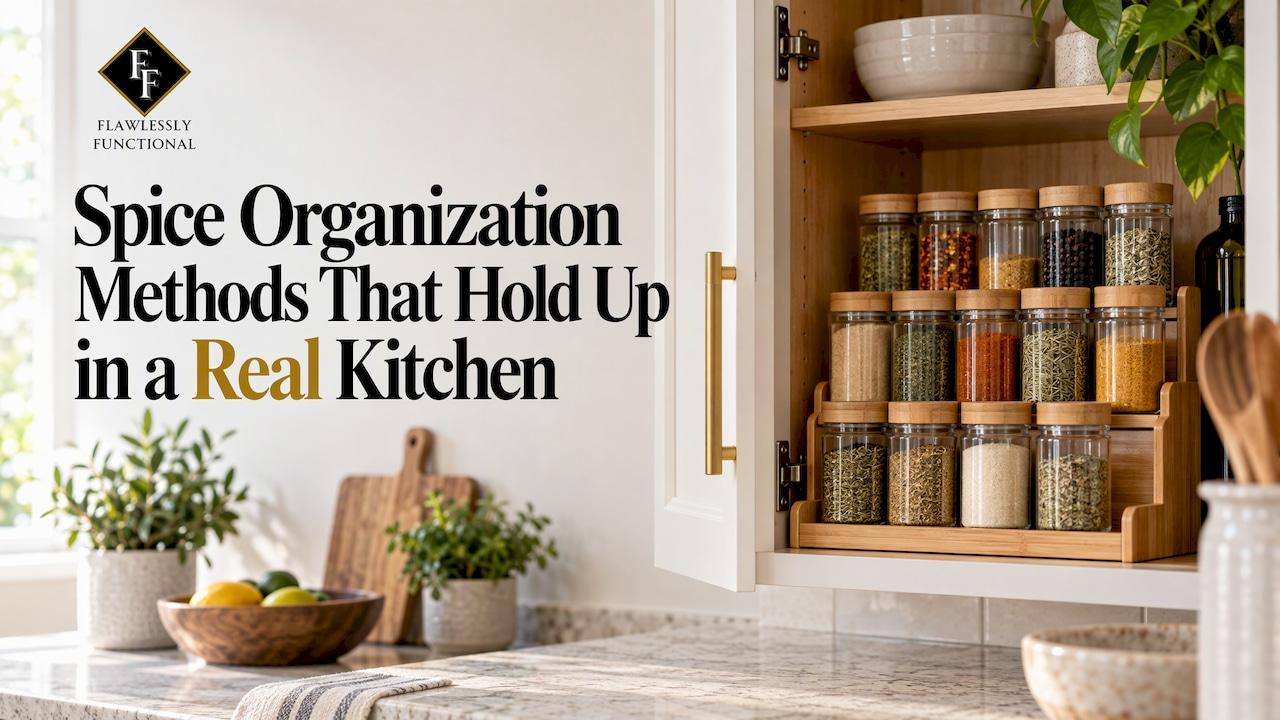
The best spice organization method is the one that matches how you cook and that you can maintain without thinking. Sort by how often you reach for a jar, store the jars where you can see every label, and clear out old stock once a year. That works in a small apartment and in a large kitchen with a walk-in pantry. In San Antonio homes we organize, the spice cabinet is rarely the real problem. The problem is a system that never fit the household's routines in the first place, so it fell apart within weeks.
This guide walks through each method, who it suits, where the jars should live and how to stop the clutter from coming back.
TL;DR
- Start by pulling out every jar, discarding duplicates and expired spices, and keeping only what you actually use.
- Pick one sorting logic: by use, by category or cuisine, or alphabetical. Frequent cooks do best with use first, then category.
- Visibility beats capacity. Tiered racks, turntables and drawer inserts keep labels in view so you never buy a third jar of cumin.
- Use matching glass jars, labeled on the lid and dated on the bottom, and run a yearly cleanout.
- If your kitchen layout fights every system you try, a professional home organizing plan built around your routines saves the trial and error.
Table of Contents
- Start with a clear-out, not a rack
- The main spice organization methods compared
- Drawer, cabinet or wall: where spices should live
- Containers and labels that make a system stick
- A worked example: a 40-jar collection
- Keeping the system alive
- Our perspective
- When you want it done for you
- FAQ
- Sources
Start with a clear-out, not a rack
Most people buy a rack first and sort second. That order is backwards. A rack holding forty jars of which twenty are stale is still clutter, only better displayed.
Consumer Reports describes the spice project as a one-to-three-hour job: take stock of what you have, choose organizers that keep everything visible, sort in a way that suits you, decant into matching jars, then label and date each one. Homes & Gardens adds a useful rule for the first pass: pull out every jar, discard duplicates and expired items, and let go of anything you have not used in the last six to 12 months.
A practical way to run the clear-out:
- Empty every cabinet, drawer and countertop spot where spices live onto one surface.
- Group identical items. Most households find two or three jars of the same spice, often from a recipe that needed only a teaspoon.
- Check dates and smell. Wirecutter notes that most spices can last up to three years but shouldn't be kept that long, because flavor fades. Its editors suggest using up half-empty jars, for example by combining them into a rub, or composting the really old ones.
- Set aside the ones you cook with weekly. They will get the best real estate.
- Wipe down the shelf or drawer before anything goes back.
Only now do you know how many jars you have to house, which is the number that decides which method and which storage will work.
The main spice organization methods compared
There is no single correct sorting logic. Martha Stewart's guide says the technique comes down to personal preference: most-used spices within easy reach, category bins, or alphabetical. Consumer Reports' expert advice says much the same: there is no right way to sort spices. Here is how the common approaches compare in practice.
| Method | Best for | Watch out for |
|---|---|---|
| By frequency of use | Daily cooks, small kitchens | Needs an honest look at what you really use |
| By category (baking, savory, blends) | Mixed cooking styles | Categories need clear boundaries |
| By cuisine | Households that cook a few cuisines regularly | Spices that belong to several cuisines |
| Alphabetical | Large collections, shared kitchens | Gets harder as new spices arrive |
| Color-coded | Visual thinkers, busy families | Takes a few minutes of sticker work up front |
By how often you use them
This is the method we reach for first. Put the jars you grab several times a week in the prime spot, near the stove or prep area, and push the occasional ones further back or higher up. Homes & Gardens lists grouping the most-used spices in a prime position as one of its three core options, and Wirecutter's guide also suggests putting high-use spices up front.
Salt, pepper, garlic powder, paprika and cumin often earn the front row. Everything else follows by category.
By category or cuisine
Consumer Reports suggests dividing spices by type, such as savory, sweet and baking, salts and peppers, and seasonings, or separating herbs from spices. Cuisine grouping works the same way: if you cook Tex-Mex on Monday and Indian on Thursday, keep the cumin, chili powders and oregano in one bin and the turmeric, coriander and garam masala in another. The advantage is that you pull a single bin and cook.
One caution: cumin, paprika and coriander cross cuisines. Decide once where each lives, and write it down on the inside of the cabinet door if more than one person cooks.
Alphabetical
Alphabetical order is the most familiar and works well when the collection is large and several people share the kitchen. Martha Stewart's guide points out that it can lead you to grab chili powder when you meant cinnamon, since neighbors in the alphabet look alike at a glance. Consumer Reports adds that it is harder to maintain as new spices come in, because every new jar means shifting the whole row. A loose alphabetical order inside each category is a good compromise.
Color-coded
America's Test Kitchen describes a system where each bottle gets a colored sticker for its category, such as red for warm spices and green for herbs, and the bottles are stored in groups so each is visible. A stranger can put things back correctly, which suits families with kids who help unload the dishwasher and groceries.
Salt and pepper get their own place
Larger canisters of salt and pepper rarely fit in with small jars. Martha Stewart's guide notes that one organizer gives them separate space for exactly that reason, and another keeps a single salt-and-pepper set on a turntable next to the stove. If you cook daily, that second approach saves a lot of reaching.
Drawer, cabinet or wall: where spices should live
The right location is the one closest to where you cook, at a height you can reach without a step stool, and sheltered from the stove's heat.
Drawers
A drawer near the cooktop is the favorite of many cooks. The Kitchn notes that a drawer saves cabinet space and puts go-to seasonings within easy reach, provided the jars stand upright or lie flat with the tops labeled. Martha Stewart's guide matches the drawer depth to the insert: shallow drawers suit tiered racks that hold jars at a slight angle, while deep drawers do better with a basket or bin to keep jars upright.

For wide shallow drawers, Consumer Reports suggests a liner, an in-drawer rack or an expandable organizer, and it names options such as a spice liner roll and an expandable shelf. Measure the drawer's interior width, depth and height before buying anything. We cover the layout logic in more detail in our guide to kitchen drawer organization.
Cabinets
In a cabinet, the enemy is depth: whatever sits in the back disappears. The solutions are a tiered riser, a turntable or a pull-out bin. Consumer Reports' pantry guide reports that professionals favor an expandable tiered organizer on a shelf because it keeps jars visible while using the space well, and a nonslip turntable for 360-degree visibility. Martha Stewart's cabinet guide recommends placing the rack in a cabinet near where you prep or cook. Awkward corner cabinets can handle a small collection on a turntable.
If spices share a deep pantry, the same logic applies to the shelves around them. Our guide to deep pantry organization covers shelves over 16 inches, and pantry zones show where spices fit among oils, baking goods and snacks.
Walls, doors and the fridge
When cabinet and drawer space is scarce, Consumer Reports lists wall-mounted racks, over-the-door organizers and magnetic jars on the refrigerator as alternatives. Wirecutter also mentions picture shelves and a custom wall rack. A wall rack looks great, but it works best for spices you use fast, since light and heat shorten their life. Put the rack away from the range.
Containers and labels that make a system stick
The jars and labels are what you see every day, so they affect both function and the look of the kitchen.
Glass, matching and visible
America's Test Kitchen found that glass is the best choice for spices. You can see how much is left, and glass does not react with spice oils or soak up odors the way plastic can. If you would rather not decant everything, you can buy in glass jars or standardize on a set of glass jars. Matching jars also give a clean, uniform look. Consumer Reports recommends decanting into matching jars as part of the process.
How much room to plan for
The same test kitchen suggests choosing a device that holds at least 50 four-ounce jars, noting that smaller models proved inefficient, and says visibility, meaning jars that do not block each other's labels, is what makes spices quick to find. Even if you own 30 jars today, plan for growth. Spice collections only get bigger.
Label twice
Label the top of the lid if jars lie flat or sit in a drawer, and the front near the top if they stand on a tiered rack. America's Test Kitchen recommends lid labels, jar-front labels, or both. On the bottom, write the date you opened or refilled the jar. Consumer Reports suggests an erasable best-by date on the base that you wipe and rewrite when refilling, and America's Test Kitchen likewise recommends dating each spice when you open it.
Labels also tell everyone in the house where things go back. If you want consistent, good-looking labels across the pantry, see our ideas for pantry labels.
A worked example: a 40-jar collection
Take a family that cooks most nights and owns about 40 jars, many of them duplicates.
- Clear-out (one hour). Pull everything out, merge the duplicates and discard the stale. The collection shrinks to about 30 jars.
- Sort by use. Eight jars are used weekly: salt, pepper, garlic powder, onion powder, paprika, cumin, chili powder and cinnamon. These go in the drawer beside the stove, labeled on the lids.
- Group the rest by category. Baking spices (nutmeg, cloves, allspice, ginger) go in one bin. Herbs go in another. Blends and international spices go in a third.
- Put the bins in an upper cabinet next to the prep area, on a two-tier riser so back jars are visible.
- Date the bottoms with the day of the cleanout.
- Leave 20 percent empty space for the jars you will buy this year.
The whole thing takes an afternoon, and nothing in it needs a special purchase except a drawer insert and a few matching jars.
Keeping the system alive
A spice system fails slowly. A new jar goes in the wrong place, another gets bought because the first was hidden, and eventually you are back where you started.
Two habits prevent this. First, when a jar runs out, refill it from a bag or replace it into the same slot, so the row never rearranges. Second, run an annual review. Martha Stewart's guide quotes an organizer recommending going through all your spices once a year and tossing anything past its best-by date, with November a good time so holiday baking tastes right. That is also a natural moment to sort the rest of the season's storage; if you are packing away holiday pieces afterward, these Christmas decor storage ideas pair well with a kitchen refresh.

For how long to keep ground spices: Consumer Reports says they may last up to four years before losing their punch, while Wirecutter's editors say to avoid keeping them as long as three. Your dated bottom labels turn that range into a simple check: if the date is more than a couple of years back and the aroma is faint, replace it.
Our perspective
Most spice advice is about racks. In our work, the rack is the last decision, not the first. What matters is who cooks, how often, what they reach for with one hand while stirring with the other, and where in the kitchen the traffic actually flows.
That is why we build every system around the household's routines instead of a template. A couple who bakes on weekends needs a different spice setup than a family cooking Tex-Mex four nights a week. We pair that with a look that suits the kitchen, because a system you enjoy seeing is a system you keep up.
The spice drawer is also a small preview of the whole house. If the kitchen works, the pantry, the closets and the garage follow the same logic, and the result lasts.
Steve
When you want it done for you
If you would rather spend your weekend on something besides measuring drawers and relabeling jars, our team handles it. Flawlessly Functional provides luxury home organizing for homeowners in San Antonio, Texas: personalized systems for the kitchen, pantry and the rest of the house, designed to be both functional and beautiful, with a collaborative, detail-oriented approach. Our clients have given us a 4.9 Google rating.

Planning a move? Our moving management concierge service covers packing, unpacking and organizing during relocation, so the new kitchen is set up the way you cook from day one. See our organizing services to get started.
FAQ
How do you categorize spices?
The three common ways are by type (baking, savory, salts and peppers, blends), by cuisine, and by how often you use them. Pick the one that matches how you cook, and keep each category in its own bin or row. If you cook a lot, put the daily jars up front and group the rest by type.
Are spices better in a drawer or a cabinet?
Both work. A drawer near the stove keeps jars within easy reach and saves cabinet space, as long as jars are upright or labeled on top. A cabinet suits larger collections when you add a tiered riser or turntable so the back row stays visible. Choose the spot closest to where you cook, away from direct heat.
Is it better to store spices in glass or plastic?
Glass is the better choice. America's Test Kitchen found that glass lets you see how much is left and does not react with spice oils or absorb odors. Matching glass jars also give the collection a uniform look.
Can I use 20-year-old spices?
They are not harmful in most cases, but they will have lost most of their flavor. Consumer Reports says ground spices can last up to four years before losing their punch, and Wirecutter says quality fades over time. Date your jars and replace anything that has lost its aroma.
Sources
- How to Organize Your Kitchen, Consumer Reports
- 6 Ways to Store Herbs and Spices, Consumer Reports
- How to Organize a Pantry, Consumer Reports
- 12 ways to organize your spices, Homes and Gardens
- How to Store Spices to Keep Them Organized, Martha Stewart
- How to Organize Your Kitchen Cabinets, Martha Stewart
- The 22 Best Ways to Organize Spices, The Kitchn
- The Best Spice Storage Solutions, America's Test Kitchen
- Our Guide to Storing and Organizing Spices, America's Test Kitchen
- Test Kitchen Tips for Organizing Your Spices, America's Test Kitchen
- Ask Wirecutter: Spice Organization