

The best temporary living plan during a remodel is decided before demolition: which rooms you keep, which option fits the length of the project, and what gets packed, labeled and moved in what order. Most stress comes from the logistics around the stay, not the stay itself. If you are in San Antonio and want that handled for you, our moving management concierge service covers packing, unpacking and organizing during a relocation, so a remodel move-out runs on a plan instead of on improvisation.
TL;DR
- Stay in the house only if you can keep one bedroom, one full bathroom and some way to prepare food. Otherwise, plan to move out.
- Match the option to the duration: family or a hotel for days, an extended-stay hotel or weekly rental for weeks, a furnished monthly rental for months.
- Budget beyond rent: storage, a double move, parking and pet fees can add $1,500 to $3,000, and timelines slip, so add a buffer.
- Sort belongings into three groups (daily, later, off-site), label every box with its destination, and pack an essentials kit.
- Start 90 days ahead. Pets need their own plan, whether you stay or go.
Table of Contents
- Stay or go: the first decision
- If you stay: build a livable house inside a work site
- If you go: matching the option to the length of the project
- The real budget
- The 90-day timeline
- Sorting belongings: three groups
- Pets during a remodel
- Moving back: don't unpack into chaos
- Our perspective
- Let us run the move-out and the move-back
- FAQ
- Sources
Stay or go: the first decision
Every other choice follows from this one. Staying costs the least in rent, but it only works when the house stays livable.
One contractor guide says staying can work when essential rooms remain usable and construction can be contained. The same guide says moving out makes sense when essential rooms or utilities will be unavailable for a long stretch, structural work affects central areas, dust or noise conflicts with sleep or health, or children and pets cannot be kept safely away from the work.
Another builder's rule of thumb is to keep at least one sleeping area and one full bathroom usable in every phase, and to set up a temporary kitchen (microwave, coffee maker, mini fridge, cooler) if the kitchen is in scope.
A quick test:
| Your project | Likely answer |
|---|---|
| One bathroom or exterior work, a second bath available | Stay |
| Kitchen out of service for more than about two weeks | Usually move out |
| Floor refinishing, abatement, or whole-house work | Move out |
| Water or power off for long stretches | Move out |
| Someone in the house is especially sensitive to dust | Move out |
An occupied house can also make the job slower, because crews have to cover, clean and secure the site every day. If you are borderline, ask your contractor to price both versions of the schedule.
If you stay: build a livable house inside a work site
Staying works when you treat the house as zones, not as one big mess.
- Create one construction-free room. No tools, no boxes, no displaced furniture. This is where the family decompresses.
- Move daily essentials before the project area is packed. Medications, documents, chargers, work equipment, school supplies, toiletries, pet items and kitchen basics all belong on that list.
- Seal the bedrooms from the work zone. Dust travels. Closed doors help, and so does clean air handling. Construction dust can settle into ductwork, which is why it is worth reading about removing construction debris from vents before the crew leaves.
- Write the livability plan down. One builder calls the room-by-room plan the step most homeowners skip, and says sharing it with the family and the contractor ends the daily argument about where everyone sleeps, eats and works.
- Have a backup. Pick the hotel or rental you would use if week three goes badly, before you need it.
Budget for the hidden cost of staying. A household eating takeout for every meal can spend roughly $600 to $1,200 a month above its normal grocery budget, according to one Oklahoma City host's estimate. Prices differ in San Antonio, but the pattern holds: a kitchen-less house is not free.
If you go: matching the option to the length of the project
The right choice is mostly a question of duration. Published guides tend to sort the options this way:
| Option | Best for | Typical monthly range (US guides) |
|---|---|---|
| Family or friends | A few days to a few weeks | $0 to $500 in extra costs |
| Extended-stay hotel | Short projects, roughly 2 to 8 weeks | $800 to $3,000 in one contractor's estimate; $1,500 to $4,500 in another |
| Short-term rental (Airbnb, VRBO type) | 2 to 6 week bridges | $1,500 to $5,000+ |
| Corporate or furnished monthly housing | 30 to 90 days or longer | $2,000 to $4,000 |
| RV on your lot | Large lots, if zoning allows | $500 to $1,500 on the same list, with utility challenges |
These are national or other-city figures from company blogs and they move with season and location, so treat them as a range to compare against live quotes in your own area. In every case, compare the full cost: rent, utilities, Wi-Fi, parking, cleaning fees, pet charges and extra commuting, not just the nightly or monthly rate. Sonesta's comparison found furnished-rental totals running 10 to 25% above advertised rates.
Choose by routine, not square footage
One relocation specialist advises staying close to the site, because large projects require dozens of small decisions a day. Choose housing that supports the routines you already have: school drop-off, commutes, dog walks. A beautiful rental forty minutes away is a poor trade if you need to be at the site daily.
Assume the project runs long
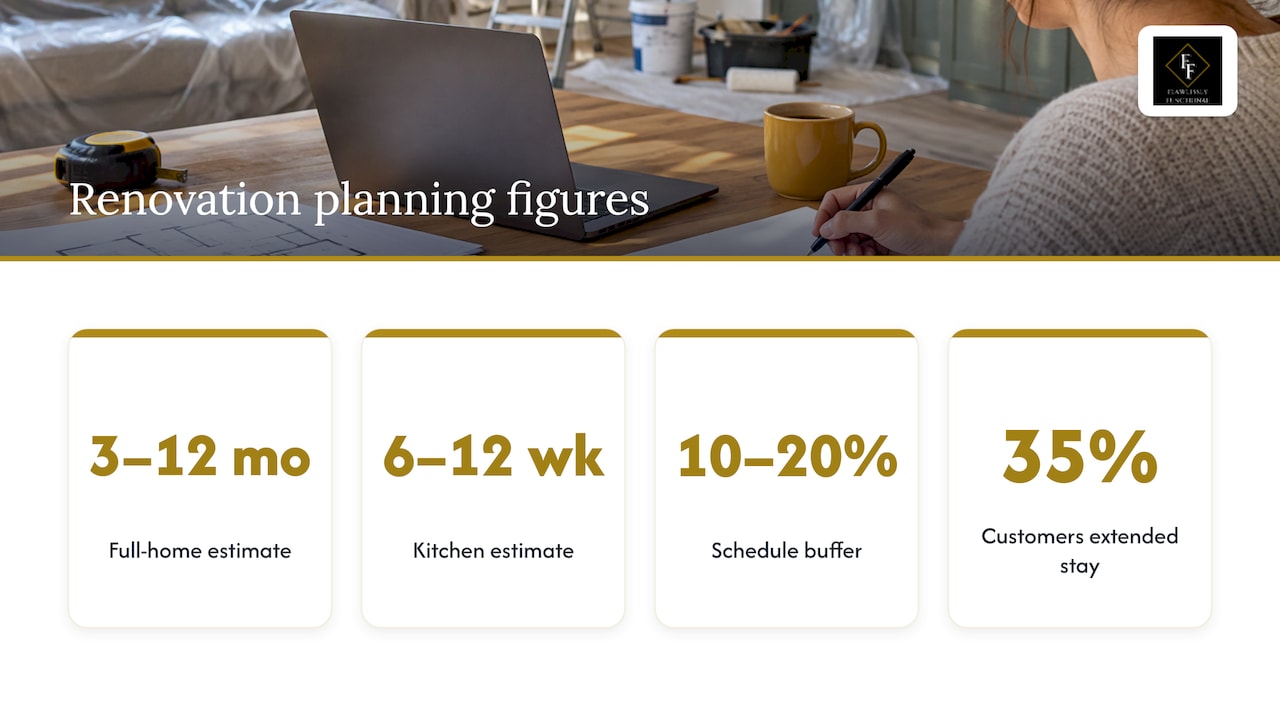
An industry guide puts full-home renovations at 3 to 12 months and kitchen remodels at 6 to 12 weeks, and suggests adding a 10 to 20% buffer for hidden issues, permits or material delays. A furnished-housing provider reported that 35% of its renovation customers extended their stay. The practical rule: book terms that extend month to month, and avoid a fixed lease that ends the week your tile is due.
The real budget
Rent is the visible number. The rest arrives later. One Atlanta housing guide lists the extras that can add $1,500 to $3,000 to a renovation housing budget:
- Storage: $150 to $350 a month for a 10x10 or 10x20 unit
- Double-move labor: $1,200 to $2,500 for two move days
- Parking: $150 to $300 a month in urban areas
- Pet deposits: $200 to $500 per pet
- Utility overlap at the house under renovation
Its advice is to add 25% to your calculated total. Nationally, a 10x15 unit averages about $158 a month, or $182 with climate control, and booking in fall or winter can be cheaper than the May to August peak. In Texas heat, climate control is worth pricing for furniture, art, wood pieces and electronics.
One more line item people forget: the house itself. Dust remains after the crew leaves, and post-construction cleaning is something to schedule before you move back in, not after.
The 90-day timeline
A widely used planning sequence from a furnished-housing marketplace works well as a skeleton:
- 90 days out: confirm the construction timeline and set a budget covering housing, storage, pets, parking, utilities and moving.
- 60 days out: compare options with full monthly quotes, and contact your insurer.
- 45 days out: choose a primary and a backup option, and reserve storage.
- 30 days out: sign the lease, schedule movers, set up mail forwarding.
- Move-in day: photograph the property, and test Wi-Fi, locks, appliances and smoke detectors.
Source: Furnished Finder's move-out timeline.
In the middle of that timeline is the work nobody schedules: deciding what goes where. That is the part a hired professional takes off your plate. Our Moving Management Concierge service includes packing, unpacking, downsizing and organizing during relocations.
Sorting belongings: three groups
A storage company's triage is the cleanest we have seen. Sort everything into three categories:
- Keep accessible: everyday clothing, toiletries, cooking supplies, medications, chargers.
- Store away at home: things needed later in the project but not daily.
- Store off-site: furniture, seasonal items, anything you will not touch for months.
The sorting is also the best moment to let things go. Every box you do not move twice saves labor and storage rent. If you want a method, our guide to downsizing before moving in 20 to 30 minutes a day works room by room, and our household inventory checklist gives you a record of what went into storage.
Pack in the order of the work
Pack the rooms under construction first, then the rest on the contractor's schedule. Label boxes with both contents and destination, and add a status such as "open now," "do not unpack" or "return after flooring". The status label is the detail that saves you at move-back time, when you are looking for a box of bathroom hardware that must go in before the vanity.
The essentials kit
Keep one bin or bag that never goes into storage: medication, chargers, work supplies, school materials, pet essentials, a few dishes and a short-term wardrobe. Even if you are staying home, keep this kit packed and in the construction-free room.
If the kitchen is in scope, our guide to packing a kitchen in 3 to 4 weeks shows what to keep out and what to box first.
Pets during a remodel
Noise, strangers and open doors all day create escape and injury risks, so many owners move the dog out even when the people could stay. If your pets come with you:
- Choose pet-friendly housing with a secure outdoor space or a nearby park.
- Get pet policies, size limits, breed restrictions and fees in writing before you pay a deposit.
- Bring familiar beds and toys, and keep feeding and exercise schedules consistent.
- Tell the landlord or property manager about the pets before arrival.
If your pets stay in the house, set them up in the construction-free room with their water, bed and gear.
Plan the pet mudroom now
If a mudroom for the dog is part of your remodel, decide its layout before the contractor locks the plan. A pet-friendly mudroom design described by DailyPaws uses a raised bathing area with a handheld sprayer and an owner's ledge, a deep apron-front sink, wall hooks for towels and leashes, water-resistant nonporous surfaces, and ceiling-high cabinets. Heavy food bags go low and lighter items go high, with hazards out of pets' reach.
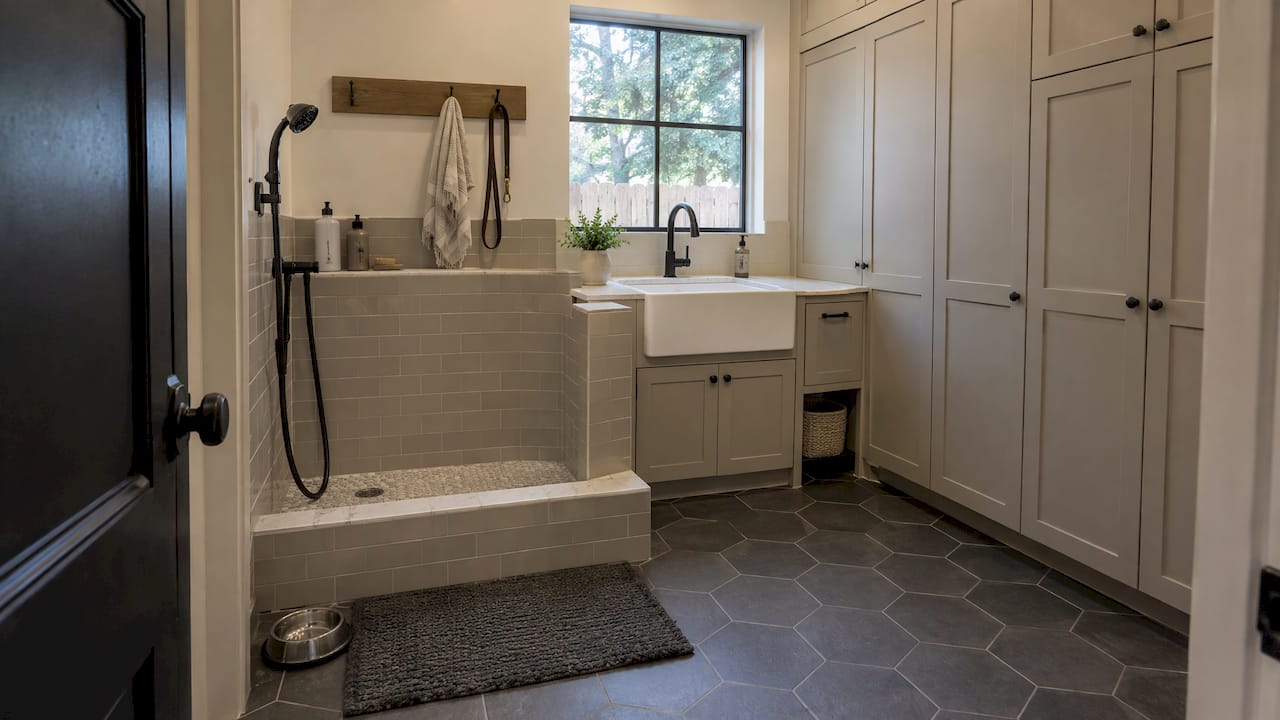
When the project ends, a well-organized pet zone is what keeps it working: a hook for every leash, a bin for towels, a closed cabinet for food and supplies. That is the kind of system we design in our luxury home organizing projects.
Moving back: don't unpack into chaos
The return move is the one people under-plan, because the finish line feels close. Walk the finished rooms before anything comes back in. Then bring items in by room, starting with the kitchen and bedrooms. Use the status labels to decide what opens first and what waits.
Two of our guides help here: the first 48 hours move-in checklist covers safety checks, and the new-build move-in setup plan walks through setting up a newly finished space. If the whole experience wears you down, our piece on managing relocation stress is a calm place to start.
Our perspective
A remodel move-out is a real relocation, just with a return address. The families who come through it well are not the ones who found the cheapest rental. They are the ones who decided early what lives where for the next few months.
We believe the most valuable work happens before the first box is taped: sorting, deciding what is daily and what is not, and setting up the temporary space so routines keep running. When the house is finished, the same thinking carries into permanent systems built around how your household actually lives, so the new space stays beautiful and functional.
That is how we approach every project, from organizing to moving management: personalized, detail-oriented and with minimal disruption to your life.
Steve
Let us run the move-out and the move-back
Flawlessly Functional serves homeowners in San Antonio, Texas, with luxury home organizing, moving management concierge services and interior styling. Our white-glove moving service handles packing, unpacking and organizing during a relocation, and our clients rate us 4.9 on Google.

If a remodel is on your calendar, tell us the scope and the timeline through our home page, and we will plan the move around it.
FAQ
How long should I plan to live elsewhere during a remodel?
Plan from your contractor's schedule and add a buffer. A kitchen remodel commonly takes 6 to 12 weeks, a full-home renovation 3 to 12 months, and the same guide suggests adding 10 to 20% for delays. Choose housing that can extend month to month.
Is it cheaper to stay home during a remodel?
Rent is cheaper, but not always the total. If the kitchen is out of service, takeout can add several hundred dollars a month, and dust and noise carry their own costs. Staying works best for single-room projects with a working kitchen, a full bathroom and a bedroom away from the work.
Where do my belongings go?
Sort them into daily, later and off-site groups. Keep the daily group in a construction-free room, and move the off-site group to a storage unit. Nationally, a 10x15 unit averages about $158 a month.
What about my dog?
A remodel is hard on pets, so many owners relocate them even when the family stays. Confirm pet policies, fees and size limits in writing before you pay a deposit, and bring the dog's bed, bowls and a familiar blanket.
Sources
- Where to Find Temporary Housing During Construction or Home Renovation
- How to Plan Temporary Housing for Home Remodeling
- Where to Live During a Home Renovation
- Temporary Housing During Renovations in Atlanta
- Are Extended Stay Hotels Cheaper Than Apartments?
- Temporary Housing: Where to Stay During a Remodel or Build
- Extended Stay vs. Furnished Rental Real Costs for 30+ Days
- How to Plan a Remodel Around Real Life
- 7 Steps for Managing a Home Renovation While Living at Home
- Living Through a Remodel vs Moving Out
- Temporary Storage During a Renovation
- 10x15 Storage Unit: Cost, Size and What Fits Inside
- How to Move During Renovation Without the Chaos
- Temporary Housing During Renovation: 7 Tips
- A Pet-Friendly Mudroom With a DIY Dog Bath