
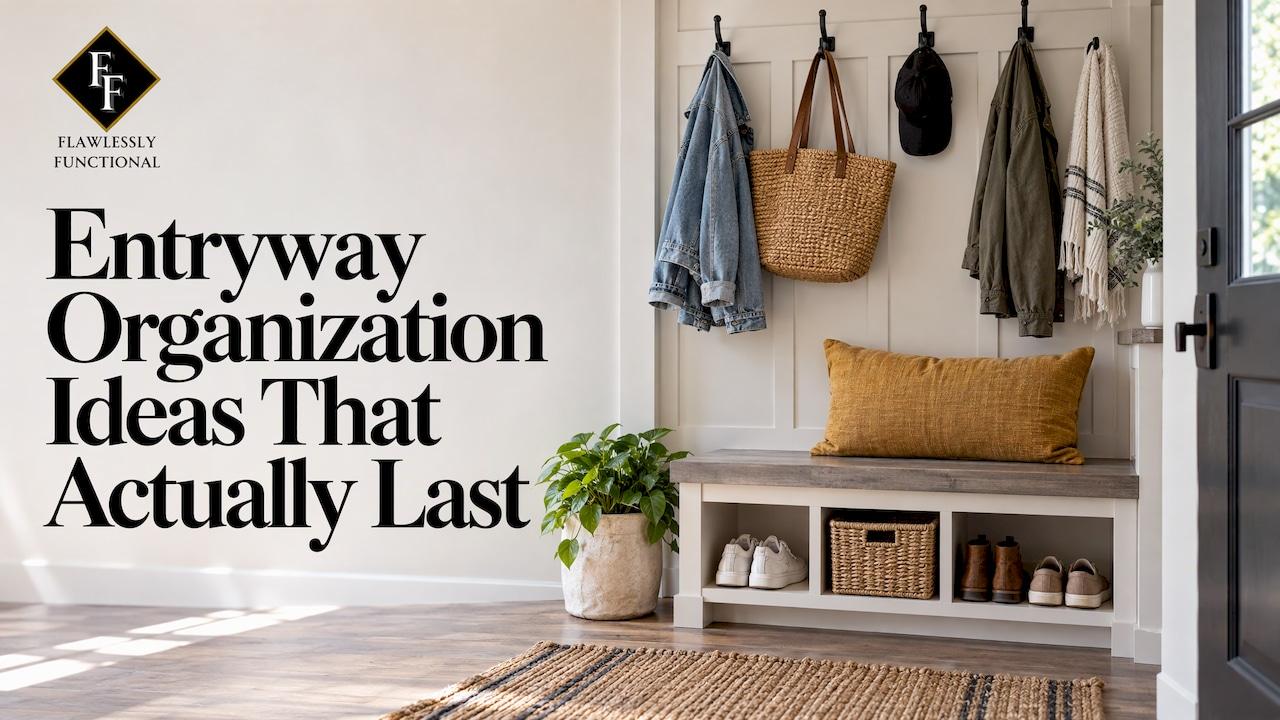
The best entryway organization starts with function, not decor: one clear spot for coats, shoes and bags, a contained home for keys and mail, and closed storage for whatever you can't hang. Design the zone around how each person in your house walks in the door, and it stays tidy. Design it around a pretty photo, and it fills up again within a month. At Flawlessly Functional, we build organizing systems around each household's routines for San Antonio homeowners, and the entry is where that approach pays off fastest.
TL;DR
- Start with function: one catchall spot for jackets, shoes and bags, plus a small container for keys, phones and mail.
- Layer the wall: hooks high for coats, mid-level for bags, baskets or a cabinet low for shoes.
- Cap what lives there: a few pairs of shoes per person, and rotate seasonal gear out.
- No closet? A bench, a hook row and a shoe cabinet give you a drop zone without building anything.
- Closed storage hides mess, which matters most in a foyer guests see first.
Table of Contents
- Start With How Your Household Uses the Door
- Build Vertical Layers Instead of One Big Pile
- Shoes: Decide How Many Live by the Door
- Drop Zone Ideas for Keys, Mail and Bags
- Entry Closet Organization
- No Closet? Build One Out of Furniture
- Small Entryway and Foyer Ideas
- Keep It Working: Rotation and Habits
- Entryways When You Are Selling or Moving
- Let Us Organize Your Entryway
- FAQ
- Sources
Start With How Your Household Uses the Door
Before you buy a single basket, watch what happens in the first 60 seconds after someone comes in. Who drops a backpack on the floor? Where do keys land? Where do packages sit? Your answers decide the layout.
Consumer Reports, citing professional organizers, puts function first: find one catchall spot for jackets, shoes and bags (a little wall space is enough), then give small items like keys, phones and mail their own containers, ideally one tray per family member. If you own more than the built-in storage can hold, add a freestanding cabinet with a rod, drawers, hooks or shoe shelves.
The door you actually use matters more than the door you wish you used. In many San Antonio homes that is the garage entry, not the front foyer. Put the drop zone where your family really walks in, and treat the formal front entry as a separate, more styled space.
The most common entryway mistake is skipping the space altogether because it feels too small to bother with. A few feet of wall is plenty for a system that works.
Build Vertical Layers Instead of One Big Pile
The easiest way to gain capacity without gaining floor space is to stack storage by how often you reach for things. The Spruce describes a layered approach: upper hooks for coats, mid-level hooks for bags, lower baskets for shoes, and quick-grab items such as gloves, scarves and keys at eye or hand level.
In practice that looks like this:
- Top layer: a single row of sturdy hooks for coats and the bags you carry daily. Matching hangers or uniform hooks make the wall look intentional.
- Middle layer: a shelf or ledge at hand height with a tray for keys and sunglasses, and a small wall file or basket for mail.
- Bottom layer: a bench or cabinet for shoes, with bins underneath for each person's gear.
If you have children, add a second, lower set of hooks. Better Homes & Gardens suggests a row of hooks under a floating shelf with labeled baskets for keys, bags, hats and pet leashes. Labels matter: a child who can read a picture label puts things back without being asked.
Shoes: Decide How Many Live by the Door
Shoes are the fastest way to lose an entryway. The fix is a limit, not a bigger rack. Organizer Katherine Picott told Real Simple to keep three pairs by the door if you live alone, two per person in a family, and one per person in households of five or more. Everything else belongs in bedroom closets.
Then choose storage that matches how you live:
- Closed shoe cabinet: hides the mess completely. The Seattle Times quotes organizer Petersen on storage with doors you can close, which is the right call when the entry is visible from the living room.
- Bench with a shoe shelf below: gives you a seat for putting shoes on and a landing spot for bags.
- Boot tray with a lip: the same article recommends a rubber tray to keep wet, muddy water off your floors. In San Antonio that means the occasional storm season rather than months of snow, but a tray still protects hardwood and tile.
Houzz also points to a closed cabinet with shoe storage inside as a way to hold many shoes while minimizing visual clutter. For more ideas on shoes across closets, walls and moves, see our guide to shoe storage ideas.
Drop Zone Ideas for Keys, Mail and Bags
A drop zone is simply the place where you consistently put your keys, bag and shoes when you walk in. Katie Clingman of Settled In Soundly told Real Simple that a consistent home for daily items makes the morning routine smoother. Her colleague Sarah Schier adds a practical tip: mount a small wall file or tray so mail has one contained place until you process it.
Here is what a well-built drop zone usually holds:
| Category | Where it goes | Why it works |
|---|---|---|
| Keys, sunglasses, wallet | Small tray or dish on a console or shelf | Keep the dish small so it doesn't become a catchall |
| Wall file, or an incoming and outgoing pair of baskets | One place for paper; simplify if you can't file a page in seconds | |
| Bags and coats | Hooks at adult height, lower hooks for kids | Two seconds to hang, less clutter later |
| Items leaving the house | One labeled basket by the door | Returns, library books, things for the car |
| Pet gear | Leash hooks near the door | Always in the same spot |
Houzz advises erring on the side of too few mail categories. If a system needs more than a few seconds per piece of paper, it will collapse by the second week.
One more idea comes from organizer Appelbaum, quoted by The Spruce: much entryway clutter is items migrating from other rooms. A single catchall basket for things that need to go back upstairs or to the car gives transient items a boundary and keeps the rest of the zone calm.

Entry Closet Organization
If you have an entry closet, it is your best asset, and most are underused. Martha Stewart's entryway organizing ideas include three moves that work in nearly any coat closet:
- Hooks on the inside of the door for bags and tote straps.
- A closet rod extender to double your hanging space, with longer coats on the upper rod and shorter ones below.
- One bin per household member for gear, sized to slide under a bench or sit on a shelf.
To take it further, clear the closet completely first. Entry closets collect vacuum cleaners, old umbrellas, holiday decor and sports equipment that belong somewhere else. What stays should be what you use on a weekly basis: current-season coats, everyday bags, guest hangers, and a basket of hats and gloves. For the larger picture of how to start with fewer things, our piece on minimalist home organization walks through decluttering before organizing.
No Closet? Build One Out of Furniture
Many homes, especially older ones and condos, have no entry closet at all. Bob Vila's suggestion is to affix a row of hooks above a bench with a shoe rack underneath, turning a dumping zone into an organized space. If any closet exists nearby, he adds a second rod, a wire organizer on the back of the door, and shelves above the top rod.
This Old House notes that the freestanding coat tree became an entryway staple by 1920, so it suits older homes that lack a mudroom. It also recommends a small bowl or tray for keys, a wall-mounted mail sorter, and hooks for leashes.
The price range is worth knowing before you plan. The Seattle Times reported in 2021 that a bench with drawers or cubbies plus a hanging rail typically runs $1,000 to $2,000, while rod-and-shelf systems typically came in under $1,000. Those are 2021 figures for ready-made pieces, so expect them to have moved. A custom-fit design is where tailoring pays off: a bench cut to the width of your wall wastes no space, and hooks placed to your family's heights get used.

Small Entryway and Foyer Ideas
Wirecutter's advice for very tight spaces is to hang a floating shelf above the door with baskets, hide the rest in attractive containers, and declutter regularly, keeping only what you need. It quotes designer Colin Chee on the idea that an entryway is a space with storage, not just a storage space.
That shift in thinking is useful for a foyer, where you want storage that doesn't look like storage. Some ways to do it:
- Slim console with drawers: keys, mail and chargers disappear, and the top holds a lamp and one tray.
- Mirror above the console: it adds light and gives you a last look before leaving.
- Bench as a pause point: The Spruce notes that a bench cues you to slow down when entering or leaving, and it gives you a place to sit for shoes.
- Matching baskets or bins: matching containers read as decor, mismatched ones read as clutter.
- Vertical focus: if floor space is tight, go up. Hooks, shelves and over-the-door storage cost you no footprint.
In a luxury foyer with a double-height ceiling or a formal front hall, the same principles apply at a larger scale: furniture that is designed to hide daily items, lighting that flatters, and one clearly defined spot for each category.
Keep It Working: Rotation and Habits
An entryway is a flow zone, so it needs a small maintenance routine. The Seattle Times names a common failure: not rotating sports equipment and seasonal gear out, so the entryway becomes a permanent drop zone. Emily Henderson suggests a weekly check on coats, pulling out the ones you don't need for the week's weather.
A realistic routine for a busy household:
- Daily, 60 seconds: shoes to their spot, mail to the wall file, the outgoing basket emptied into the car.
- Weekly, 5 minutes: rotate coats and bags for the forecast, return strays to other rooms.
- Each season: pull out anything you didn't use, from umbrellas to pool gear, and reset the layout.
In San Antonio, where summer heat means few heavy coats for most of the year, the seasonal swap is often about sunhats, sunscreen, water bottles and pet gear rather than parkas. Abby Organizes lists small daily-use essentials like sunscreen, bug spray, hand sanitizer and umbrellas as items worth giving their own basket near the door.
Entryways When You Are Selling or Moving
The entry is the first thing a buyer sees and the first thing you unpack. If you're listing a home, a clear, hook-and-bench entry says that the house has storage to spare. A room-by-room home staging checklist can help you build a manageable, clutter-free routine as you prepare.
If you're moving into a new home, set up the entryway early. It is the zone that decides whether the first week feels calm or chaotic, because everyone is carrying keys, bags and boxes through it. Our other guides on handbag storage and walk-in closet layouts pair well with an entry plan, since bags and coats often travel between the two.
Our Perspective
We organize homes in San Antonio, and the entry is the room homeowners tell us they have given up on. It is the most-used, least-planned space in a house. Everyone passes through it carrying something, and nobody owns it.
That is why we don't start with products. We start with the people: who comes in with a stroller, who has three sets of keys, who brings a dog, who needs to find a bag at 6:45 a.m. A system for that household looks different from one for the neighbors, even if the floor plans match.
Our approach is designed to combine function and beauty, so the foyer you show guests is also the one that holds your daily life. We think a good entry should feel like part of the house's design, not a storage afterthought, and that the best systems are lasting because they fit the routines of the people who use them.
Steve
Let Us Organize Your Entryway
If you would rather have the entry designed and set up for you than sort through hooks, benches and bins on your own, our luxury home organizing service handles decluttering and customized storage for every space in your home, entryways included. We work with homeowners across the San Antonio region, and our clients rate us 4.9 on Google.

Moving soon? Our moving management concierge covers packing, unpacking and organizing during a relocation, so the new front door opens onto a space that is already working.
FAQ
How do I organize my entryway?
Start with function: one catchall spot for coats, shoes and bags, and small containers for keys and mail. Add vertical hooks, a bench or cabinet for shoes, and closed storage for anything you don't want on display. Limit what lives there to what each person uses weekly.
How do I organize an entryway without a closet?
Combine a row of hooks, a bench and a shoe rack or cabinet to create a closet out of furniture. A freestanding coat tree works well in older homes, and a wall-mounted mail sorter keeps paper off surfaces. Keep the number of shoes low and rotate coats weekly.
What belongs in a drop zone?
A drop zone holds the things you carry in and out daily: keys, wallet, phone, bag, mail and shoes. Give each a clear home, such as a small tray, a wall file, hooks and a shoe bin. Add one basket for items that need to go back to the car or upstairs.
How can I make a small entryway work harder?
Go vertical. Hang a floating shelf with baskets above a row of hooks, use over-the-door storage, and choose a slim console or cabinet with doors. Hiding what remains in attractive containers keeps a small space calm.
Sources
- Simple Ways to Organize Your Home's Entryway, Consumer Reports
- The One Change That Will Organize Your Entryway For Good, The Spruce
- 11 Must-Know Tips for Organizing an Entryway, Better Homes & Gardens
- Organizers Share Their Top 7 Small Entryway Hacks, Real Simple
- How to tame your entryway, The Seattle Times
- Post-KonMari: How to Organize Your Keys, Mail and More, Houzz
- 10 Entryway Ideas for a More Organized Space, Martha Stewart
- What to Do if Your Home Has Little or No Closet Space, Bob Vila
- A Comprehensive Guide to Entryways and Mudrooms, This Old House
- Great Ideas to Declutter Your Home's Small Entryway, Wirecutter
- Small Entry Organization Hacks, Style by Emily Henderson
- Home Staging Checklist: Room-by-Room Guide for Sellers