
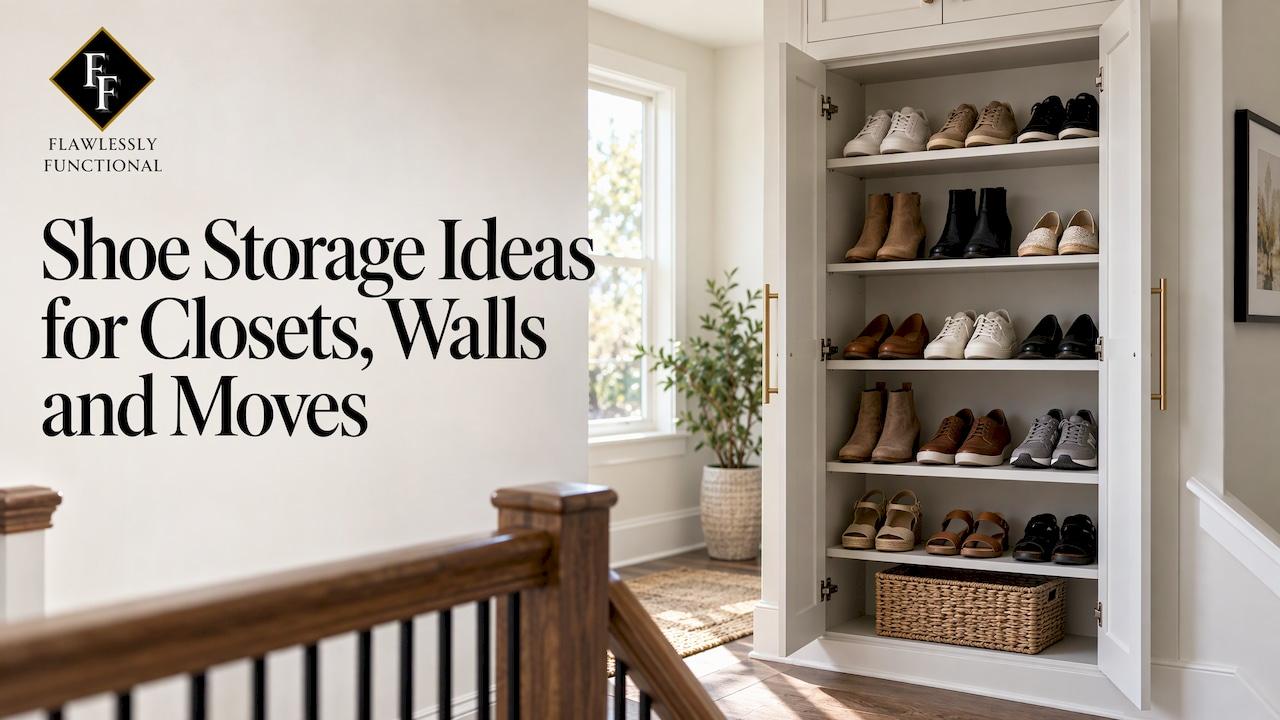
The best shoe storage starts with a smaller, sorted collection and a home for every pair: everyday shoes at eye level, off-season pairs in clear containers up high, and vertical space (walls, doors, tall shelving) doing the work the floor cannot. Below are the layouts that work in closets, entryways and tight spaces, plus how to pack shoes and handbags when you move. If you want the whole system designed around your household, we do that for San Antonio homeowners through our luxury home organizing service.
TL;DR
- Sort first. Split shoes into "in use now" and "not right now," and keep the first group easiest to reach.
- Use clear containers or windowed boxes, and put off-season pairs on high shelves or under the bed.
- Go vertical: wall shelves, over-the-door racks, tall slim cabinets and floor-to-ceiling shelving free up the floor.
- Heels, boots and sneakers each need their own support so they keep their shape.
- For a move, pair, stuff, wrap and box shoes by type, and give designer handbags their own padded boxes.
Table of Contents
- Start with an inventory, not a rack
- Shoe closet organization: a layout that stays put
- Shoe wall storage and floor-to-ceiling ideas
- Shoe cabinet organization for everyday pairs
- Storing a lot of shoes without losing track of them
- Shoe storage with very little space
- How to pack shoes for moving
- What we do about shoe storage
- Let us design it for you
- FAQ
- Sources
Start with an inventory, not a rack
Most shoe clutter is a quantity problem dressed up as a storage problem. Before you buy a single shelf, pull every pair out and look at what you actually own.

Professional organizer Melissa Gugni, quoted by Livingetc, recommends starting with an inventory and sorting shoes into special-occasion, activity and everyday piles. That gives you three different storage needs instead of one giant one.
A simple way to run it:
- Lay out every pair in one room, including the ones by the door, in the car and in the back of the guest closet.
- Set aside pairs that are worn out, don't fit or haven't been on your feet in a year or more.
- Divide what is left into "currently in use" and "not right now." IKEA's US guide frames the first step the same way, with worn pairs kept accessible.
- Measure the space you plan to use, and measure a few of your bulkiest pairs. Boots and sneakers need far more room than flats.
Only then choose hardware. The count and mix of what remains decides whether you need a rack, a cabinet, a wall or a dedicated closet.
Shoe closet organization: a layout that stays put
A closet works best when it is zoned by how often you wear things, not by what looks tidy on day one.
Put frequency first
Organizer Christian, quoted by CNN Underscored, advises keeping frequently worn shoes at eye level and putting off-season shoes in containers on high shelves. Clarks' US guide says much the same about arranging closet shoes: group by frequency of use, season or style, with the pairs you reach for most easiest to grab.
Use the floor, the door and the rod
- Angled floor racks. Livingetc suggests an extendable angled rack along the floor, with larger, less-worn shoes on the back row.
- Over-the-door storage. A wire rack or clear shoe bag on the back of the closet door uses space nobody else is using. Nike's guide, citing organizer Prominski, recommends both options. The Home Depot notes that door shoe bags can hold a dozen or more pairs.
- Hanging pairs of tension rods. Architectural Digest describes hooking a shoe's heel over the higher rod and resting the sole on the lower one, and using S-hooks on the closet rod for strappy sandals and heels.
- Shelves for heels. Heeled shoes sit better on wood shelves, because heels can slip through the gaps in wire shelving, according to The Home Depot.
A small trick that gains inches
Livingetc recommends storing the left shoe facing you and the right facing away. Pairs nest more closely, so each shelf holds more.
If you are planning a full walk-in rather than adjusting a reach-in, the aisle width and shelf depths matter as much as the shoe hardware. Our guide to a 36-inch aisle walk-in closet layout covers the dimensions, and luxury closet organization walks through zones and lasting order.
Shoe wall storage and floor-to-ceiling ideas
When the floor is full, go up. A shoe wall turns a blank stretch of drywall into the most visible storage in the room, so it has to be both sturdy and good to look at.
Wall options
- Floating shelves at varying heights. Real Homes quotes an expert, Leman, saying shelves at different heights make the most of small entryways, with hooks or brackets under the shelves for keys and bags.
- Recessed shelving. Houzz suggests recessing shelves into a thick wall for an accessible shoe closet, with lights that turn on when the doors open.
- Wall baskets. Organizer Amy Woidtke tells Apartment Therapy that metal or wire baskets can corral shoes where there is no floor space, using cup hooks or Command Strips for lighter baskets and wall anchors for heavier ones.
Floor-to-ceiling systems
A full-height wall of shelving is the classic answer for a large collection. Two details decide whether it works:
- Depth. Wirecutter advises measuring a tall bookcase's depth and your shoes' depth before using it as a shoe organizer. It also suggests risers or clear shelves to stack two or more pairs per shelf, organized by color or style.
- Reach. The top shelves are for off-season and special-occasion pairs. House Beautiful reports designer Elizabeth Georgantas used raised storage and ceiling-height shelving to clear floors for shoeboxes and favorite pairs.
Shelving that holds shoes at eye level also reads as display. If you are putting shoes on open shelves, keep the edit tight and the spacing even. Our notes on open shelving organization explain how to keep shelves looking curated rather than crowded.
Wall-mounted and tall units should be anchored to studs or with proper wall anchors, especially in a home with children or pets.
Shoe cabinet organization for everyday pairs
A closed cabinet is the tidiest answer for an entry or hallway because the door hides the pile. The key is to treat it as the home of your everyday shoes only.
- Slim profile. Organizer Eileen Kelly Reed recommends a slim cabinet for homes without a mudroom or entryway closet, noting it encloses shoes and can double as a spot for keys or a device charging station.
- Flip-down drawers. HGTV's 2026 roundup lists an 18-pair cabinet with three flip-open drawers, adjustable feet and an anti-tip kit, priced at $107 on Wayfair. Retail prices move, so treat that as a snapshot.
- Pullouts for bigger spaces. Houzz recommends kitchen-style pullout shoe cabinets for bedrooms, hallways and walk-in closets, including one design that hides shoe pullouts inside a wood bed surround.
To keep a cabinet working, give each household member a shelf or drawer, leave a little air in each compartment so shoes aren't wedged, and move shoes out when the season changes. A cabinet that is full on the first day has no room for the pair you buy next month.
Storing a lot of shoes without losing track of them
The larger the collection, the more visibility matters.
- Make containers see-through. Christian, quoted by CNN Underscored, says at least one side of a shoe container should be transparent so you can see what's inside.
- Skip stacked shoe boxes for good pairs. Nike's guide, citing Prominski, says original boxes don't hold their shape when stacked and can dent shoes, and suggests clear acrylic boxes instead.
- Lay boots flat if you must. Organizer Carey recommends large flat bins or under-bed containers so winter boots can be laid horizontally.
- Support tall boots upright. The Home Depot suggests a boot mat stuffed with curled magazines, rolled towels or paper towel rolls to keep their shape.
- Rotate by season. Gugni suggests storing seasonal sandals in clear airtight under-bed bins in winter.
- Keep it simple. Nike quotes Prominski saying the most important part is a system simple enough that putting shoes back is easy. For a very large collection, the same piece suggests a dedicated closet with everyday pairs on a rack or mat by the entrance.
Shoe storage with very little space
Small homes and apartments need storage that uses height and dead space.
| Space problem | What fits | Why it works |
|---|---|---|
| Tiny entry corner | Spinning shoe rack | Real Homes says it fits in a corner and makes pairs easy to locate |
| No floor space | Over-the-door organizer | CNN Underscored's Gizinski notes the back of a door is frequently unused |
| Studio apartment | Tall rotating shelf | House Beautiful says it takes up vertical rather than horizontal space |
| Bedroom with no closet room | Under-bed containers | Good for off-season pairs and flat-stored boots |
| Narrow hallway | Tall, slim cabinet | Real Homes' Coddington advises this when floor space is limited |
| Entryway bench | Bench with cubbies or a shelf below | HGTV features a 15-cubby bench for entryways, bedrooms and mudrooms |
One more option from House Beautiful: designer Emily Janak used an arched entryway bench with frequently worn pairs tucked underneath, so the daily shoes are right where you sit to put them on.
If you have a small closet to start with, our guide on reclaiming small closet space has weekend-sized moves that free up room for shoes.
How to pack shoes for moving
Shoes are heavy for their size, awkward to stack and easy to crush. Packing them well protects the pairs you paid the most for and makes unpacking quick.
- Edit first. Moving shoes you no longer wear costs you box space, labor and closet room later. Sort into keep, donate and discard before anything touches a box.
- Pair up and clean. Wipe off dirt so it doesn't transfer to other pairs, and tie or band each pair together so nothing gets separated.
- Stuff to hold shape. Fill toes and boot shafts with acid-free tissue, clean packing paper or clean socks. Avoid newspaper on light-colored or leather shoes, since the ink can rub off.
- Wrap each shoe. Use packing paper or a soft wrap, with extra padding around heels and delicate straps.
- Choose small or medium boxes. A small box keeps weight manageable and stops contents from shifting. Original shoe boxes work for special pairs if you stack them inside a larger moving box with the heaviest at the bottom.
- Pack by weight. Boots and sneakers on the bottom, flats and sandals above, heels packed so they don't press into other shoes. Fill gaps so nothing slides.
- Label by room and type. "Primary closet, boots" is faster to unpack than "shoes."
On a white glove move, our team handles packing and unpacking as part of moving management, so shoes arrive sorted and ready for their new shelf instead of waiting in a stack of unlabeled boxes.
Packing designer handbags

Handbags follow the same logic as shoes: keep their shape, keep them apart, keep them off the bottom of a heavy box. Stuff each bag with tissue or paper, put it in its dust bag or a clean pillowcase, and pack bags upright or flat in a sturdy box with no heavy items on top. Chains and hardware get wrapped so they don't scratch leather. Our handbag storage guide shows how to store them once they have arrived.
What we do about shoe storage
Most people come to us after they have already bought the rack. It's full, the shoes are still by the door, and the closet doesn't feel any better.
We think shoe storage has to be built around your routine: which pairs you reach for on a Tuesday morning, where you take them off, who else in the house needs access. Our approach is to make a home functional and beautiful at the same time, and to design systems that last because they fit how your household lives.
That is also why we pair organizing with moving management. When shoes, handbags and closets are sorted before the move, packed with care and unpacked into a plan, the new home starts organized instead of becoming a second project.
Steve
Let us design it for you
If you would rather have a finished closet than a weekend of measuring, our luxury home organizing service is built for San Antonio homeowners who want customized, lasting systems with minimal disruption. Moving soon? Our moving management concierge covers packing, unpacking, downsizing and organizing during relocation. Clients rate us 4.9 on Google.

Tell us about your closet or your move through flawlesslyfunctional.com.
FAQ
What is the best way to store a lot of shoes?
Sort into everyday and off-season pairs, then store the everyday group at eye level and the rest in clear containers on high shelves or under the bed. Organizers quoted by CNN Underscored recommend containers with at least one transparent side so you can see what's inside. A dedicated shoe closet or floor-to-ceiling shelving suits very large collections.
How do I store shoes with no space?
Use the vertical and hidden areas: the back of a door, a corner spinning rack, a tall slim cabinet, wall baskets or under-bed bins. Real Homes and House Beautiful both point to over-the-door organizers and tall rotating shelves for tight spaces.
What is the best way to organize shoes in my closet?
Start with an inventory, then zone by use: everyday pairs most accessible, seasonal and special-occasion pairs higher up. Add an angled floor rack, an over-the-door organizer and shelves for heels. Storing one shoe facing forward and the other facing back lets pairs sit closer together.
Should I keep shoes in their original boxes?
For long-term storage, clear boxes usually work better. Nike's guide says original boxes don't hold their shape when stacked and can dent shoes, and you cannot see what is inside. Keep original boxes for special pairs that you will pack carefully in a move.
How do I pack shoes for a move?
Pair them, stuff them to hold their shape, wrap each shoe, and use small or medium boxes with heavier pairs at the bottom. Fill gaps and label by room and shoe type so unpacking goes quickly.
Sources
- CNN Underscored: best shoe storage ideas
- Livingetc: how to organize shoes in a closet
- IKEA US: ideas for how to store and organize your shoes
- Clarks US: a guide to shoe storage
- Nike: how to store shoes
- The Home Depot: closet organization ideas
- Architectural Digest: shoe storage ideas for tiny closets
- Real Homes: shoe storage ideas for a small entryway
- Houzz: storage ideas for shoes
- Apartment Therapy: storing shoes without a mudroom
- Wirecutter: using a tall bookcase for shoes
- House Beautiful: shoe storage ideas
- HGTV: best shoe organizers