
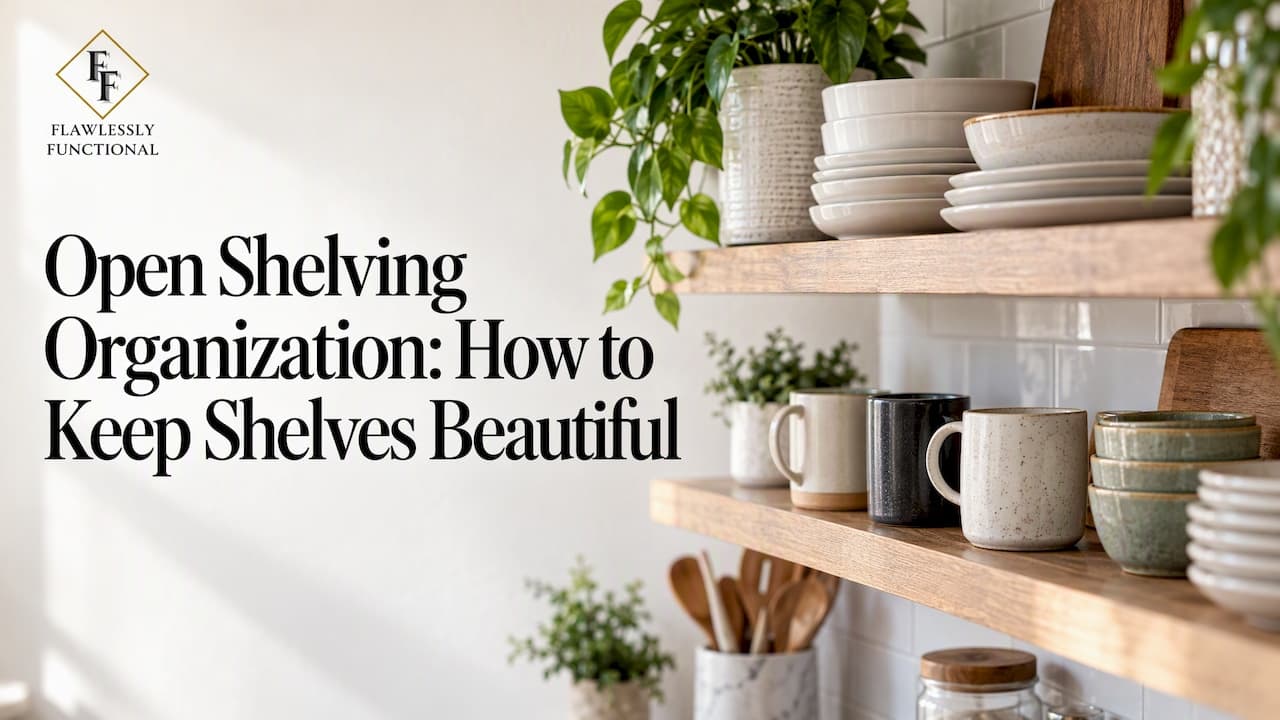
Open shelves look organized when you edit before you arrange. Clear them completely, keep only what you use daily or what is truly attractive, group it by category, and leave real empty space around each group. Everything else moves behind doors. Buying matching containers helps, but the editing does most of the work.
This guide covers the full routine: what belongs on open shelves, a step-by-step reset, how to style them, what they cost compared with cabinets, and when a hybrid layout is the smarter call.
TL;DR
- Open shelving works as a curated zone, not a replacement for every cabinet. Display daily-use items and a few beautiful pieces, and conceal the rest.
- Start by emptying the shelves, sorting by use and category, and returning only essentials. Then add height variation, a limited palette and visible negative space.
- Dust, grease and visual clutter are the real costs. Plan a short, regular reset routine before you commit.
- Open shelves can cost less than cabinets, but compare equivalent installed storage and keep enough closed storage for overflow.
- Anchor shelves properly, keep heavy items low, and plan reach and lighting around the people who actually live in the home.
Table of Contents
- Decide what deserves to be on display
- A step-by-step reset for any open shelf
- Styling open shelves so they look curated
- Open kitchen shelves: the specific problems
- The maintenance reality
- Safety: anchoring, weight and reach
- Are open shelves cheaper than cabinets?
- Alternatives to open shelves
- Our perspective: selective openness
- When it helps to bring in a professional
- FAQ
- Sources
Decide what deserves to be on display
The most common mistake is treating open shelves as extra storage for whatever does not fit elsewhere. They work best for two kinds of things: items you reach for constantly and items attractive enough to count as decor.
The Kitchn makes the case for everyday plates and glasses: you use and wash them often, so they rarely sit long enough to gather dust. That logic is the filter for every shelf in the house.
A quick sort:
| Keep on open shelves | Keep behind doors |
|---|---|
| Everyday plates, bowls and glasses | Small appliances and their cords |
| Spices, oils and pantry staples in coordinated containers | Plastic packaging and mismatched food containers |
| A few sculptural or sentimental objects | Backstock and bulky, rarely used pieces |
| Cookbooks or books you actually read | Paperwork, chargers and miscellaneous small objects |
The in-between category is the trap. Items used a few times a year sit long enough to collect dust and are rarely beautiful enough to justify the space. Research on when open shelving is a poor fit points to medium-frequency items, greasy items near cooking surfaces, and households unwilling to keep up a visible reset routine.
A step-by-step reset for any open shelf
This works for kitchen shelves, a pantry run, a living room wall unit or a bathroom ledge.
- Remove everything. Wipe the shelves down. Seeing the bare structure shows you how much space you actually have.
- Sort by use and category. Make three piles: daily, occasional, and display-worthy. The Seattle Times advises sorting this way and returning only essentials.
- Place daily items near where you use them. Glasses near the sink or fridge, oils and salt near the stove (but see the grease note below), mugs near the coffee station.
- Contain the small stuff. Jars, baskets or clear bins turn a pile of small items into one calm object. Shelf dividers keep stacks of plates and bowls from sliding.
- Label opaque containers. In a family home, labels make the reset routine obvious to everyone, so the system survives a busy week. If you want label styles that hold up in a kitchen, see our pantry label ideas.
- Stop at about two thirds full. The empty space is not wasted. It is what lets each group read as intentional.
Styling open shelves so they look curated
Design professionals consistently describe visual order as a matter of hierarchy rather than perfect matching, according to House Beautiful's designer tips. One focal object, varied scale, grouped categories, a limited palette and enough room for each item to stand on its own.

Group like with like
Stack plates with plates, line up glasses by height, keep mugs together. Grouping is what makes ordinary dishware look deliberate. Mixed categories scattered along a shelf read as clutter even when each item is tidy.
Weight the edges and layer the middle
Place taller or heavier-looking pieces toward the ends of a shelf and keep the center lighter. Layer a small item in front of a larger one, such as a bowl in front of a framed print, so the eye has depth to travel through.
Limit the palette
Pick two or three colors and a couple of materials: white ceramic with wood and one metal, for instance. Matching every container is unnecessary. A restrained palette does the same job at lower cost.
Mix practical and decorative
Combine working items with a few larger decorative pieces, and avoid exposing unattractive appliances or plastic packaging. Decant dry goods into glass or ceramic canisters, or tuck them into rattan or fabric baskets. If you are building shelves into a living area, our bookshelf styling formulas give you four layouts you can copy.
Pull the room together
The wall behind the shelves is part of the composition. A tonal paint, a textured finish or a pattern gives the objects a backdrop, and this short guide to adding personality to a room is a useful starting point if you are weighing options for that wall.
Open kitchen shelves: the specific problems
Kitchens are the hardest place for open shelving because of grease, steam and constant use.
- Keep delicate, rarely washed items away from the cooktop. Airborne grease settles on whatever sits nearby. Put open shelves near the sink, fridge or coffee area instead, and keep cooking-zone storage closed.
- Use real ventilation. A range hood that vents effectively reduces what lands on your dishes. Homeowners who rely on open shelves should treat it as part of the system.
- Store what you wash often. Everyday dishes get cleaned regularly, which is the best defense against buildup.
- Keep pantry staples in lidded containers. Open shelving in a pantry looks great, but flour, sugar and pasta stay fresher and tidier in sealed jars.
If your kitchen is part of a larger renovation, we cover how to plan zones and clearances in our guide to organizing a luxury kitchen. For deep pantry shelves where items disappear to the back, see deep pantry organization.
The maintenance reality
The honest tradeoff is visibility versus upkeep. Open shelves make things easier to find and reduce rummaging, but dust, grease, pet hair and visual clutter are ongoing household costs. A 2025 peer-reviewed study of older adults found some benefits from open kitchen shelving, yet interviews still named dust and visual clutter as important concerns. It was a small study of 11 participants, so treat it as a signal rather than a verdict.
How often to clean depends on your home. The Kitchn suggests wiping shelves about every two weeks, while some Apartment Therapy contributors report cleaning display items weekly or every 7 to 10 days, depending on dust, grease, pets and use. In Texas, where windows and doors open to dusty air for much of the year, lean toward the weekly end if you have pets or cook often.
A simple routine:
- Weekly, five minutes: Return stray items, straighten stacks, wipe any visible spills.
- Every two weeks: Remove items from one shelf at a time and wipe both shelf and objects.
- Seasonally: Run the full reset above and re-edit. Ask whether each item still earns its spot.
Dust in the air does not only land on shelves. If it seems excessive, it is worth checking your home's airflow too, and this air vent cleaning workflow explains what a cleaning routine for vents involves.
Safety: anchoring, weight and reach
Open shelving is easy to overlook as a safety issue because everything is visible. It still needs planning.
- Confirm shelf and bracket weight ratings with the manufacturer, and anchor into appropriate wall structure rather than relying on drywall alone.
- Keep heavy objects on lower shelves.
- Do not display unstable breakables or hazardous chemicals where they could fall or be reached by children.
- Leave clear circulation space so no one brushes against a shelf edge.
Seattle's earthquake safety guide recommends moving heavy objects to lower shelves and securing open shelves with nylon webbing in earthquake-prone areas. San Antonio is not a seismic hotspot, but the same low-and-secure principle applies to households with kids or pets. For a specific installation, such as a heavy stone-topped unit or a tall wall of shelves, have a licensed contractor or handyman confirm the anchoring.
Accessibility deserves the same attention. Open visibility can help some people locate items and avoid unnecessary reaching, but shelf height, weight, lighting and clutter should be planned around the actual household, including older adults and changing needs.
Are open shelves cheaper than cabinets?
Often, yes, but there is no single answer. A run of simple wood shelves usually costs far less than custom cabinetry, though the price depends on material, brackets, finish and installation. For context on the cabinet side, Angi reports that built-in cabinet installation averages $4,500, with most projects between $2,000 and $7,500.
Those numbers come from a different project scope than a shelf run, so do not treat them as a direct quote. Compare equivalent installed storage and include:
- Wall preparation and structural anchoring
- Brackets and hardware
- Finish and lighting
- The cost of keeping or adding closed storage for everything that cannot be displayed
An all-open kitchen can sacrifice concealed capacity and cause retrofit costs later. That is why most good designs stay hybrid.
Alternatives to open shelves
If you love the look but not the upkeep, you have options:
- Glass-front cabinets: Visibility and display, with dust protection.
- Closed upper cabinets: Maximum concealment for busy kitchens.
- Drawers and pull-out pantry shelving: Easier access to deep storage, with no visual noise.
- Baskets inside concealed cabinetry: Order without display.
- Hybrid layouts: One or two open runs, with the rest closed.
For homes that may change, adjustable modular systems make sense. IKEA's ELVARLI guide describes wall- or ceiling-anchored components with adjustable shelves, drawers and rails that can be rearranged or extended, which suits households that expect needs, or even the address, to change.
Our perspective: selective openness
We organize homes in San Antonio, and open shelving comes up in almost every kitchen, pantry and living room project. Our view is that the best-looking shelves belong to the households that open the fewest of them.
We treat open shelves like a gallery wall: a small number of pieces, chosen deliberately, with everything else assigned a home out of sight. That means daily dishes, a few good vessels and the objects that make the house feel like yours on display, while appliances, backstock, paperwork and visually inconsistent items go to concealed zones. The result reads as luxury without needing constant styling.
We also build around routines, not photographs. If a shelf looks perfect only on the day it is styled, it is the wrong shelf for that family. So we ask who cooks, who unloads the dishwasher, whether there are pets, and how much time the household will really spend on a reset. Then we design a system that survives a normal Tuesday.
For clients preparing to move, we favor flexible pieces and clear categories so the system can travel or be rebuilt in the next home.
— Steve
When it helps to bring in a professional
Many homeowners can do this reset themselves in a weekend. It is worth calling in help when the shelves are part of a larger project: a kitchen renovation, a pre-move downsizing, a staging plan before listing, or a home where nobody has time to maintain a visible system.
Flawlessly Functional offers luxury home organizing tailored to each household's routines, plus interior styling and home staging for homes being prepared for sale. If a move is on the horizon, our moving management concierge covers packing, unpacking, downsizing and organizing during the relocation. You can start from our San Antonio home organizing page to tell us about your space. If you are packing a kitchen with open shelves, our kitchen packing plan walks through a 3 to 4 week timeline.
FAQ
How do I make open shelves look organized?
Empty them, sort by use and category, and return only essentials. Group like items, limit your palette, vary heights and leave visible empty space. Editing matters more than buying new containers.
How do I make open shelving look less cluttered?
Show fewer objects and keep categories together. Coordinate containers, add a few larger decorative pieces, and hide appliances, plastic packaging and miscellaneous small items behind doors. Wipe and reset the shelves regularly so clutter does not creep back.
What is an alternative to open shelves?
Glass-front cabinets, closed upper cabinets, drawers and pull-out pantry shelving all work. A hybrid layout that keeps only one or two shelf runs open gives you display space with far less upkeep.
Are open shelves cheaper than cabinets?
They can be, especially for simple wood shelves, but the answer depends on materials, installation and finish. Cabinet installation costs vary widely too, with Angi's 2026 figures showing most projects between $2,000 and $7,500. Compare equivalent installed storage and factor in the closed storage you will still need.
Sources
- 12 tips for using open storage without adding to clutter, The Seattle Times
- 11 Tips to Make Open Shelving Work in Real Life, The Kitchn
- Visual Accessibility through Open Shelving, PMC
- Built-in cabinets cost, Angi
- ELVARLI guide, IKEA
- Earthquake Home Safety Guide, City of Seattle
- Open shelving designer tips, House Beautiful