
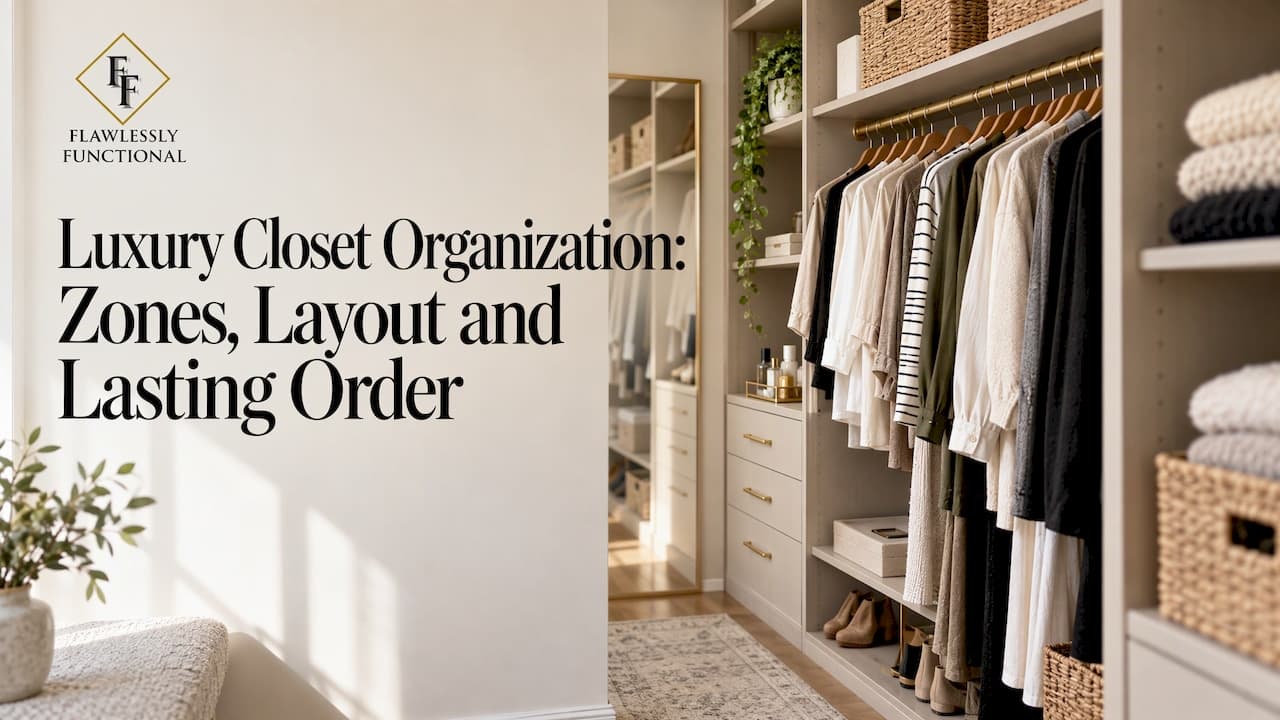
A luxury closet is organized around the way you get dressed, not around the amount of space you have. Map your habits first, size each zone from a real garment count, light the room from several angles, and leave part of it empty. Do those four things and the closet looks like a boutique and works like a well-run kitchen.
This guide walks through the process in the order we would follow it in a San Antonio home: edit, plan, build the zones, choose finishes and lighting, then protect the result.
TL;DR
- Watch how you dress for a week or two before moving anything. Zone the closet by routine and occasion, not only by item type.
- Plan from a garment inventory. Common working figures are 40 to 42 inches of drop per double-hang section, 63 to 70 inches for long-hang, and a 36-inch aisle.
- Layer the light (warm bulbs, 2700K to 3000K, from more than one direction) and keep every metal finish consistent.
- Leave 10 to 15 percent of capacity empty, and keep a rotation system for seasonal pieces.
- If the project is large, a professional organizer can run the edit, the layout and the install so the closet is done in one pass.
Table of Contents
- Start with how you actually get dressed
- Edit before you design
- Measure and plan the layout
- Build zones that make sense
- Materials, finishes and lighting
- Small and walk-in closets: ideas that scale
- Keep it that way
- When to bring in a professional
- FAQ
- Sources
Start with how you actually get dressed
Before buying a single rod or drawer, find out what your closet is being asked to do. One New York organizer's method, described on the Bird & Branch NYC blog, is to map dressing behavior for two weeks before moving a single item. The questions are simple: what do you reach for first, what do you consistently skip, and what takes a search to find?
The same source describes organizing by outfit building rather than only by type. A Brooklyn architect quoted there says that grouping by occasion ended his morning decision-making, because everything needed for a given day sat in one zone. For a busy household, that is the difference between a closet that looks good on installation day and one that still works in March.
A few practical ways to run your own two-week map:
- Keep a note on your phone of what you wore and where you had to hunt.
- Photograph the closet as it is now, so you can see where things migrate to the floor or a chair.
- Note which hours you dress in: early-morning gym clothes and evening wear want different spots.
Edit before you design
A design built around clutter simply preserves the clutter in nicer materials. The editing method reported by Fashion Times in the stylist approach is to pull everything out, sort by category, and then edit with three questions: does it fit, has it been worn in the past year, and does it work with at least three other pieces. Then organize by category and color.
Keep three piles beyond "keep": donate, consign, and alter. Anything in the alter pile gets a deadline and a tailor appointment, or it leaves. Heirlooms and sentimental pieces get their own protected place rather than competing with daily wear for hanger space.
One caution on quantity. Pamela Meluskey, cofounder of the organizing company Settled, advises in Architectural Digest that your space should dictate your inventory, and that you aim to keep a closet 80 percent full. That is a useful target for the edit: the closet's capacity decides how much stays, not the other way around.

Measure and plan the layout
With the edit done, you have an inventory. Count it: how many shirts, trousers, dresses, long coats, folded knits, pairs of shoes, bags and accessories. Every zone is then sized from that count.
Measure the room first
Lowe's closet design guide advises measuring height, usable wall length and depth, and noting windows, doors, utilities, access panels and studs. It also says a closet should be at least 24 inches deep so clothes clear the back wall. Write down every obstruction, because a vent or an attic hatch will change where a tall unit can go.
Working dimensions for each zone
The figures below are common planning allowances published by closet designers and a home improvement retailer. Treat them as starting points and adjust to your wardrobe.
| Zone | Typical working dimension | Best for |
|---|---|---|
| Double-hang | 40 to 42 inches of drop per rod (Hedgeford & Berkley) | Shirts, blazers, folded trousers |
| Long-hang | 63 to 70 inches of clear drop (Hedgeford & Berkley) | Dresses, gowns, overcoats |
| Shelving | 12 to 16 inches deep (Hedgeford & Berkley) | Knitwear, handbags |
| Drawers | 18 to 24 inches deep (Hedgeford & Berkley) | Folded pieces, jewelry |
| Walkway | 36-inch minimum clearance (Karamia Designs) | Comfortable dressing |
| Shoe shelves | 7 to 8 inches high, 12 or more for boots (Karamia Designs) | Heels, flats, boots |
Lowe's gives complementary rules of thumb: a double rod with the top at about 84 inches and the bottom at about 42 inches, single rods at 70 inches, shelves at least 12 inches apart for folded clothes, and about 6 to 7 inches between women's shoe shelves. If you are planning a walk-in, our guide to a 36-inch aisle walk-in closet layout shows how the aisle and the zones fit together.
Pick a system that matches your wardrobe
The structure behind the doors matters as much as the finish. If you are weighing built-in cabinetry against adjustable rails and shelves, this overview of types of custom closet organizers helps you compare the options before you commit to a layout.
Build zones that make sense
Once the dimensions are set, assign each zone a job.
Zone by reach
Karamia Designs splits a closet into three vertical zones. The prime zone, from eye to waist level, holds everyday items and the shoes you wear most. The lower zone, floor to waist, takes drawers, hampers and heavy footwear. The upper zone, above eye level, holds off-season wardrobes, luggage and rarely used pieces. It is a simple rule, and it stops the best real estate from filling up with things you touch twice a year.
Clothes
Hang by occasion or outfit stage, then by category and color inside each group. Keep long-hang in one place where the floor is clear below, so hems never touch the ground. Fold knits on shelves rather than hanging them, and keep the shelf at a depth that lets each stack stay square.
Shoes
Nicole Leininger recommends open, angled shelving so the full silhouette is visible, with one row per shelf rather than stacking. For the pairs you want to protect, she suggests glass-front cabinetry for shoes and handbags to keep dust off while they stay visible. Designer Kelly Wearstler takes another route, using brass rods instead of slanted wood shelves for heels and dress shoes, with baskets underneath for flats and tennis shoes.
Bags, jewelry and watches
Handbags keep their shape when they stand upright in their own cubbies, on shelves roughly 12 to 14 inches deep. Jewelry and watches belong in shallow drawers lined in felt or velvet, with dividers sized to the collection. Karamia Designs also lists integrated pull-out hampers and retractable valet rods among the details that make a dressing room feel complete. Wearstler suggests movable glass partitions in handbag shelving, arranged by color or material, which also lets the layout change as the collection grows.
An island or bench
If the room allows it, an island or bench gives you somewhere to stage an outfit and doubles as drawer storage. It only works with a clear aisle around it, so go back to the 36-inch figure before you commit.
Materials, finishes and lighting
This is where "organized" becomes "luxury," and it is also where beauty can quietly undermine daily use if you are not careful.
Surfaces and shelf profiles
According to Woodworking Network, design professionals specify higher-grade surfaces in high-end closets, including textured thermally fused laminate that replicates natural textiles and backlit panels in translucent resin or natural stone such as onyx. The same report notes shelving has moved to profiles one inch or thicker for a furniture-grade look. Thicker shelves also read as more solid, which suits the weight of stacked knits and shoe boxes.
Hardware with one voice
Leininger points out that finish consistency is a hallmark of high-end design: when rods, shelf edges and drawer pulls share a metal tone, such as brushed brass, matte black or polished nickel, the room reads as deliberate. Choose one and carry it through.
Light from more than one direction
Wearstler says overhead downlights alone can be unflattering, and recommends light from multiple angles, including task lighting in the millwork, sconces and chandeliers. Lutron's Cecilia Ramos, quoted in Architectural Digest, explains that lighting shoes and bags from behind with recessed cove lighting sharpens their silhouettes, while uplighting from below gives hanging garments a floating look.
For bulbs, Leininger recommends warm white in the 2700K to 3000K range so fabric colors render accurately, with dimmers on every circuit so you can move from bright task light to a softer evening glow. Woodworking Network adds that integrated LED strips can sit in recessed channels inside shelves for even, downward light with no visible fixtures. Have an electrician handle any new wiring, circuits or dimmers.
Display without losing function
A closet can be part boutique, part command center. Architectural Digest's 2026 roundup points to retail-inspired lighting, two-story layouts and expressive color palettes. Display what you wear. Pieces you wear rarely belong higher up or in closed storage, so the showpiece shelf never becomes a dumping ground.
Small and walk-in closets: ideas that scale
Luxury is not a square-footage number. Designer Heather Hungeling advises keeping a visual line of sight when you enter and resisting the urge to cram. She suggests a separate cedar-lined storage closet elsewhere for seasonal or rotating garments, which keeps the main closet calm. Her point about channeling high-end stores is useful in any room: space between clothes and shoes makes each piece look more appealing.
In a smaller closet:
- Use the upper zone for off-season clothing and luggage, with a pull-down rod for reach.
- Go to double-hang wherever you have enough short garments to fill both rods.
- Choose slim, consistent hangers so the rod looks like one line.
- Move the bulky items, such as winter coats, to a hall closet or a dedicated storage spot, as in our seasonal closet switch guide for San Antonio.
Keep it that way
An organized closet is a system you run, not a state you reach. Three habits do most of the work.
- Leave room to grow. Hedgeford & Berkley advises leaving 10 to 15 percent of capacity empty, because a closet at full capacity tends to fail within a year. Keep everyday pieces in the prime zones and rotate seasonal items to the perimeter or high shelves.
- One in, one out. When something new arrives, something leaves. Practical Home Living lists this alongside a weekly five-minute reset and a seasonal rotation twice a year.
- Keep the floor clear. The floor is not temporary storage. If a pile starts there, the system has a gap, and the fix is a hook, a basket or a drawer.
A nightly reset is easier than it sounds. Our note on master bedroom organization in five minutes a night covers the routine.
Our perspective
We see the same pattern in nearly every closet we are asked to fix: the problem is rarely the space. It is that the closet was arranged for a wardrobe, a routine or a season that no longer exists.
That is why we begin with the household, not the shelving. We look at how you get ready, what you reach for, what you travel with, and who else shares the room. Then we design a system that fits those habits and still looks like it belongs in your home. A closet that is beautiful but fights your routine will not stay beautiful for long.
Our approach is personalized and detail-oriented, and built to cause as little disruption to your household as possible. For clients who are moving, the same thinking carries through packing, unpacking and setting up the new closet so that the wardrobe lands in its place rather than in boxes.
Luxury, to us, is a morning with no searching.
Steve
When to bring in a professional
A closet edit and a layout plan are very doable alone for a small project. They get harder when the wardrobe is large, the closet is a full dressing room, or you are in the middle of a move or a sale.
We offer luxury home organizing for homeowners in the San Antonio area, including closets, tailored to each household's routines and designed to last. If you are relocating, our moving management concierge covers packing, unpacking and setting up your wardrobe in the new home. You can also read how we pack a home wardrobe so heirlooms are protected and everything is rehung in one day.

To talk through your closet, start at Flawlessly Functional. We hold a 4.9 Google rating from clients, and we will tell you what your space needs.
FAQ
How much does a luxury closet organization project cost?
Costs depend on the size of the closet, the materials and how much of the work is organizing versus building. We do not publish a fixed price, because each engagement is customized to the home and the household. Contact us with your closet size and goals for a conversation about scope.
How deep should a luxury closet be?
At least 24 inches is the usual minimum, so clothes clear the back wall, according to Lowe's. Karamia Designs lists 24 inches as the standard cabinet depth in walk-in closets. Shelving for knits and handbags is often shallower, at 12 to 16 inches.
Should I organize by color or by type?
Both, in layers. Group first by category or occasion, since that is how you build outfits, then arrange by color inside each group. A stylist method reported by Fashion Times follows the same order: sort by category, edit, then organize by category and color.
What lighting works best in a walk-in closet?
Warm white bulbs between 2700K and 3000K, layered from several angles and dimmable. Leininger recommends this range for accurate fabric color. Combine task lighting in the shelving with softer ambient light, and have an electrician install any new circuits.
How often should I reorganize my closet?
A light weekly reset and a seasonal rotation twice a year keep most closets in order. A full edit once a year is enough for most households. Leaving some capacity free makes each pass faster.
Sources
- 13 Small Closet Storage Ideas (Architectural Digest)
- How to Design a Closet (Lowe's)
- Luxury Closet Design: Dressing Room Standards (Hedgeford & Berkley)
- His and Hers Closet Design Ideas (Karamia Designs)
- How to Organize a Luxury Closet: Zones, Lighting, & Display (Nicole Leininger)
- Kelly Wearstler Shares 6 Tips for Closet Organization (Architectural Digest)
- Trends in high-end closet design (Woodworking Network)
- 6 New Closet Design Ideas for 2026 (Architectural Digest)
- My Top 10 Tips for Creating the Perfect Luxury Closet (Heather Hungeling Design)
- How to Organize a Small Closet (Practical Home Living)
- Types of Custom Closet Organizers