
Luxury home organization means systems that last, built from elevated materials and tailored to how you actually live. The fastest way to start is to pick one high-impact room, such as the closet or kitchen, and either apply a design standard like WELL v2 ergonomics or book a consult with us at Flawlessly Functional to scope it properly.
TL;DR:
- Declutter before design: sort belongings into keep, donate, relocate, discard, or store elsewhere, then measure what remains to set shelf depths and drawer sizes.
- Plan kitchen aisles at least 42 inches wide for one cook and 48 inches for two; place frequently used items between 30 and 48 inches high.
- Compare proposals by requesting separate costs for design, millwork, hardware, finishes, and styling; custom orders take longest and can be hard to reverse.
- Plan power, lighting, and ventilation before cabinetry is built, and keep manual controls for essential features that must work during outages.
- Spend ten minutes each week returning items to their assigned zones, review storage seasonally, and check slides and hinges yearly for problems.
Table of Contents
- Which luxury organization ideas transform a home the most?
- How do you plan a luxury organizing project?
- What design principles and ergonomics make luxury organization work?
- What should you expect from a high-end organizer, and how do you brief one?
- How should you declutter before installing any system?
- Where does technology fit into luxury organization?
- How do you keep luxury organization looking flawless over time?
- How do you brief and collaborate with a luxury organizer or stylist?
- What do successful luxury organization projects look like?
- Why luxury organizing is an experience, not a speed race
- Ready to bring this to your home?
- FAQ
- Sources
Which luxury organization ideas transform a home the most?
Ten ideas can help homeowners think through luxury organization. Pick the two or three that match the rooms you use every day, then build outward.
- Closet built-ins: dedicated zones for hanging, folding and shoes, premium drawer fronts, and lighting that shows color accurately.
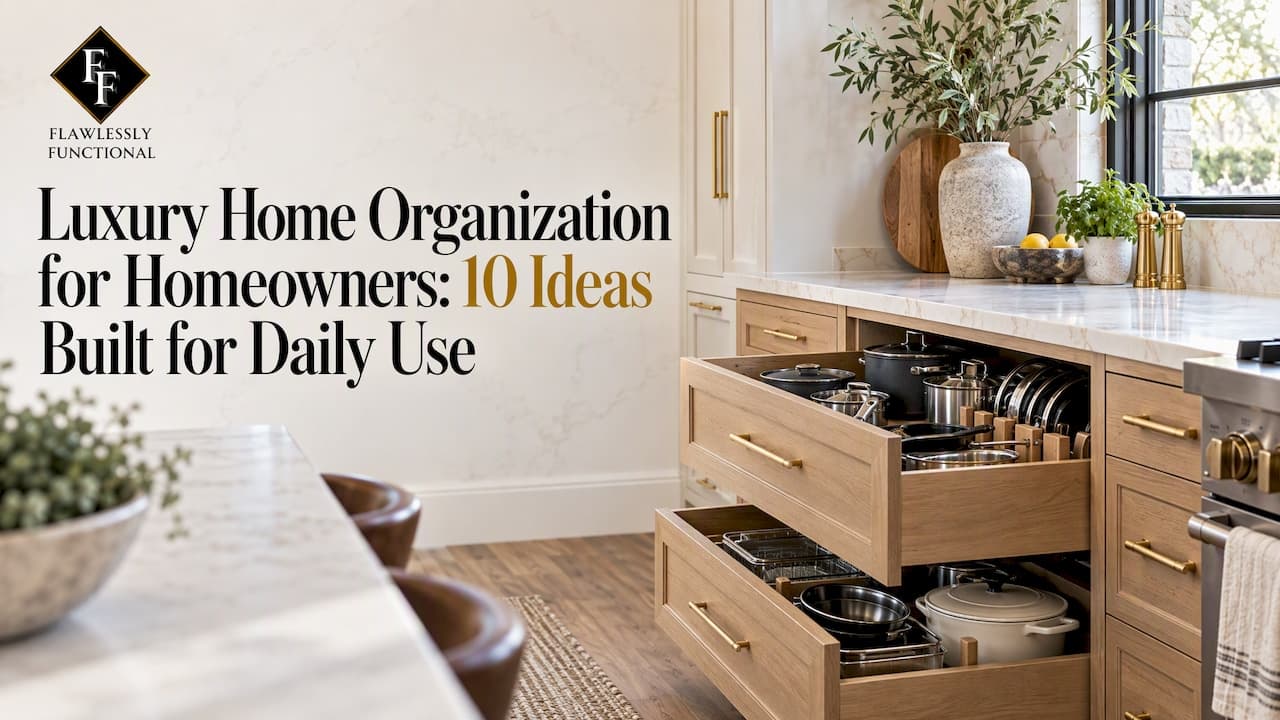
- Kitchen zones: reinforced, full-extension drawers placed by task height, so pots sit low and daily utensils sit near the counter.
- Pantry pull-outs: tiered trays with integrated lighting, so you see everything without moving anything.
- Entry storage that styles the room: a bench, valet hooks and concealed cabinets that hide shoes and mail.
- Home office systems: a leather desk unifier, integrated cable management and tailored shelving. A desk organizer like the Minister's Dispatch Desk Unifier shows the idea: full-grain Italian leather, gold-foil accents and dedicated compartments.
- Bathroom vertical pull-outs: narrow sliding units beside the vanity, paired with a matched linen system. Our guide to bathroom cabinet organization walks through measuring first.
- Laundry stations: a built-in folding surface with staging zones for daily routines or a move.
- Wardrobe capsule approach: display shelving for the pieces you wear most, with matched hangers so the rail reads as one clean line.
- Jewelry and accessory storage: felt-lined modular dividers with lockable trays.
- Moving and concierge zones: pack and unpack staging with labeled systems, so your curated displays survive a transition intact.
Closets deserve special attention because they reward layout planning. Our walk-in closet layout guide covers an aisle approach that keeps a tight space usable.
Small footprints can borrow the same logic. These apartment organization tips show how compact spaces adopt a scaled-down version of zoning and vertical storage.
Pro Tip: Photograph each room from the doorway before you decide anything. The camera shows visual clutter your eye has learned to ignore.
How do you plan a luxury organizing project?
A good project follows a predictable path, and knowing it lets you compare proposals fairly. The phases run in this order:
- Consult: walk the home with the organizer and name your daily frustrations and the rooms you want to prioritize.
- Declutter decisions: decide what stays, goes or gets stored before any design begins.
- Design: the organizer drafts layouts, finishes and hardware, often with a mood board.
- Procurement: custom millwork, inserts and hardware are ordered, which is usually the longest wait.
- Install: systems go in, ideally with minimal disruption to your routine.
- Styling: the final layer, with items placed, labeled and displayed so the space looks finished.
Timelines depend on scope. A single-room project and a whole-home project can take different amounts of time, mostly because custom pieces take time to build.
When you compare proposals, ask what each budget bucket covers: design and service fees, custom millwork, premium hardware and finishes, and styling. Proposals that bundle everything into one number are hard to compare. Ask for line items.
Before your first consult, gather a short checklist: room measurements, photos from several angles, and an inventory of the items you use daily. Handing that over saves a visit and sharpens the first proposal. We use the same pre-consult list with our own clients.
What design principles and ergonomics make luxury organization work?
Beauty fails if the system is awkward to use, so sizing comes first. Design practitioners treat a 30–48 inch band from the floor as the ergonomic strike zone: frequent items live there, heavy items sit lower, and aisles stay at least 42–48 inches wide to avoid open-drawer clashes.
Task heights near elbow level and frequent-use items between roughly 30–48 inches from the floor are the WELL v2 ergonomics guidance, and small tweaks of 2–3 inches in drawer height can change daily workflow.
Use these numbers when you evaluate a design or brief a pro:
- Drawer stacks: size the top, middle and bottom drawers to suit the utensils, bowls and pots they will hold.
- Aisle clearance: plan at least 42 inches for a single cook and 48 inches for two. For more on layout rules, this kitchen work triangle guide is a useful companion, and our own post on organizing a luxury kitchen covers zones and clearances.
- Hardware: specify full-extension, soft-close slides rated for heavy loads, since cookware drawers can be demanding.
- Construction and finish: dovetail or solid drawer boxes and low-VOC finishes keep interiors durable and fresh.
What should you expect from a high-end organizer, and how do you brief one?
A premium engagement delivers more than tidy shelves. Expect an assessment of your routines, mood boards, procurement of materials, installation and styling. Each step should be visible to you before money is spent.
Questions worth asking any provider:
- What is your process, and who is on site during installation?
- What timeline do you expect for design, ordering and install?
- What warranty or guarantee covers the installed systems?
- Can you show finish samples and hardware in person?
- Can I speak with past clients or see completed projects?
Judge mockups and samples in your own light. Hold hardware in your hand to feel the weight and the soft-close action, and view color swatches against your actual walls and floors at different times of day. A finish that looks perfect in a showroom can read cooler or warmer at home.
A good organizer also protects your day-to-day life. They schedule work in phases, protect your finishes during install and choose materials that hold up, so the system outlasts the initial excitement.
How should you declutter before installing any system?
Install nothing until you have decided what belongs in the space. Professional organizers plan space design after decluttering, because storage built around items you do not need locks clutter into expensive cabinetry.
Work in a repeatable sequence:
- Empty one zone completely. A single drawer or shelf is not enough, because you cannot judge items you cannot see together.
- Sort into four piles: keep, donate, relocate and discard. Add a fifth, "store elsewhere," for seasonal or sentimental pieces.
- Apply a use test. If you have not touched an item recently and it has no real sentimental weight, it is a candidate to leave.
- Group what remains by task, not by category alone. Baking supplies together beat all bowls together.
- Measure the keepers. Your final inventory drives shelf depths, drawer heights and divider sizes.
Be especially honest in closets and pantries, where duplicates hide. Buying a second set of something you already own is the most common reason systems overflow within months.
If decisions stall, a neutral third party helps. Our organizers guide this step so you keep the pieces that matter and only build for what remains.
Where does technology fit into luxury organization?
Technology should disappear into the design. The best integrations make a space easier to use without turning the room into a gadget showcase.
Common upgrades include:
- Motion-activated lighting inside closets, drawers and pantries, so you see contents the moment you open them.
- Charging drawers and concealed outlets in the entry, bedroom and office, which keep devices out of sight.
- Integrated cable management in desks and media cabinets, with channels behind the millwork instead of cords across the surface.
- Motorized or lift-assisted storage, such as pull-down rails for high shelves, which helps reach in tall closets.
- Inventory aids, like labeled bins with scannable tags, for households that manage large collections.
Plan technology before cabinetry is built. Running power to a drawer or lighting channel after the fact means opening finished walls and millwork. Tell your organizer or stylist which devices you want housed so wiring and ventilation are part of the first drawing.
Keep manual overrides for anything essential. A system that depends on an app or a sensor should still open by hand when the power is out. Simple, reliable mechanisms usually serve a household better than the newest feature.
How do you keep luxury organization looking flawless over time?
Maintenance is what separates a one-time makeover from a lasting system. The goal is small habits that take minutes, not a yearly overhaul.
- Reset weekly. Spend ten minutes returning items to their homes. A system with labeled, defined zones makes this fast because every object has an obvious place.
- Follow a one-in, one-out rule for categories that grow, like clothing, shoes and kitchen tools.
- Review seasonally. Swap wardrobe pieces, check pantry dates and reassess entry storage as weather and routines change.
- Clean the materials correctly. Leather, timber and brass each need their own care, so ask for the manufacturer's guidance on finishes at handover.
- Check hardware yearly. Tighten slides and hinges, and note any drawer that sticks before it becomes a failure.
Notice when a zone starts to overflow. That is usually a signal that routines have changed, not that you have failed. Adjust a shelf height or add a divider rather than letting a pile form.
Share the system with everyone who uses the home. A walkthrough of labels and zones for family members or house staff keeps the logic intact when you are not the one putting things away.
How do you brief and collaborate with a luxury organizer or stylist?
A clear brief can make the project easier to coordinate. Start with how you live, not just how you want the room to look: who uses the space, at what times, and where things currently go wrong.
Bring these to the first conversation:
- Photos of rooms you admire, plus a few you dislike, so taste is explicit.
- Your daily-use inventory, the objects you reach for repeatedly.
- Constraints: budget range, timeline, pets, children, accessibility needs and any items that cannot move.
- Your priorities, ranked. Decide whether function, display or speed matters most.
During the project, give feedback on samples and mockups quickly and in specifics. "The brass feels too yellow next to the wall color" is more useful than "I don't love it." Agree on a single point of contact so decisions do not get lost between household members.
Ask for approvals in writing at each phase, especially before procurement, since custom orders are hard to reverse. If an interior stylist and an organizer are both involved, introduce them early so finishes, hardware and display plans match. Our styling work is described on our interior styling page, and we coordinate it with organizing so the final look is one coherent picture.
What do successful luxury organization projects look like?
The details below are illustrative scenarios based on common requests, not client results.
A closet that works like a boutique. A homeowner with a crowded walk-in wants everything visible. The solution is zoned hanging, drawer-front cabinetry for folded pieces, a shoe wall and warm lighting. The outcome is a closet where getting dressed takes minutes, because each category lives in one defined place.
A kitchen organized around tasks. A busy household finds pots buried and daily tools scattered. Heavy cookware moves to deep, full-extension drawers at the bottom of the strike zone, and everyday utensils shift near the prep surface. The cook stops bending and reaching for the same items repeatedly.
A move that protects the curated home. A family relocating wants its displays and wardrobes to survive the transition. Labeled staging zones for packing and unpacking mean each room is reassembled to its intended layout, not rebuilt from boxes over weeks. This is the kind of work our Moving Management Concierge service handles.
An entry that greets guests. A cluttered front hall becomes a styled space with a bench, valet hooks and concealed cabinets. Shoes, bags and mail disappear, and the area looks intentional.

In each case the pattern is the same: declutter first, design around real routines, choose materials that last and finish with styling that makes the result feel complete.

Why luxury organizing is an experience, not a speed race
Rushed organizing is why most systems fail. A space can look sharp for a week and still collapse because the shelves never matched how you move through your day. We believe the work is craft: study the routine, choose materials that age well, and install quietly so your household keeps running.
That is also why concierge moving paired with organizing matters. When we pack, stage and unpack with care, your curated displays arrive intact and you skip the stress of rebuilding. Use the pre-consult checklist above, then ask us for a discovery call.
— Steve
Ready to bring this to your home?
We make the ideas above real for homeowners who want beauty and function together. Our Luxury Home Organizing service starts with a discovery consult, then covers design, procurement, installation and styling. Moving soon? Our Moving Management Concierge handles packing, unpacking and organizing. Book your consult and tell us which room to start with.

FAQ
What is luxury home organization?
Luxury home organization combines lasting function with premium materials and systems tailored to how you live. It goes beyond bins and labels to include custom millwork, quality hardware and styling. The result looks refined and works every day.
How long does a luxury organizing project take?
Project timelines vary with scope, and whole-home projects may take longer. Custom pieces are the main driver, because millwork and hardware are made or ordered after the design is approved.
What is the ergonomic strike zone?
The strike zone is the band between roughly 30 and 48 inches from the floor, where reaching is easiest. Store frequently used items there and keep heavy objects lower, so you limit repetitive reach and strain.
Should I declutter before hiring an organizer?
Start the process, but you do not need to finish alone. Organizers plan space design after decluttering decisions, so sorting what you keep first prevents you from paying to build storage for things you do not need.
Sources
- Coohom
- Smart Space Design, Session 4-3 - National Association of Productivity and Organizing Professionals (NAPO)