
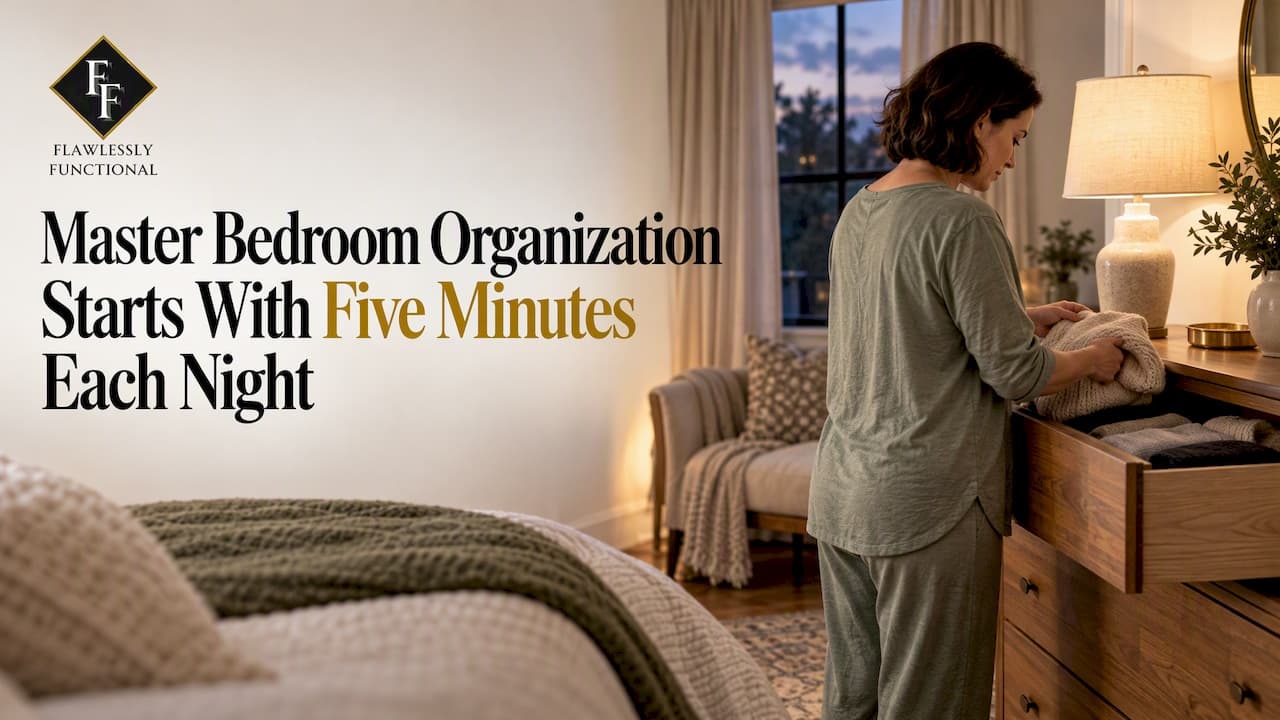
Create a calmer master bedroom by clearing every visible surface, giving each category of belongings one fixed home, and locking in a five-minute nightly reset. That sequence, backed by IKEA's safety guidance and decluttering research from Harvard, is the fastest route from chaos to order, and it's the same foundation we build on for every client project.
TL;DR:
- The same day reset allocates 20 minutes to surfaces, 40 to clothing and laundry, and 60 to sorting essentials into labeled containers.
- Anchor every dresser or bookshelf taller than it is wide with hardware suited to the wall; store heavy items in the bottom two drawers.
- A bedtime cue can trigger the reset; trials found mental contrasting and preplanned responses reduced bedtime procrastination, with later checks one to three weeks afterward.
- A Harvard decluttering intervention improved perceived control and how participants felt in the short term, but lasting effects remain uncertain.
- Maintain the system with weekly surface clearing and laundry, then refresh one drawer monthly and rotate seasonal clothing between the closet and storage beneath the bed.
Table of Contents
- Quick 3-step action plan for a same-day reset
- Zone-by-zone storage solutions for every corner of the room
- Routines and habit systems to keep the master bedroom organized
- Safety and evidence-backed notes on anchoring and decluttering's real benefits
- Maintenance checklist: weekly and seasonal tasks
- Incorporating luxury storage options like custom cabinetry and high-end materials
- Integrating lighting to enhance organization and ambiance
- Personalizing organization systems to match your lifestyle
- Tips for organizing accessories like jewelry, watches, and belts
- Optimizing space for a multifunctional corner
- When a professional organizer makes the bigger difference
- How we can help with your master bedroom project
- FAQ
- Sources
Quick 3-step action plan for a same-day reset
A master bedroom rarely needs a full renovation to feel calm again. It needs a focused afternoon and three clear moves, each with its own time box so the project doesn't stall halfway through.
- Clear and sort surfaces (20 minutes): Empty every dresser top, nightstand, and windowsill into four piles: keep, store, donate, trash.
- Handle clothing and laundry (40 minutes): Put away clean clothes immediately, bag donations for drop-off, and box off-season pieces for the closet's top shelf or under-bed storage.
- Containerize essentials (60 minutes): Sort what's left into bins, baskets, and drawer dividers, then label each one so the home sticks.
The order matters. Clearing surfaces first gives you visual proof of progress, which keeps momentum through the harder sorting work in step two. By the time you reach containers, you're placing items into a system instead of hunting for one.
A single tool makes the biggest difference in this plan: an adjustable drawer divider set or a slim rolling under-bed bin. Both give messy categories an instant, enforceable boundary instead of a vague "somewhere in that drawer."
Pro Tip: Do the donation bag last and carry it straight to the car. A bag left by the door has a way of becoming permanent furniture.
Zone-by-zone storage solutions for every corner of the room
Once the quick reset is done, each zone benefits from its own system. Treating the closet, dresser, under-bed space, nightstands, and open surfaces as five separate problems, rather than one big mess, is what makes the result last.
- Closet: Split hanging space into workwear, casual, and seasonal zones, add a second rod for shorter items, and use vertical shelving above the rod for bins. A 36-inch aisle layout gives enough clearance to open drawers and bend down comfortably, which matters more than square footage in a small walk-in.
- Dresser and drawers: Adjustable dividers, like the bamboo drawer organizers sold at Target, keep folded stacks upright and prevent the slow collapse into a single pile. Keep heavier items, like jeans and sweaters, in the bottom drawers for stability.
- Under-bed storage: Low-profile rolling bins with dust-proof lids make seasonal or spare bedding accessible without a wrestling match. Handles on the end, not the sides, make pulling bins out from a low bed frame much easier.
- Nightstands: One lamp, one small tray, and a charging solution, like a slim power strip or a dedicated charging tray, is enough. Everything else goes in the drawer.
- Open surfaces: A single small basket acts as an "inbox" for daily items like keys or glasses, which stops the dresser top from refilling within a week.
IKEA's bedroom decluttering guidance points to the same pattern: small, defined containers for small items do more to keep a bedroom calm than one large catch-all basket ever will. A Stanford sleep study measured significantly poorer sleep quality in adults with hoarding disorder compared to healthy controls, a reminder that visual overload has a real, if extreme, end point worth avoiding long before it gets there.
Routines and habit systems to keep the master bedroom organized
Systems fall apart without small daily habits to support them. A few short routines, repeated consistently, do more than any single big cleanout.
- Nightly five-minute reset: Put away any clothes worn that day, clear the nightstand of stray items, and set out tomorrow's outfit.
- Laundry workflow: Sort clothes the moment they come off, directly into a hamper by category, and fold-and-put-away in one motion rather than letting a "clean pile" accumulate on a chair.
- Cue-based bedtime habit: Pair a fixed nightly cue, like turning down the bed, with the reset action itself.
That third habit has research behind it. Randomized trials on bedtime procrastination found that combining mental contrasting with implementation intentions, essentially picturing the obstacle and pre-deciding the response, reduced bedtime procrastination over follow-ups of one to three weeks. Applied here, the cue might be "lights off" and the response "clothes in the hamper, not on the chair."
Pro Tip: Keep the nightly reset under five minutes. Anything longer turns into a chore you start skipping within a week.
Safety and evidence-backed notes on anchoring and decluttering's real benefits
Organization isn't only about looks. IKEA's safety guidance recommends anchoring tall dressers and chests to the wall with hardware matched to the wall type, and keeping heavier items in lower drawers to reduce tip-over risk.
- Anchor every dresser or bookshelf taller than it is wide.
- Store heavy items, like winter sweaters or boots, in the bottom two drawers.
- Never place a TV on furniture not built to hold one.
The emotional payoff of decluttering is real but modest. A Harvard decluttering intervention found short-term improvements in perceived control and well-being after a structured clearing process, though the researchers note more work is needed to confirm how long those gains last.
Decluttering interventions can shift attitudes about possessions and produce short-term improvements in perceived control and well-being, though researchers caution that more study is needed to understand lasting effects.
Maintenance checklist: weekly and seasonal tasks
A reorganized bedroom holds up only with light, regular upkeep.
- Weekly: Clear surfaces, run laundry through, vacuum under the bed, and spot-check the nightstand drawer.
- Monthly: Tidy one drawer fully, declutter a single small category, like socks or jewelry, and check whether the donation bag is full.
- Seasonal: Rotate out-of-season clothing between closet and under-bed storage, wipe down bins, and relabel anything that's shifted categories.
Incorporating luxury storage options like custom cabinetry and high-end materials
Bins and dividers solve the daily clutter problem. Custom cabinetry solves the long-term one, especially in a primary closet or dressing area that gets heavy daily use. Built-in units with soft-close drawers, solid wood fronts, or glass-front display sections turn storage into part of the room's design instead of something hidden away.

Materials matter here as much as layout. Solid wood and quality veneers hold their shape under weight better than particleboard, which sags over years of folded sweaters and stacked shoes. A local custom closet system installer can scan a closet digitally and build cabinetry to the exact dimensions of the space, which gets far more usable storage out of an awkward layout than off-the-shelf units ever manage.
Custom builds also let you plan for specific categories from the start: a shoe wall with angled shelving, a pull-out valet rod for the next day's outfit, or a dedicated jewelry drawer with velvet-lined compartments. These additions cost more upfront than stackable bins, but they're built to last the life of the room rather than a single apartment lease.
Integrating lighting to enhance organization and ambiance
Good lighting does two jobs in a master bedroom: it makes a system usable, and it makes the room feel finished. Closets and drawers benefit most from task lighting, LED strips mounted under shelves or inside cabinet frames so you can actually see what's in the back of a drawer without pulling everything forward.
In the main room, layering light sources, a ceiling fixture, bedside lamps, and perhaps a reading sconce, lets you shift the mood between a bright space for getting dressed and a dim one for winding down. Dimmable bulbs are worth the small extra cost for that flexibility alone.
Lighting also has an organizing side effect that's easy to overlook: a well-lit drawer or shelf gets used correctly, while a dark one becomes a dumping ground because nothing in it is visible anyway. Placing a small puck light inside a deep closet shelf or a nightstand drawer keeps that space functional instead of forgotten.
Personalizing organization systems to match your lifestyle
A system copied from a magazine photo rarely survives contact with a real household. The right setup starts with how you actually get dressed and wind down, not with what looks tidiest in a listing photo.
Someone who exercises every morning needs workout clothes staged near the door, not folded at the back of a drawer. A night-shift worker needs blackout curtains and a drawer system that doesn't require daylight to navigate. A couple sharing one closet needs a clear, visible split, by side, by category, or both, so neither person's system quietly erodes the other's.

The best test of a personalized system is whether putting something away takes less effort than leaving it out. If a drawer requires unpacking three other things to reach what you need, the system will fail within a month regardless of how good it looked on day one.
Tips for organizing accessories like jewelry, watches, and belts
Small accessories cause outsized clutter because they have no obvious home. A stackable jewelry tray with felt-lined compartments separates rings, earrings, and bracelets so nothing tangles into a knot at the back of a drawer. Watches do best on a small stand or in a shallow, divided box that keeps bands from scratching against each other.

Belts tend to pile up on closet floors or hooks until they're a tangled mess. A dedicated belt hanger with multiple hooks, or a slim vertical slot in a custom closet build, keeps each one visible and easy to grab.
The same rule from the dresser section applies here on a smaller scale: give each category, rings, watches, belts, sunglasses, its own compartment rather than one shared tray. A single catch-all tray for "accessories" turns into the same kind of clutter you just cleared off the dresser top.
Optimizing space for a multifunctional corner
Many primary bedrooms now double as a small home office or a reading retreat, especially in homes without a spare room to dedicate. The key is containment: a multifunctional corner needs a visual boundary, even a loose one, so it doesn't bleed into the rest of the room.
A narrow desk with a closing cabinet below keeps work supplies out of sight when the day is done. A reading nook works best with a single comfortable chair, a small side table for a lamp and one book, and a basket for the two or three books in rotation rather than a growing stack on the floor.
Both setups benefit from the same accessory lighting principle covered earlier: a focused task light for the desk or reading chair keeps that corner functional without flooding the whole bedroom with bright light at night.
When a professional organizer makes the bigger difference
A weekend reset handles the basics. A tailored system, custom cabinetry, a closet layout built around your actual wardrobe, or a moving day where unpacking happens for you, saves hours and holds up longer. That's the gap professional organizing fills: a system designed around your routine instead of a generic template.
At Flawlessly Functional, our work centers on exactly that kind of custom, detail-focused project, and client feedback reflects it in a 4.9 Google rating.
— Steve
How we can help with your master bedroom project
If the quick reset above gave you a taste of what a calm bedroom feels like, we can take it further with a system built for how you actually live. Our luxury home organizing projects cover closets, dressers, and every surface in between, designed to last well past the first few weeks.

- Luxury Home Organizing: Custom storage plans for closets, dressers, and nightstands, built around your daily routine.
- Moving Management Concierge: Packing, unpacking, and organizing support to help your new bedroom feel ready.
- Interior Styling: Finishing touches that make an organized bedroom look as good as it functions.
A first consultation walks through your space, your habits, and what's not working, then maps a plan from there. Visit our organizing services page to see how a project might take shape for your bedroom.
FAQ
What are some effective ways to organize my bedroom?
Start by clearing every visible surface, sorting belongings into keep, store, donate, and trash piles, then giving each category a fixed container, like a drawer divider or labeled bin. Finish with a short nightly reset so the new system doesn't slide back into clutter within a few weeks.
What are the four C's of decluttering?
The four C's commonly used in decluttering guidance are Clear, Categorize, Contain, and Clean, referring to clearing a space, sorting items into groups, giving each group a container, and maintaining the result. Different organizers phrase this framework slightly differently, so treat it as a general approach rather than a fixed rule.
What are the golden rules for bedroom design?
There's no single official list, but consensus guidance across design sources points to keeping surfaces clear, choosing a calm color palette, maximizing natural light, anchoring tall furniture for safety, and designing storage around how you actually get dressed and wind down. IKEA's safety guidance specifically recommends anchoring dressers to the wall as part of a safe bedroom layout.
How do I set up a master bedroom?
Group the room into zones, sleeping, dressing, and any extra function like a reading corner, then assign each zone its own storage: closet systems for clothing, drawer dividers for folded items, and a small basket or tray for daily essentials on open surfaces. Anchor tall furniture to the wall before filling it, since a loaded, unanchored dresser carries real tip-over risk according to IKEA's furniture safety guidance.
Sources
- Examining subjective sleep quality in adults with hoarding disorder
- Understanding well-being: clearing (decluttering intervention study)
- Creating safer homes together — IKEA
- Mental contrasting and implementation intentions reduce bedtime procrastination
- Set of 4 Bamboo Drawer Adjustable Drawer Dividers - SpaceAid® | Target