
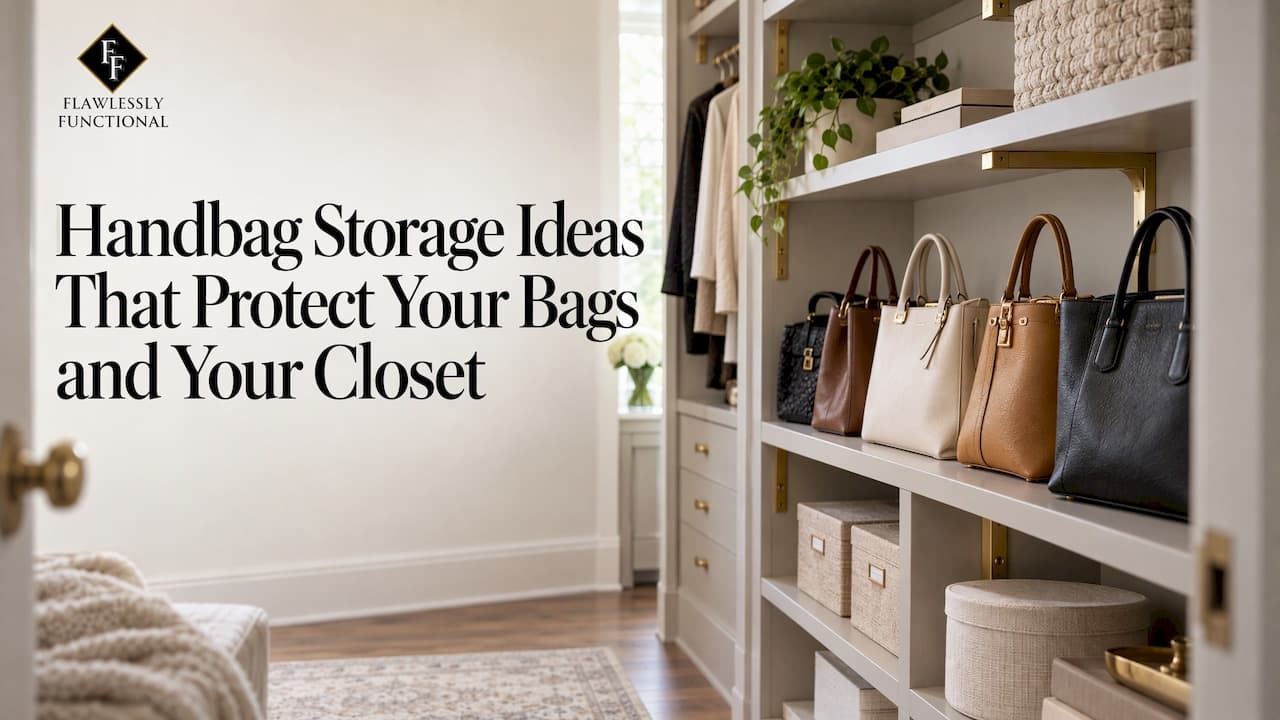
The best way to store handbags is on open shelves with dividers, each bag stuffed lightly so it holds its shape, with your two or three daily bags on a hook or low shelf. Edit the collection first, then choose storage to fit what you keep. The same logic works for jewelry: sort by how often you wear a piece, and give each category its own compartment.
Below you will find ideas for roomy closets and tight ones, display options for bags you love to see, and a practical approach to jewelry drawers and necklace storage.
TL;DR
- Sort bags into keep, toss or donate before you buy a single bin or hook.
- Shelves with dividers are the easiest default: bags stay visible, reachable and supported.
- Stuff bags lightly with acid-free tissue and store leather in breathable dust bags, not sealed plastic.
- Short on space? Use door hooks, vertical racks and nesting small bags inside larger ones.
- For jewelry, a shallow drawer with compartments sorted by type keeps pieces separate and untangled.
Table of Contents
- Edit before you organize
- Shelves: the most reliable handbag storage
- Handbag storage when space is limited
- Keep the shape: stuffing, dust bags and the right environment
- Handbag display ideas that look good
- Jewelry drawer organization
- Jewelry storage ideas for every type of piece
- Making handbag and jewelry storage work in a new home
- Our perspective
- Let us organize it for you
- FAQ
- Sources
Edit before you organize
Storage fails when it is asked to hold too much. Consumer Reports recommends sorting bags into keep, toss or donate before buying storage products, which prevents overcrowding and makes the system easier to maintain.
A simple way to do it:
- Pull every bag out and put them on a bed or a clean floor.
- Separate the ones you carried in the past year from the ones you did not.
- Check condition: broken hardware, peeling edges, stained linings.
- Group what remains by size and by how often you use it.
That last step matters most. Your grouping tells you what deserves prime real estate (eye level, within reach) and what can go up high or into a bin. Most people find they use two or three bags nearly every day, a handful for work or travel, and the rest only for occasions.
Shelves: the most reliable handbag storage
If you have the wall space, shelving is the answer. In a roundup of handbag organizers, WWD points to shelving as the primary storage surface, since bags are easy to grab and shelves help them keep their shape. Adding dividers preserves them further. The organizing expert quoted there favors shelves because they combine visibility and protection: bags are quickly reachable while remaining supported.
How to set up a shelf
- Adjustable open shelves. HGTV notes that adjustable open shelves and floor-to-ceiling shelving can accommodate a handbag collection. Adjustable matters because a slouchy hobo and a structured tote need very different heights.
- Dividers. The Spruce suggests shelf dividers to keep bags upright and separated, with tissue paper inside to help them hold their form.
- Mixed methods. The same guide describes combining approaches: smaller bags between dividers, larger totes on shelves, and clutches in clear acrylic holders.
- Height by frequency. One bag-care guide advises putting the least-used bags on the top shelf and keeping the two or three you carry daily on a hook or low shelf, then rotating them once a season.
If you already own a bookshelf or a cubby unit, you do not need custom millwork to start. Give each bag its own cubby, stand it upright, and keep the shelf depth in mind: a bag that overhangs the edge gets crushed when the closet door closes.
Handbag storage when space is limited
Not every home has a walk-in closet. Plenty of bags live in reach-in closets, shared bedroom closets or a corner of a hall. The goal in tight spaces is to use the vertical dimension and the backs of doors.

Hooks, hangers and door storage
Consumer Reports suggests hanging frequently used bags on purse hangers, hook racks or door hooks, and placing less-used bags in fabric containers or on higher shelves. The Spruce adds that hooks on doors and vertical racks save space, and that small bags can be stored inside larger ones.
A few rules keep hanging storage from damaging your bags:
- Hang only sturdy, structured bags by their straps. Soft or heavy bags can stretch at the strap attachment over time, so lay those flat on a shelf instead.
- Choose hooks with a wide, rounded curve so straps are not creased.
- Do not overload a door. Three or four bags on a rack is plenty.
If your closet is small overall, layout matters as much as hardware. This overview of small apartment organization ideas covers closet storage products and layouts that help when every inch counts, and our own guide to reclaiming small closet space walks through weekend-sized fixes.
Nesting and bins
Put small crossbody bags and clutches inside a larger tote of the same material family, so one bag stores several. Fabric bins on a high shelf work for seasonal or occasion bags. Label the front so you are not pulling everything down to find a black evening clutch.
Keep the shape: stuffing, dust bags and the right environment
Organized bags that are slowly deforming are not really organized. Three habits protect your investment.
Stuff lightly, upright
Store bags empty, then give them internal support. Consumer Reports recommends purse shapers, or bubble wrap, packing paper or air pillows, so bags stand properly and retain their shape. One care guide suggests acid-free tissue and an upright position on a shelf.
There is a balance. Rebag advises stuffing a bag enough to support its structure but not so much that it stretches or bulges, then storing it in a dust bag. Fill until the bag looks the way it does when carried, no further.
Use breathable dust bags
Christie's advises storing handbags in a cool, dry area in a soft, breathable dust bag. Brahmin recommends keeping leather handbags upright in a dry, cool place away from sunlight, using the dust bags to guard against dust, moisture and sun exposure.
One common mistake: sealed plastic bins trap moisture, so avoid them for leather and choose breathable dust bags instead. If you want to see your bags through a clear container, use a cabinet or an acrylic case with a door rather than an airtight tub, and keep it out of direct sun and away from heat sources such as vents or exterior walls.

Handbag display ideas that look good
For many people, bags are part of how a room looks. Display and storage can be the same thing when you plan it.
- Glass-fronted cabinets. HGTV lists glass-fronted cabinets and color-coding among practical display options, and notes that partitions can create cubbies for bags. A glass door keeps dust off while the collection stays visible.
- Color-coded rows. Arranging bags from light to dark gives a shelf a finished look and makes a specific bag easy to find.
- Clear cubbies for small pieces. Clear plastic cubbies help small purses and wallets stand up straight and stay visible.
- Even heights. Stands or risers keep a row level, so a shelf reads as a deliberate display rather than a pile.
- Rotate the showpieces. Keep three or four bags on view at a time, and swap them with the seasons. Everything else goes into dust bags on a higher shelf.
A good rule: display what you use or love, protect what you rarely touch. Display everything and you end up with a crowded shelf; display nothing and the beautiful pieces never get carried.
Jewelry drawer organization
Jewelry follows the same principle as bags: visible, separated and sorted by use.
Better Homes & Gardens recommends a shallow drawer with a compartment organizer, which keeps pieces accessible and separate, with compartments sorted by type. Depth matters: in a deep drawer, pieces pile up and tangle, and you lose track of what you own.
A workable layout:
- Rings and earrings in the smallest compartments, near the front.
- Bracelets and watches in wider, flatter sections.
- Necklaces laid flat, one per section, with clasps fastened so chains do not knot.
- Everyday pieces at the front, special-occasion pieces at the back.
Before you fill the drawer, edit the way you did with bags. Broken clasps, single earrings and pieces you have not worn in years should be repaired, set aside or let go.
Jewelry storage ideas for every type of piece
No single container suits every piece. Jeffrey Phillip advises separate boxes for good pieces, everyday items and party items, with a solution suited to each need. Carolyn Forté says the best organizers keep jewelry protected and untangled, and easy to organize, access and put back.
Hidden storage for valuable pieces
Jewelry boxes and cabinets keep jewelry hidden and safe, while wall hooks, stands and decorative holders display pieces for easy access. Fine jewelry belongs in the first group: closed, lined and out of sight.
Display storage for everyday pieces
Wall-hanging organizers can use hooks, hangers and floating shelves, and trinket boxes or ring dishes can hold a few pieces on a bedside table or vanity. For fun, low-risk ideas, vintage teacups or saucers can hold bracelets or rings.
Necklace storage solutions
Necklaces are the hardest category because chains tangle. Hang them on separate hooks, a wall-mounted bar or a stand with several arms, with at least a finger's width between pieces. For long chains, a shallow drawer with one lined section per necklace works well. Never toss a delicate chain into a shared pile.
If you are moving soon, a different set of rules applies. Our guide on how to secure jewelry during a move shows how to keep valuable pieces with you instead of on the truck.
Making handbag and jewelry storage work in a new home
A new home is the best moment to build storage properly, because nothing has been unpacked into the wrong place yet. Here is the order we suggest.
- Decide where bags and jewelry will live before moving day. Daily bags near the door you leave from or in the bedroom closet, occasion bags higher, fine jewelry in the dressing area.
- Measure shelf depth and hanging space. A bag that is 12 inches deep will not sit well on a 10-inch shelf. Our walk-in closet layout guide explains how to plan a 36-inch aisle that stays comfortable to use.
- Unpack bags in their dust bags with tissue still inside. They go straight onto shelves instead of onto the floor.
- Unpack jewelry last, into its final organizer. A pile in a temporary dish becomes permanent clutter.
- Build a nightly reset. A short routine keeps the system working, and our piece on master bedroom organization shows how five minutes each night does it.
Once a season, swap the bags on display with those in storage. If you live in San Antonio, our seasonal closet switch guide fits neatly with that rotation.
Our perspective
Most clients who call us about handbags do not have a bag problem. They have a system problem. The bags are beautiful, the closet is not, and every morning starts with a search.
We approach a closet the way we approach any home: we look at how you move through your day, which bags you actually reach for, and how you want the space to feel. Then we design storage that fits those habits, so it still works months later. A shelf that looks lovely but makes you move three bags to reach one is not finished.
We care about both halves of the job. The bags should be protected, supported and easy to reach, and the closet should look like a place you are happy to open. That balance of function and beauty is why we customize every project instead of installing a one-size-fits-all solution.
And when a client is moving, we treat the closet as part of the whole plan: packing handbags with care, and setting up the new space so the first morning in the house already feels organized.
Steve
Let us organize it for you
If you would rather have your closet designed and set up than do it yourself, that is what we do. Flawlessly Functional provides luxury home organizing for homeowners in San Antonio, tailored to your routines, your collection and the look of your home. We handle the editing, the layout and the setup, with minimal disruption to your household.

Moving soon? Our moving management concierge service covers packing, unpacking and organizing at the new home, so your bags and jewelry arrive and settle in properly.
FAQ
What is the most efficient way to store handbags?
Open shelves with dividers are the most efficient option for most people. Bags stay visible, reachable and supported, and the dividers keep them upright. Put your daily bags on a low shelf or hook and the rest higher up.
How do I organize purses with no space?
Use the vertical space: hooks on the back of a door, a hanging rack, or a higher shelf with fabric bins for occasion bags. You can also nest small bags inside larger ones. Start by sorting into keep, toss and donate, because fewer bags make everything else easier.
Should I stuff my handbags when I store them?
Yes, lightly. Acid-free tissue or a purse shaper helps a bag hold its structure, but too much filling can stretch or bulge the material. Fill it until it looks as it does when you carry it, then store it upright in a breathable dust bag.
How should I organize a jewelry drawer?
Choose a shallow drawer with a compartment organizer, and sort compartments by type: rings, earrings, bracelets, necklaces. Keep everyday pieces at the front. Fasten necklace clasps and give each chain its own space so nothing tangles.
Is it okay to keep leather handbags in plastic bins?
Avoid sealed plastic bins for leather because they can trap moisture. Breathable dust bags in a cool, dry spot away from sunlight are the better choice.
Sources
- How to Store Bags So They're Not a Mess, Consumer Reports
- 13 Best Handbag Organizers, WWD
- The Best Handbag Closet Organization Ideas, HGTV
- 26 Best Ways to Store Handbags and Purses, The Spruce
- How to Store Handbags So They Keep Their Shape for Years
- Handbag 101: How to Properly Store Your Handbags, Rebag
- Handbag storage guide, Christie's
- How to Store Purses and Leather Handbags, Brahmin
- 37 Jewelry Storage Ideas to Try, Better Homes & Gardens
- 16 Best Jewelry Organizers, Good Housekeeping
- 10 Functional Jewelry Storage Ideas, Lowe's