
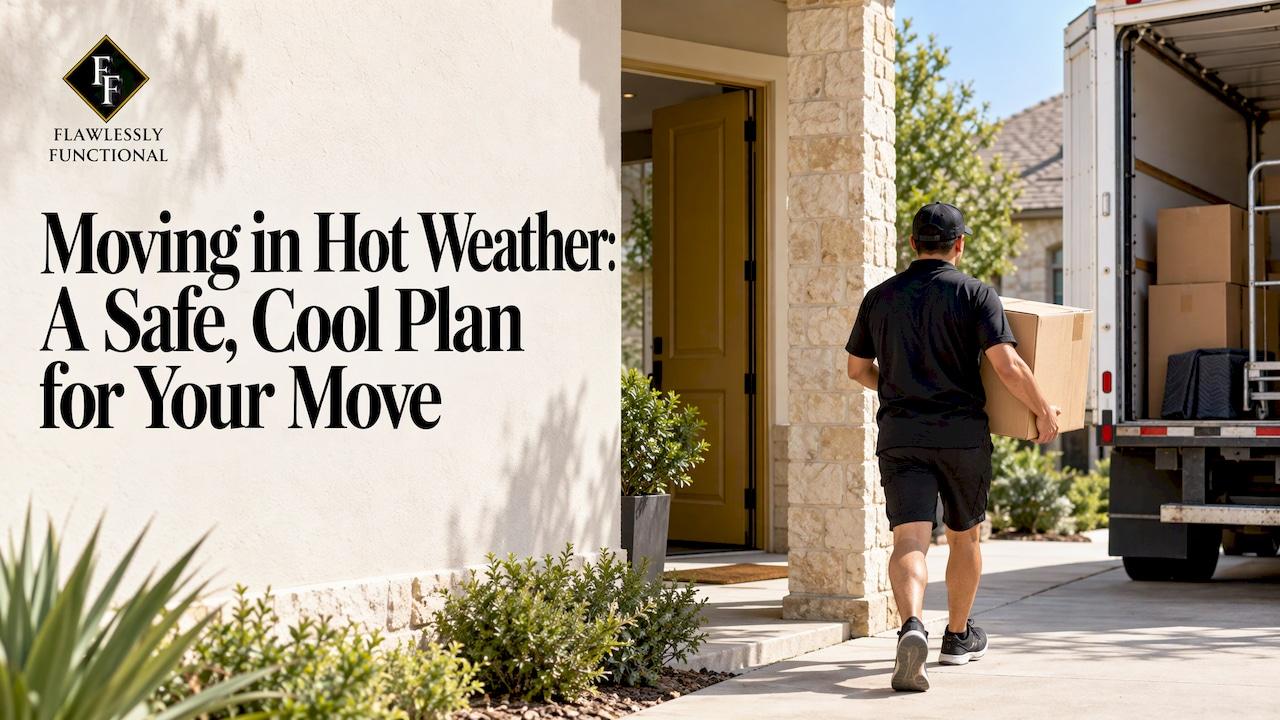
A hot-weather move goes well when you treat the heat as a scheduling problem: finish the heavy work before the afternoon peak, put water and rest breaks on a clock, and keep heat-sensitive belongings out of a sealed truck. Moving is hard physical labor, and heat turns small mistakes into real health risks. In Texas, where summer heat arrives early and stays late, the best protection is a plan that takes the guesswork out of move day. That is the work our moving management concierge team does for San Antonio homeowners, and the plan below shows what it takes.
TL;DR
- Start at first light and finish loading before the hottest hours. Official guidance puts the peak of the day in the afternoon, so build the schedule backward from there.
- Drink on a schedule, not when you feel thirsty. Health departments give hourly water targets, and they rise sharply with hard physical work.
- Learn the difference between heat exhaustion (stop and cool down) and heat stroke (call 911). Confusion is the line.
- Keep electronics, medications, documents, plants, artwork and jewelry in your air-conditioned car, not the truck.
- Fewer boxes means less time in the heat. Declutter and pack the rarely used items weeks ahead.
Table of Contents
- Why heat changes the way you plan a move
- Build the schedule around the hottest hours
- Hydration and rest breaks, with real numbers
- Know the warning signs: heat exhaustion versus heat stroke
- Protect children, pets and the people who are not lifting
- Keep heat-sensitive belongings out of a hot truck
- The best heat strategy is fewer boxes
- What a hot-weather move looks like when someone else runs it
- Perspective: we plan the move so the heat is the smallest problem
- Ready for a calmer summer move?
- FAQ
- Sources
Why heat changes the way you plan a move
A normal move already asks a lot of the body: lifting, stairs, repeated trips between a house and a truck. Add direct sun, a hot driveway and a closed cargo area, and the work happens in conditions that workers in outdoor trades are formally trained to manage.
The Utah Department of Health and Human Services explains that heat exhaustion happens when the body loses too much water and electrolytes through heavy sweating, and that it can progress to deadly heat stroke. Nobody on a move crew, family or friend, is exempt, and the people most at risk are often the most motivated ones: the homeowner who insists on carrying one more box.
There is also no federal rulebook to lean on for a household move. According to a 2026 state-by-state review of heat rules, the U.S. still has no final federal OSHA heat standard, though OSHA reissued its Heat National Emphasis Program on April 10, 2026 and heat hazards remain enforceable at work under the general duty clause. Those rules protect employees. If you are moving yourself with family and friends, the protection has to come from your plan.
Build the schedule around the hottest hours
The single most effective decision is when the work happens. Agencies phrase the peak differently, but the direction is the same. The Utah health department advises avoiding hard physical activity during the hottest hours, about 2 p.m. to 6 p.m. Move-day work is hard physical activity, so the heavy loading belongs in the morning.
A workable hot-weather timeline looks like this:
- Dawn to mid-morning: load the heaviest furniture, appliances and anything that needs several people. Cooler air, shaded driveways and fresher legs all help.
- Late morning: load boxes and lighter items, and start the drive while you can still cool down between trips.
- Afternoon: unload into a house that has been cooling since morning, and save the unpacking for evening.
- Hold the afternoon block for easy work: sweeping, last-look walkthroughs, paperwork, and the handoff of keys, all indoors.
Two scheduling details people overlook. First, the unloading end matters as much as the loading end. If your new home has been closed up in summer, turn the air conditioning on a day ahead so the house is livable when the first box arrives. Second, leave a buffer. A move that is rushed to finish before dark pushes people to skip breaks, and skipped breaks are where heat illness starts.
If your timeline forces a long day, split it. A morning crew for loading and an evening crew for unloading is far safer than one continuous push through the afternoon.
Hydration and rest breaks, with real numbers
"Drink plenty of water" is not a plan. Numbers are. The Utah Department of Health and Human Services recommends 16 ounces of water per hour under normal conditions and 32 ounces per hour during strenuous activity. Carrying furniture in July counts as strenuous.
The City of Boston's heat-illness guidance for outdoor workers is more specific about pacing: for moderate work in moderately hot conditions, about 8 ounces of clear fluid every 15 to 20 minutes. Small, frequent drinks are easier to sustain than a bottle gulped at lunch. The same guidance recommends a buddy system, so people remind each other to drink and watch each other for symptoms.
Turn that into a routine:
- Set up a hydration station in the shade or indoors, stocked with cold water and electrolyte drinks, before anyone lifts anything.
- Name a heat monitor. One person's only job is to watch faces and behavior, not to carry.
- Take scheduled breaks in air conditioning or deep shade, whether or not anyone feels they need one. Waiting until you feel bad means you are already behind.
- Skip the beer at the end. Caffeine and alcohol work against rehydration, and the Boston guidance advises avoiding both when recovering from heat exhaustion.
- Wear the right gear: loose, light-colored, breathable clothing, closed-toe shoes with grip, and gloves for hot metal handles and ramps.
Acclimatization: the helper who just arrived
Bodies adapt to heat gradually. The Boston guidance advises easing into hot work over the first week, with lighter workloads and more frequent breaks. Utah's department suggests new workers spend no more than 20% of their first shift in the heat, increasing by up to 20% daily. A relative who flew in from a cool climate and volunteered for the heavy lifting is the person most likely to get into trouble. Give that person the indoor, shaded jobs first.
Know the warning signs: heat exhaustion versus heat stroke
Everyone on the move should know these two lists before the first box goes out. The City of Boston's guidance describes them this way.
| Heat exhaustion | Heat stroke | |
|---|---|---|
| What you see | Heavy sweating, weakness, fatigue, nausea, vomiting, muscle cramps, headache, dizziness, fainting | Confusion, lethargy, agitation, seizures, dry skin, sweating that has stopped |
| Body temperature | Elevated | Possibly above 106°F |
| What to do | Stop work, move to a cooler place, rehydrate with water or an electrolyte drink | Call 911 immediately |
Source for both columns: the City of Boston heat-illness guidance.
If someone shows signs of heat exhaustion: stop their work, move them to air conditioning or shade, and give water or an electrolyte drink. Do not send them back out because they say they feel better.
If someone shows signs of heat stroke: treat it as a medical emergency. Call 911, move the person to air conditioning or deep shade, remove unnecessary clothing, cool them with water, ice packs or cold cloths, and never leave them alone. The Utah health department adds that any change in mental state, such as confusion, irritability or slurred speech, should be handled as an emergency.
A clinicians' guide on heat-related illness goes further: it states that any loss of consciousness, decline in mental function, loss of coordination or seizure must be considered heat stroke regardless of core temperature, with immediate aggressive cooling. In plain terms, when in doubt on move day, call for help rather than waiting to see.
Sunburn is the quieter risk. Wear SPF 30 or higher, water-resistant, broad-spectrum sunscreen, and reapply every two hours and after heavy sweating. Sun protection is one of the first things people forget when they are focused on a truck.
Protect children, pets and the people who are not lifting
Move day is chaotic, and the people who are not working are easy to lose track of. Never leave a child or pet in a parked vehicle or moving truck, even for a few minutes. Arrange childcare or pet care for the day if you can, so that every adult's attention goes to the schedule and every young person is somewhere cool and supervised. If a pet must be home, give it one air-conditioned room with water and keep the door closed so it cannot slip out through an open front door.

On a long drive to the new home, keep extra water in the cab, plan fuel and rest stops, and park in shade when you can.
Keep heat-sensitive belongings out of a hot truck
A closed cargo area in summer can get hotter than the air outside, and a house full of belongings includes plenty that was never meant to sit in that heat for hours. Make a short list of what rides with you in the air-conditioned car instead:
- Laptops, tablets, phones, hard drives and chargers
- Medications and medical devices
- Important documents, passports and the closing paperwork
- Jewelry and small valuables (our guide to securing jewelry during a move covers the steps)
- Houseplants, candles, vinyl records, photographs and framed artwork
- Delicate fabrics and heirloom textiles
A simple test works: if you would not leave the item in a hot car for the afternoon, it should not sit in the truck. Perishable food needs the same care. Keep it in coolers with fresh ice and do not let it sit out for hours between kitchens.
Fragile items need heat-aware packing too, since a hot afternoon on a loading ramp is not the time to be improvising with tape and half-full boxes. Our room-by-room guide to packing fragile items shows how to do it before move day, and if belongings must wait between homes, climate controlled versus regular storage is worth weighing before you commit to a unit.
Pack an essentials box that rides with you
In summer the essentials box does double duty. Beyond the usual toiletries and chargers, add bottled water, electrolyte packets, sunscreen, a towel, and a change of light clothing. Our move-day essentials box checklist lists what to pack and keep with you.
The best heat strategy is fewer boxes
Every box you do not move is a trip you do not make in the sun. That is why the most useful hot-weather preparation happens weeks earlier, indoors, in air conditioning.
Sort each room into three piles: move, store, and donate or discard. Do this three to four weeks out, and pack the things you rarely use first: seasonal decorations, extra linens, books and off-season clothing. Packing the kitchen is usually the longest job, so start it early using our kitchen packing plan. If you are crossing the state or the country, long distance move essentials covers what to plan, pack and keep.
The arrival end benefits from the same thinking. A home that has been cleaned before the furniture arrives lets the crew carry things straight in and set up rooms without working around dust and open surfaces. A move-in cleaning checklist is a good way to find the corners that are easiest to reach while the rooms are still empty.
What a hot-weather move looks like when someone else runs it
Everything above is manageable, and it is also a lot to hold in your head on the busiest day of your year: a timeline, a water schedule, a heat monitor, a plan for the pets and a car full of valuables. The more that is on your plate, the more likely it is that a break gets skipped.
A concierge approach changes who carries that load. Our moving management concierge service covers packing, unpacking, downsizing and organizing during relocations for San Antonio homeowners, so the decluttering is done before the truck arrives and the new home is set up room by room afterward. The practical result in summer is a shorter, calmer day in the heat. Our White Glove Moving service is built for exactly that kind of premium, low-disruption experience, and it is distinct from what a typical mover offers.
Perspective: we plan the move so the heat is the smallest problem
Most people think of a summer move as a logistics problem: book a truck, find a date. We think of it as a household project that happens to take place in the hottest part of the year, and the best moves are decided long before anyone lifts a box.
What we work toward is a lighter move. When a home has been decluttered and organized first, there is simply less to carry, less to pack and less to unpack. Fewer items means fewer trips outside, and that is the best protection from heat there is. It also means the home you arrive in can be styled and set up the way you intended, rather than filled with boxes that no one has the energy to open.
Our approach is personal and detail-oriented. We look at how each household actually lives, then build the packing, the unpacking and the organizing systems around those routines, so that the new space works as well as it looks. For busy families and for homeowners moving into a larger home, that is the difference between surviving a move and enjoying the first week in the new house.
If your move falls in a Texas summer, the kindest thing you can do for yourself is hand the plan to people who do this every day.
Steve
Ready for a calmer summer move?
If you are moving in San Antonio and want the heat, the packing and the unpacking handled with care, our team can plan the move around you. We combine moving management with luxury organizing and interior styling, so your new home is set up beautifully from the first day. Explore our moving management concierge services or see how luxury home organizing can lighten the move before it starts.

FAQ
What time of day is best for moving in hot weather?
Early morning. Cooler air gives you the safest hours for the heaviest work, and official guidance recommends avoiding hard physical activity in the hottest part of the afternoon. Load furniture and appliances first thing, and keep the afternoon for indoor, lighter tasks.
How much water should movers drink on a hot day?
Health guidance gives 16 ounces per hour in normal conditions and 32 ounces per hour during strenuous activity. For hard work in heat, the Boston guidance describes about 8 ounces every 15 to 20 minutes. Sip on a schedule rather than waiting for thirst.
What should I keep out of the moving truck in summer?
Electronics, medications, documents, jewelry, plants, candles, records, artwork and delicate fabrics should travel in your air-conditioned car. Perishable food should stay in iced coolers. If you would not leave an item in a hot car for hours, keep it with you.
When is heat illness an emergency?
Confusion, agitation, seizures, fainting or skin that is dry with sweating stopped are signs of heat stroke, which is a medical emergency. Call 911 immediately, move the person to air conditioning or deep shade, and cool them while help arrives. Heat exhaustion, with heavy sweating, dizziness and nausea, calls for stopping work and cooling down.
Sources
- Utah Department of Health and Human Services: Heat Illness
- City of Boston: Heat Illness Prevention Planning for Outdoor Workers
- 2026 Heat-Related Illness Clinicians Guide
- Heat Illness Rules by State, 2026
- Move-in cleaning checklist