
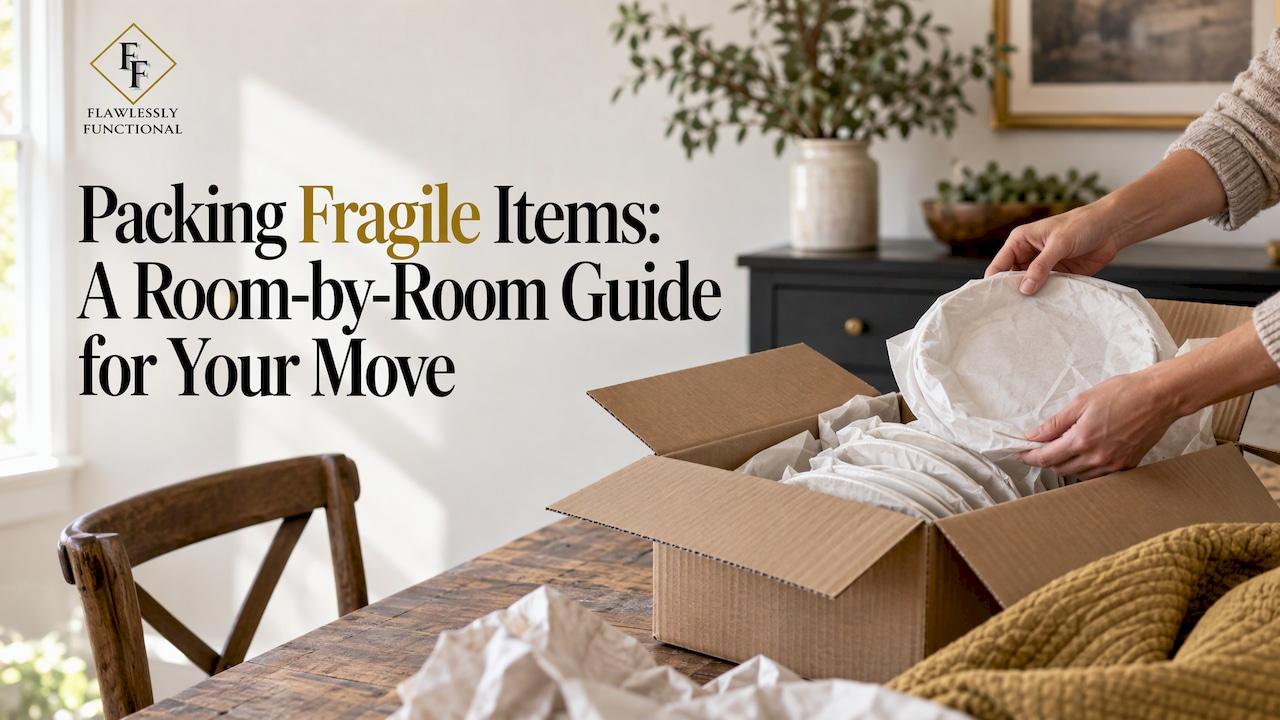
Fragile items survive a move when each piece is wrapped on its own, boxed in a small sturdy box, and packed so nothing can shift, even if the box lands on its side. The method is simple. The hard part is doing it consistently for hundreds of pieces while the rest of your house is also coming apart. That is why many San Antonio homeowners hand the fragile rooms, such as the dining room, the china cabinet and the art wall, to our moving management concierge team and keep the rest of their week free.
Below is the full routine for china, crystal, framed art, mirrors and awkward shapes, with the points where packing usually goes wrong.
TL;DR
- Wrap every fragile piece individually, then cushion the box so nothing moves. Shifting and pieces knocking together cause most breakage.
- Use small, sturdy boxes for heavy breakables. Pack plates and bowls on their sides, and glasses wrapped and on their sides.
- Carry framed art and mirrors on edge, with corners protected. Put tape on the glass only, never on canvas or paint.
- Label every fragile box on several sides and the top, and load it on top of heavier boxes.
- Our team can pack, label and unpack fragile rooms for you, so the pieces you care about are handled by people who do this work.
Table of Contents
- Why fragile items break in a move
- Gather the right materials first
- The basic box method, step by step
- How to pack china
- How to pack crystal glasses
- How to pack framed art, prints and mirrors
- Odd shapes, lamps and sculptures
- Loading and unloading: where careful packing is won or lost
- The common mistakes
- When it makes sense to hand it off
- Our perspective
- FAQ
- Sources
Why fragile items break in a move
Boxes rarely break things by themselves. Movement does. When a box has gaps, plates slide, glasses clink, and a frame corner finds the neighboring vase. A box that feels solid when you close it can still be a loose pile once it has been carried down stairs, loaded and driven across town.
So every decision in packing comes back to three questions:
- Is each piece wrapped so it cannot touch another piece or the box wall?
- Is the box small and strong enough to carry its weight?
- Is every empty space filled, so the contents cannot shift in any direction?
The guidance from This Old House lines up with that: wrap fragile items individually in packing paper, foam or bubble wrap, pack them in sturdy small boxes, and fill empty spaces with cushioning to restrict movement. Everything below is a variation on those three ideas.
Gather the right materials first
Starting to pack before you have materials is how people end up wrapping crystal in a single sheet of newsprint. Set up a packing station with the following before the first plate goes in a box:
- Plain packing paper (unprinted) for wrapping and for crumpling into cushioning
- Bubble wrap or foam for shock protection around the most delicate pieces
- Small, sturdy boxes with fresh, undamaged walls, plus divided inserts for glasses if you have them
- Strong packing tape and a thick marker
- Corner protectors and moving blankets for framed art and mirrors
- Painter's tape for glass surfaces
Paper or bubble wrap?
You do not have to pick one. Paper is flexible and quick to use, and crumpling it creates protective air pockets, a point organizer Lior Rachmany makes in The Kitchn's guide to packing glasses and dishes. Bubble wrap earns its place as the outer shock layer on pieces that would suffer from a hard knock. Our own breakdown, how pros pack by item, puts paper against the surface and bubble wrap around it for shock.
If you run out of bubble wrap, household textiles work. The Spruce notes that linens, sheets, pillowcases or old newspaper can wrap fragile items. Newsprint can leave ink on porcelain and glass, so use clean paper against anything you will put in a cabinet without washing first.
The basic box method, step by step
This is the routine behind every fragile box, whatever is inside.
Step 1: Pick a small box
Heavy fragile things go in small boxes. They are easier to lift, so they get carried more carefully, and they leave less room for contents to move. A large box of dishes becomes too heavy to lift safely, and a mover who strains with a box is more likely to drop it. Where it goes wrong: grabbing a big box because it is the one on hand and filling it with every glass you own.
Step 2: Build a cushioned base
Line the bottom with a generous layer of crumpled paper, air pillows or bubble wrap before any item goes in. The bottom of a box takes the hardest knock when it is set down. Where it goes wrong: a thin layer that flattens in the first few minutes of handling.
Step 3: Wrap each piece on its own
One piece, one wrap. Never wrap two plates together because they are "basically the same." Cover every surface, including rims, handles, stems and spouts. For mugs and glasses, a double layer of paper or bubble wrap is a sensible baseline.
Step 4: Place heavier pieces low, lighter ones high
Plates and bowls go at the bottom, lighter stemware and cups toward the top. Keep a layer of paper between each layer of items.
Step 5: Fill every gap
Press the box gently with your palm. If anything shifts or rattles, add crumpled paper in the voids until it does not. Wendy Trunz, a lead organizer quoted by The Spruce, makes the point that nothing in the box should move even if the box ends up on its side. That is the test to apply to every box.
Step 6: Add a top layer and seal
Finish with a cushion layer on top so the lid does not press on the contents. Close the flaps and tape them in an H pattern, running tape along the center seam and along both edge seams. Use more tape than looks necessary on the bottom.
Step 7: Label for the people who carry it
Write FRAGILE on at least two sides and on the top, add arrows showing which end is up, and name the room it belongs in. Labels are only useful if a mover can read them from any angle. A color system for rooms speeds up the unloading too, which we cover in our guide to color-coded moving boxes.
How to pack china
China is a common worry, and rightly so: it is heavy, it chips at the edges, and it is often irreplaceable.
- Prepare the box. Use a small, strong box (a dish pack made for the purpose, if you have one), with a thick base of crumpled paper.
- Wrap each plate individually. Lay a plate on a sheet of paper, pull the corners over the center, and repeat so the plate is fully covered. Then add a second wrap or a bundle wrap around two or three wrapped plates.
- Stand plates on their sides. The Kitchn advises packing plates and bowls vertically on their sides, which helps prevent chips. Flat stacks put all the weight on the bottom plate and its rim.
- Nest bowls carefully. Put paper between bowls, or wrap each one and stand it on its rim side.
- Pad the sides and top. Fill all gaps, then add another cushion layer before closing.
- Keep cups and saucers separate. Handles snap easily, so wrap each cup alone and pack with the open end down or on its side with paper tucked inside.
A full china cabinet is rarely a one-afternoon job. A kitchen takes much longer than people expect; our kitchen packing plan maps it across three to four weeks, whether you pack yourself or bring in help.
How to pack crystal glasses
Crystal and stemware have thin walls and delicate stems. The method is a little different from plates.
- Stuff the inside. Loosely fill each glass with paper so it is supported from the inside as well as the outside.
- Wrap each glass individually. Cover the bowl, stem and base. Wrap the stem separately where it is thin.
- Pack on their sides. The Kitchn advises stuffing glasses with paper, wrapping each one, and packing them on their side rather than upright with the stem taking all the load.
- Use dividers if you have them. Cardboard inserts that separate glasses in layers keep each one from touching its neighbor.
- Put the lightest pieces on top of the box, and pad the spaces between rows.
For a set that matters to you, such as wedding crystal or an inherited decanter, build a custom nest: a snug wrap of paper, a layer of bubble wrap, then a small box of its own with no other items in it. Crystal packed alone does not suffer from the weight of anything else.
How to pack framed art, prints and mirrors
Fine art needs more care than any kitchen item, because the damage is often not repairable in the way a replaced plate is.
Carry and store art on edge
Pack framed art, mirrors and large glass pieces on their edges, not flat, with corner protectors and moving blankets. Flat stacking puts pressure across the face of the piece. Prints and smaller works can be packed vertically in a box with bunched paper at the bottom, top and sides so they cannot slide.

Tape the glass, not the picture
Making an X across glass with painter's tape helps hold the pieces together if it cracks. Keep tape off canvas and painted surfaces entirely, because removing it can lift paint or leave residue.
Know what the frame is doing
The Smithsonian's guidance for packing paintings, in a professional-level handbook, says canvas paintings should be properly mounted in frames with mending plates, and that glass should be removed from frames unless it is laminated safety glass or clear plastic (Plexiglas). It also notes that frames are integral to protecting paintings, and that if a frame cannot protect the painting and travel safely, you should consider a traveling frame.
For high-value works, conservators go further. The Smithsonian's Museum Conservation Institute describes modular "travel boxes" that attach to the back of a painting, so safe packing, shipping and handling do not require touching the painting repeatedly. If you own a significant piece, that is the standard you are measuring against, and it is a good reason to talk with us before move day rather than the night before.
Odd shapes, lamps and sculptures
Irregular items are where improvised packing fails. A tip that works: wrap narrow, protruding parts such as handles, arms and spouts in bubble wrap until they match the width of the main body, then wrap the whole piece so it presents a uniform shape. Then box it with cushioning on all six sides.
For small, high-value personal items, think about what should never be on the truck at all. Our guide on keeping jewelry off the truck covers that, and the move-day essentials box covers what stays with you. A piano is its own category entirely, covered in moving a piano safely.
Loading and unloading: where careful packing is won or lost
A perfectly packed box can still be crushed. On the truck, fragile boxes belong on top of heavier ones, never beneath them, with art and mirrors standing on edge and secured against movement. At the new house, fragile boxes should come in last to be opened, but first to be placed in the right room, so they are not stacked under anything or set in a hallway.

Unpacking is also a point of risk. Open the box from the top, lift items out one at a time, and keep paper aside until you have checked that nothing small was wrapped inside it. People often discard a chip of porcelain or a tiny stopper along with the paper.
The common mistakes
| Mistake | What happens | Fix |
|---|---|---|
| Oversized box for heavy items | Box is hard to lift, gets dropped or bottoms out | Use small boxes for dishes and glassware |
| Wrapping several pieces together | Pieces hit one another inside the wrap | One piece, one wrap |
| Empty space in the box | Contents shift and collide | Fill all voids until nothing rattles |
| Plates stacked flat | Weight and rim stress cause chips | Pack plates vertically on their sides |
| Tape on canvas or paint | Paint lifts or leaves residue | Tape the glass only |
| Vague labels | Boxes get stacked under heavy loads | FRAGILE on several sides and the top, with arrows |
When it makes sense to hand it off
Everyone can pack a box of mugs. A full home of crystal, china, framed art, mirrors and sculptures is a different job, and it happens during the busiest weeks of a move. The time cost is the real one: wrapping, padding, labeling and later unwrapping every piece takes days when done carefully.
We offer moving management concierge service in the San Antonio region, which includes packing, unpacking, downsizing and organizing during relocations. For the pieces you most want handled well, that means someone else carries the checklist, the materials and the labeling while you decide what goes where in the new home.

If you would also like the new home to feel finished, not just unpacked, our luxury home organizing service sets up storage that fits how your household actually lives. Details on pricing are quoted per project, so reach out through the site.
Our perspective
Most people think of packing fragile things as a materials problem: more bubble wrap, bigger boxes, more tape. We see it as a planning problem. The pieces that survive a move are the ones someone decided about in advance: this goes in its own box, this stays with the family, this one needs a conversation before the truck arrives.
That is why we pair packing with organizing. When a home is sorted and decluttered before it is packed, there are fewer items to wrap, fewer boxes to carry and fewer places for damage to happen. Our approach is personalized, detail-oriented and designed to cause minimal disruption, and it is built around the idea that a move should end with a home that works, not a room full of unopened boxes.
If your move includes pieces that matter, our white-glove moving service is designed to handle them with the same care you would.
Steve
FAQ
What is the best material for packing fragile items?
Plain packing paper against the surface and bubble wrap or foam as the outer shock layer is a dependable pairing. Paper is flexible and fast to work with, and crumpled paper makes useful cushioning. Use clean, unprinted paper against anything that will go straight into a cabinet.
How do you pack fragile items without bubble wrap?
Linens, sheets, pillowcases and old newspaper all work, according to The Spruce. Wrap each piece individually, then fill the box so nothing can move. Towels are especially useful as padding between wrapped pieces.
Should fragile boxes be big or small?
Small. They are easier to carry and leave less room for contents to shift, which is why This Old House recommends them for heavy breakables. Keep each box light enough to lift with a straight back.
How should I label a box of fragile items?
Write FRAGILE on at least two sides and the top, add arrows pointing up, and note the room. Clear labels help whoever carries the box know how to handle it and where to put it down.
How do I pack a framed painting for a move?
Carry it on edge with corner protectors and a moving blanket, tape an X across the glass only, and never put tape on canvas or paint. For valuable works, follow museum practice and consider a traveling frame or a custom box.
Sources
- How To Pack Fragile Items, This Old House
- How to Pack Glasses and Dishes for Moving, The Kitchn
- 7 Pro Tips for Packing Fragile Items for Your Move, The Spruce
- Adapting Sustainable Practices to Art Transit, Smithsonian MCI
- Smithsonian Institution guidance on packing paintings