
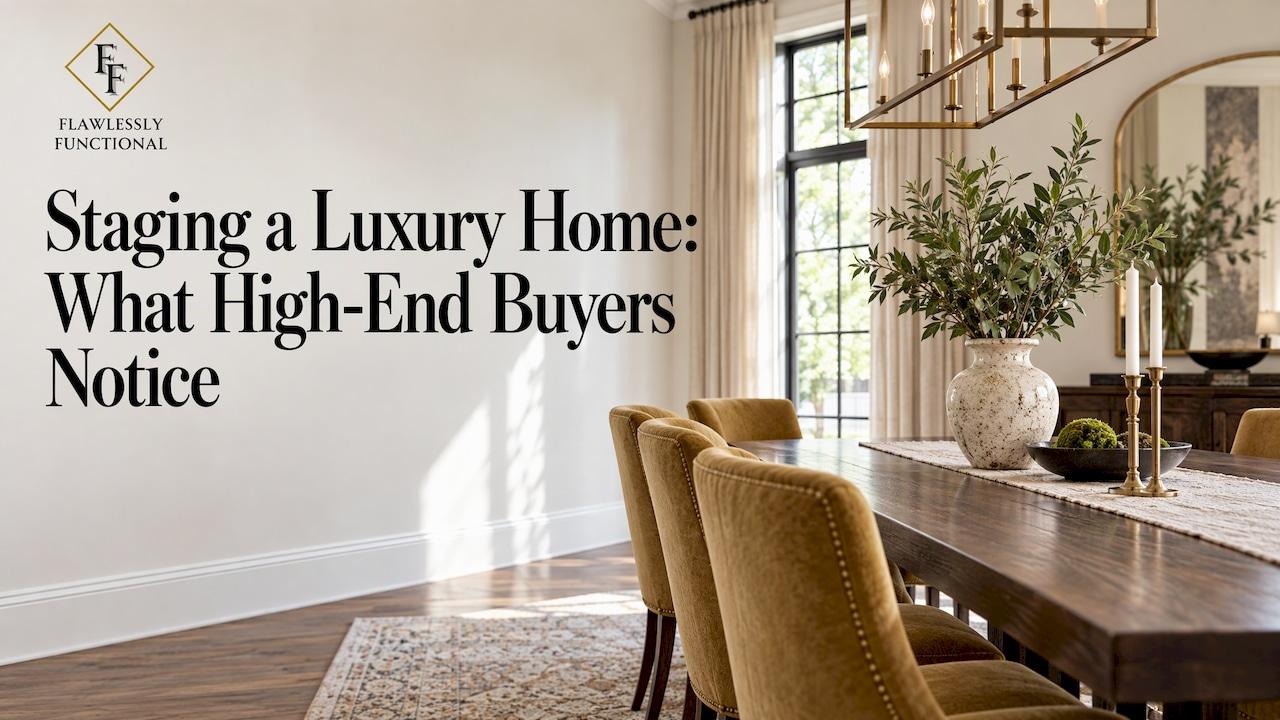
Staging a luxury home means editing what is already there, not piling more in. Remove the personal and the excess, let the architecture, light and flow lead, and add only a few well-scaled pieces that tell buyers how they would live in the house. Do that first in the living room, primary suite and kitchen, and hide everyday storage behind doors, baskets and built-ins. This guide walks through the sequence, the details and the mistakes.
TL;DR
- Subtraction comes first. Clear counters, family photos, collections and surplus furniture before any new piece comes in.
- Start with the living room, primary bedroom and kitchen. Agents stage these most often, and buyers weigh them most.
- Storage should disappear or look designed: closed cabinets, woven baskets, built-ins, and closets organized by color and type.
- The biggest mistakes are over-staging, wrong-scale furniture, a generic look and neglected outdoor spaces.
- Staging has measurable value: the National Association of Realtors reports that 49% of sellers' agents saw it shorten time on market.
Table of Contents
- What staging means at a luxury price point
- Does staging pay off?
- Step one: subtract before you add
- Which rooms to stage first
- Stylish storage that keeps the look intact
- Details that make a luxury home feel finished
- Staging mistakes to avoid
- Staging while you still live there
- Our perspective
- Get help staging and organizing in San Antonio
- FAQ
- Sources
What staging means at a luxury price point
Staging a home at this level is not about making a house look full. It is about making it look inevitable for the buyer who can afford it. Redfin describes it as balancing personal style with clean, open arrangements that show off space, light and room flow, so buyers can picture themselves living there.
The frame of reference is also different. Inman reports that a Sotheby's International Realty broker compares luxury staging to the look buyers see in publications like Architectural Digest. Buyers will not keep your furnishings. They are judging whether the house lives up to the image they carry in their heads.
That is why a home that is already beautifully decorated can still need staging. Inman notes that presentation has to match the space and the market, not just the owner's taste.
A useful distinction comes from the Hamptons Real Estate Showcase: generic staging fills rooms so they do not look empty, while lifestyle-driven staging anticipates how buyers imagine spending their time. A reading chair by a tall window, a dining table set for a long dinner, a bar cart near the terrace doors. Each tells a small story.
Does staging pay off?
The national numbers are encouraging. In its 2025 Profile of Home Staging, the NAR found that 29% of agents said staging led to a 1% to 10% increase in the dollar value offered. The same report says 49% of sellers' agents observed less time on the market. Median cost was $1,500 when a staging service was used and $500 when the agent handled it, though a large luxury home will usually need far more than a typical listing.

An important point: those figures describe the market broadly, not any single house. What they support is the logic of doing the work before the first showing, when buyers form their impression.
Step one: subtract before you add
Most owners picture staging as shopping. Most professionals will tell you it starts with removal. House Beautiful's stager roundup points to the same list: family photos and highly personal decor, countertop clutter, and surplus furniture that adds visual noise.
The same article quotes a stager saying counters read as square footage. Every air fryer, knife block and paper towel holder shrinks the workspace a buyer thinks they are getting. Another stager notes that less furniture gives rooms breathing room, improves circulation and often makes them look significantly larger.
A practical edit, room by room
- Surfaces. Clear kitchen and bath counters down to a few intentional objects. A tray with one good bottle of olive oil beats ten daily-use items.
- Personal items. Pack away family photos, refrigerator magnets, medications and pet supplies. Collections that could distract buyers, or raise privacy concerns once photos go online, go into boxes too.
- Furniture. Take out the extra armchair, the second console, the side tables that crowd walkways. Keep the pieces that define each room's purpose.
- Accessories. A September 2026 staging guide suggests removing about half before anything new arrives. It is a handy rule of thumb.
- Walls. Take down highly specific art and political material so buyers can project their own identity. Keep one or two strong pieces instead of covering every wall. A room that feels like a gallery is a room that feels like someone else's.
Sentimental items are the hardest part of this edit. If you are packing a lifetime of belongings, our guide to decluttering sentimental items offers a calm way to decide what stays, what goes and what moves with you.
There is a bigger reason to be thorough. Fine & Country explains that overfilled wardrobes and busy surfaces make rooms feel smaller and ceilings lower, and make flow worse. Decluttering gives you more apparent space without moving a single wall.
Which rooms to stage first
If the budget or the calendar is tight, work in the order buyers care about. According to the NAR report cited above, the most commonly staged rooms are the living room (91%), primary bedroom (83%), dining room (69%) and kitchen (68%).
| Space | What to do | Why it matters |
|---|---|---|
| Entry | Clear shoes, hooks and mail; one focal element; a clean welcome mat; warm bulbs | First impression sets the tone for the whole tour |
| Living room | Pull furniture off the walls; one focal point; two complementary colors for pillows and throws; a nearly clear coffee table | Shows scale and gathering space |
| Kitchen | Clear counters; update or refresh where it counts | Updated kitchens and baths tend to resonate in the luxury market, according to Redfin |
| Primary suite | Crisp neutral bedding; clear nightstands of cords and toiletries; closets organized by color and type | Signals calm, and closet volume |
| Bathrooms | Fresh caulk, spotless glass, folded white towels | Buyers read cleanliness as care |
| Outdoor areas | Furniture arranged for entertaining, tidy edges | Often neglected, often a deciding feature |
The entry and living room details come from Eddie Weir's Houston staging tips, which suggest warm bulbs in the 2700 to 3000K range and a single focal point per room. For layout, keep paths comfortable: our 36 inch walkway guide shows how to arrange furniture so traffic flows naturally.
Highlight the lifestyle features
Redfin notes that luxury buyers value lifestyle features such as spa-like bathrooms, chef's kitchens, home gyms, outdoor entertaining areas and wine cellars. Neutral, polished decor should point toward these amenities, not compete with them. If you have a wine room, make sure it is organized and lit, not used as overflow storage.

The kitchen deserves special care in a high-end home. We cover zones, clearances and what to keep in reach in organizing a luxury kitchen as architecture. And bathrooms are where small spending goes far, as in our bathroom staging ideas for listing photos.
Stylish storage that keeps the look intact
Buyers open closets, pantries and cabinets. At luxury prices they expect storage to be generous and orderly, which means a staged home needs a plan for the things you still live with.
Hide, do not stack. The Spruce reports designers warning that stacks of plastic bins in the open make even a curated room feel like a storage unit. The recommendation is storage with privacy: baskets, fabric bins or cabinets. Woven baskets beat plastic bins on looks every time, according to one designer quoted there.
Use built-ins and baskets. The Guardian's organizing roundup quotes an organizer recommending built-ins and baskets to use every available inch and neatly hide what accumulates. Another expert there advises a few high-quality products in natural fibers, wood, metal or heavy canvas rather than many cheap ones that degrade.
Make furniture work twice. Martha Stewart's hidden storage piece quotes a professional organizer recommending storage ottomans and lift-top coffee tables that reduce visible clutter. Ottoman beds hold bulky items like duvets and extra pillows, freeing closet and shelf space.
Show closets as an asset. Christie's guidance for luxury sellers, summarized in the research we reviewed, suggests organizing walk-in primary closets by color and clothing type to signal volume. It also advises keeping closet doors closed during private showings. Both are easy to adopt.
Edit what goes in. Fine & Country also points out that crowded shelving and overfilled storage areas distract from what buyers evaluate: volume, flow, light, craftsmanship and potential. A half-empty closet looks bigger than a perfectly arranged full one. Pack seasonal items off site if you can.
For ideas built around daily routines, rather than a listing only, see our luxury home organization ideas.
Details that make a luxury home feel finished
First impressions outside
Redfin recommends a strong arrival: landscaping, flowers near the front door or a punchy door color, followed by a foyer moment that makes buyers pause. If the lawn, beds and entry need more than a tidy-up, the curb appeal landscaping moves with the highest return are worth reading before you book anything else.
Light and materials
Lighting gets less attention than it deserves. Curtis Bain's guide recommends layering ambient, task and accent lighting to add depth and highlight architecture, with warm color temperatures of 2700 to 3000K for an inviting feel. And IACrea advises letting marble, hardwood, stone and glass breathe instead of covering them, and favoring natural light before artificial.
Warm, not sterile
Staging should not make a home feel like a hotel suite. Zellerman's view, as noted in the research, is that the goal is an edited, current home ready for a discerning owner. The Hamptons Real Estate Showcase says luxury buyers increasingly favor layered, warm, livable interiors, with organic fabrics, linens, layered lighting and earthy palettes. Think texture, not clutter.
Built-ins and focal walls
A family room often has one dominant wall. If the television wall is a tangle of cords and mismatched furniture, buyers notice. Clean cabinetry with hidden wiring supports the polished, architectural feel, and custom media wall designs show what a tidy wall can look like. Plan this well before listing, since it is a project, not a weekend task.

Repairs and cleaning
Bay Gold's checklist recommends repairing visible flaws first: chipped paint, loose hardware, worn caulking, damaged flooring, flickering bulbs and sticking doors. Then deep clean every surface, including windows, grout, appliances, baseboards, closets, patios and garage floors. Staging on top of flaws makes the flaws look worse, not better.
Staging mistakes to avoid
Over-staging. Too many accessories, artificial plants, pillows or small pieces create visual noise. IACrea warns that piling on decor to look expensive can backfire.
Furniture at the wrong scale. A dining table too small for the room, or several seating groups crammed into a large great room, makes the space look like a showroom. One staging guide calls out both as deal-costing errors. Luxury rooms should feel grand and correctly proportioned.
A generic look. Catalog furniture that does not match the home's perceived level breaks the fit. The look should suit the architecture, price point and likely buyer, not a template.
Bold or eccentric pieces. Redfin notes that temporary swaps of overly bold decor can make a space feel more inviting and universally appealing.
Forgetting outdoors. Patios, terraces and gardens are part of the house at this price. Treat them as rooms.
Skipping photos. Most buyers see the house online before they see it in person. Stage for the camera as well as the walk-through, which means clean sight lines and uncluttered corners. Our open house staging plan lays out three moves and a three-week schedule.
Staging while you still live there
Most owners are not moving out first. A realistic approach is to stage the public rooms fully, keep daily-use items in a few closed containers, and reset the house on a short routine before each showing. Our occupied home staging plan gives a 15 to 20 minute reset for exactly this. If you are weighing where to spend first, the pre-listing checklist puts the budget in order.
Our perspective
We see the same pattern in nearly every home we walk through before a sale. The house is not short of beauty. It is short of space to see the beauty. Staging begins with organizing.
That is why we treat it as one job, not two. When shelves, closets, pantries and counters have a logical home for everything, the home looks calmer to buyers and works better for the family that lives there until closing. Our approach is personalized and detail-oriented: we look at your routines, then build systems that hold up after the photos are taken.
When a move is part of the plan, we think the staging, packing and unpacking should be one managed experience, not a string of vendors. Fewer handoffs mean less disruption for you. And a home that is organized before it goes on the market is far easier to pack, move and settle into at the other end.
Luxury is about experience, not speed. Take the time to edit, and let the house speak.
Steve
Get help staging and organizing in San Antonio
If you are selling in the San Antonio area, we can handle the edit, the storage and the styling. Our interior styling and home staging service prepares your home for buyers, and our luxury home organizing builds the closets, pantries and cabinets that hold up under a showing schedule.

If you are also relocating, our moving management concierge covers packing, unpacking and organizing at the new address. Reach us through Flawlessly Functional and tell us your timeline.
FAQ
How much should I remove before staging a luxury home?
More than most owners expect. A good starting point is to clear counters to a few objects, take down family photos, pack collections, and cut accessories by about half. Then remove furniture that blocks walkways or makes a room feel smaller. You can always add a piece back, but it is hard to see the room until the extra items are gone.
Which rooms matter most when staging a high-end home?
The living room, primary bedroom and kitchen. According to the NAR's 2025 profile, the living room and primary bedroom are staged most often, followed by the dining room and kitchen. Put the entry and outdoor areas right behind them, since they shape the first impression and the lifestyle story.
How do I hide storage without making the home look empty?
Use closed storage: cabinets, built-ins, woven baskets and fabric bins, and avoid visible stacks of plastic bins. Dual-purpose furniture such as storage ottomans and lift-top coffee tables also helps. Leave closets partly empty and organized by color and type, with doors closed during private showings.
What are the most common luxury staging mistakes?
Over-staging, furniture at the wrong scale, a generic catalog look, bold or eccentric decor, and ignoring outdoor spaces. All of them add visual noise or break the sense that the home fits its price point. Editing and proportion fix most of them.
Sources
- NAR: 2025 Profile of Home Staging
- Redfin: Luxury Home Staging
- Inman: Handbook on Staging Luxury Listings
- Hamptons Real Estate Showcase: Setting the Stage
- House Beautiful: What Professional Stagers Remove
- Luxuryhom: Staging for Editorial Listing Photos
- Fine & Country: The Art of Subtraction
- The Spruce: Organizing Products That Look Bad
- The Guardian: Stylish Home Organization
- Martha Stewart: Hidden Storage Ideas
- Eddie Weir: Home Staging Tips
- Curtis Bain: Staging Luxury Properties
- IACrea: Luxury Home Staging Guide
- Getstageflow: Luxury Home Staging
- Curb Appeal Landscaping
- Luxe Custom Media Walls